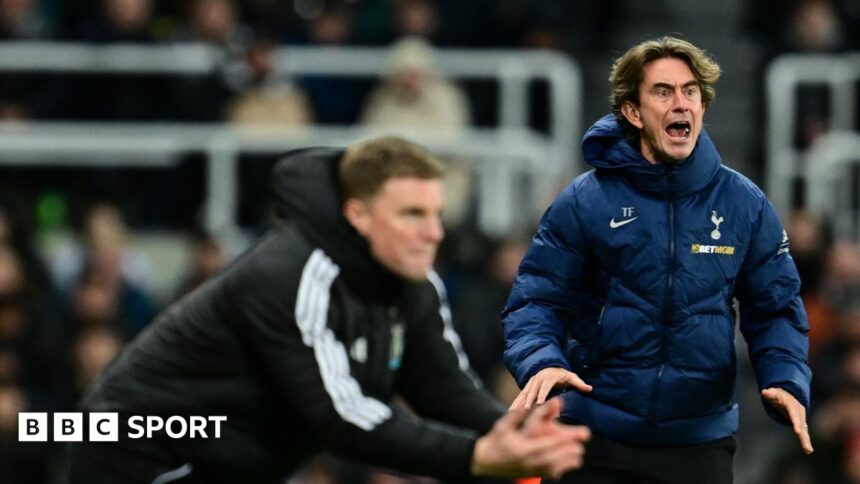
Newcastle vs Spurs Drama: Frank Blasts ‘Absolute VAR Mistake’ as Romero Rescues Point
The Theatre of the North, St. James’ Park, was the stage for a Premier League classic on Saturday—a match that had everything: stunning goals, late drama, and yet another VAR controversy threatening to dominate the headlines. In a pulsating 2-2 draw, Tottenham Hotspur’s Cristian Romero wrote the final act with a breathtaking 93rd-minute overhead kick. But it was the intervention of the video assistant referee just minutes earlier that left Brentford manager Thomas Frank, watching from afar, and the football world at large, locked in fierce debate.
A Rollercoaster Finale Overshadowed by Controversy
With the score locked at 1-1 and the clock ticking towards the 90th minute, Newcastle won a corner. As the ball sailed into the Tottenham penalty area, a familiar tangle of arms and bodies ensued. Spurs midfielder Rodrigo Bentancur and Newcastle’s towering defender Dan Burn were engaged in a mutual grapple. Referee Thomas Bramall saw no clear offence and allowed play to continue. Moments later, however, the game was halted. The VAR official, John Brooks, had reviewed the incident and advised Bramall to take a second look at the pitchside monitor.
What followed was a decision that has split opinion. After reviewing the monitor, Bramall pointed to the spot, judging Bentancur’s holding of Burn’s shirt to be a penalisable offence. Alexander Isak stepped up and coolly converted, sending the home crowd into raptures and seemingly condemning Tottenham to a cruel defeat. Yet, the drama was far from over. In the third minute of added time, Cristian Romero’s spectacular bicycle kick ripped through the narrative, securing a dramatic point for Ange Postecoglou’s side and leaving the Magpies stunned.
Thomas Frank’s Blunt Verdict: “An Absolute Mistake”
While the managers directly involved offered measured post-match comments, it was a peer from another club who delivered the most scathing indictment. Brentford boss Thomas Frank, whose team has felt the sting of VAR decisions this season, did not mince his words when asked for his analysis on the incident.
“For me, it was an absolute VAR mistake,” Frank stated unequivocally. “That is exactly the type of situation we do not want VAR to get involved in. It was two players holding each other in a completely normal way during a corner. The referee on the pitch had the best view and saw no issue. The consistency is the problem—if that’s a penalty, then we would have 10 penalties every game.”
Frank’s critique touches on the core tension in modern officiating: the quest for forensic accuracy versus the preservation of the game’s flow and physical context. His argument highlights several key points:
- Minimal and Mutual Contact: The holding was not a clear, one-sided foul that was “clear and obvious.”
- Referee’s On-Field Decision: Bramall’s initial non-call indicated he saw the incident as part of normal jostling.
- The Precedent Problem: Penalising such commonplace contact sets an untenable standard for set-pieces.
Expert Analysis: Where Does the Line Get Drawn?
This incident is not an isolated one; it’s a symptom of an ongoing philosophical crisis in football officiating. The Premier League’s directive at the start of the season was for referees to show greater leniency in physical duels, particularly from corners. Yet, the VAR intervention in this case appears to contradict that very principle.
The critical question is: what constitutes a “clear and obvious error”? The VAR is not meant to re-referee the game with a hyper-sensitive lens. By instructing Bramall to review an incident that was, at worst, a 50/50 tussle, the VAR effectively re-officiated the match based on a technicality many feel falls outside the spirit of the “clear and obvious” threshold.
Furthermore, the focus on Burn’s shirt being held ignores the simultaneous action of Burn himself, who was also applying force to Bentancur. This selective application of the rules fuels frustration. It creates a lottery where the outcome depends less on the nature of the contact and more on which player the camera happens to follow or which shirt tug is momentarily most visible.
The psychological impact on the game is also profound. Newcastle, energised by the decision, thought they had won it. Tottenham, feeling aggrieved, found a miraculous equaliser. The controversy, rather than the football, becomes the central story.
Predictions: Ripple Effects and Future Flashpoints
This decision will have consequences beyond this single match. We can anticipate several developments:
- Increased Managerial Fury: Frank’s outspoken comments may encourage other managers to publicly challenge VAR interpretations, increasing pressure on PGMOL (Professional Game Match Officials Limited).
- Set-Piece Pandemonium: Defenders will now be acutely aware that any contact could be penalised in slow motion, potentially leading to more exaggerated reactions in the box to “draw” the VAR’s eye.
- A Tighter VAR Protocol? This incident could force another round of clarification from PGMOL to their officials, reiterating the need for a higher threshold for intervention in such subjective, physical battles.
- Spurs’ Resilience vs. Newcastle’s Fragility: For Tottenham, this late escape could galvanise belief in Postecoglou’s never-say-die philosophy. For Newcastle, dropping two points in this manner may expose lingering mental frailties in closing out big games.
Conclusion: A Spectacular Save for Spurs, But VAR Loses Again
Cristian Romero’s last-gasp overhead kick was a moment of pure footballing brilliance, a goal that deserved to be the defining image of a thrilling contest. Yet, the enduring memory for many will be the controversial penalty decision that preceded it. Thomas Frank’s label of an “absolute VAR mistake” resonates because it speaks to a growing sentiment that the technology is being applied in a way that damages the game’s essence.
While the draw was a fair result on the balance of play and drama, the method of its arrival leaves a bitter taste. The Premier League and its officials are caught in an impossible bind, striving for unattainable perfection. In doing so, they risk sanitising the sport’s inherent physical contest and, as seen at St. James’ Park, shifting the focus from players’ skill to officials’ scrutiny. Until a consistent and common-sense approach to “clear and obvious” is universally applied, these debates will continue to overshadow the very spectacle VAR was introduced to protect. The system, designed to eliminate controversy, has instead become its greatest source.
Source: Based on news from BBC Sport.
Image: Source – Original Article