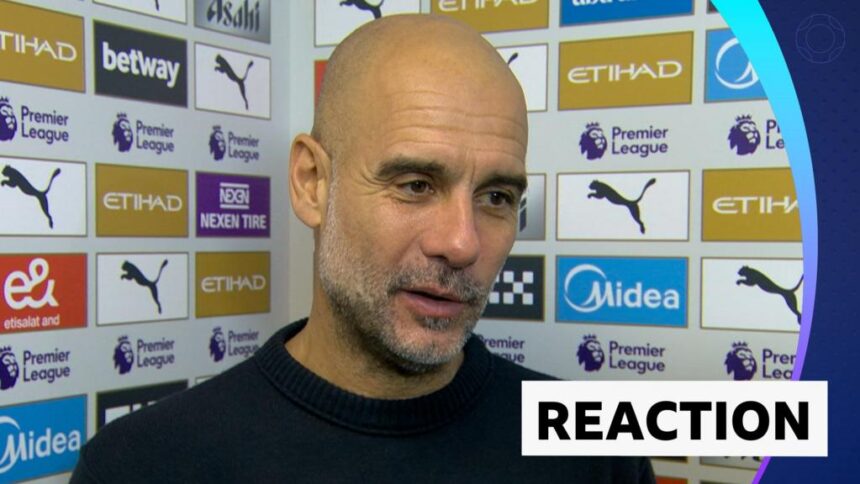
Guardiola’s Masterclass in Mentality: Why Cherki’s Rabona, Not the Result, Dominated Post-Match Talk
The Etihad Stadium had just witnessed another surgical, controlled 3-0 victory. Manchester City, under Pep Guardiola, had dispatched Sunderland with the cold efficiency of a champion. The goals were crisp, the possession was dominant, and the three points were secure. Yet, in the aftermath, the conversation wasn’t about Erling Haaland’s brace or Kevin De Bruyne’s orchestration. It was hijacked by a single, audacious moment of flair from a young opponent: a 20-year-old named Rayan Cherki and his rabona assist that, for a fleeting second, lit up the Manchester rain.
The Art of the Rabona and the Philosophy of the Pragmatist
For those who missed it, the moment was pure street football magic. With City leading and controlling the game, Lyon’s Rayan Cherki, on as a second-half substitute, received the ball wide on the right. Instead of taking a conventional touch or crossing with his right foot, he wrapped his left leg behind his standing right and executed a perfect rabona cross, slicing through the City defense to find a teammate at the back post. The finish was squandered, but the assist was immortalized instantly on social media.
It was the kind of skill that defines highlight reels and makes fans leap from their seats. It was also, in the eyes of the victorious manager, an unnecessary risk. When asked about the flash of brilliance from the young Frenchman, Pep Guardiola’s response was a masterclass in his own footballing dogma. Pep Guardiola’s philosophy has never been about stifling creativity, but about channeling it with purpose. His praise was, famously, lukewarm.
“It’s nice, yes,” Guardiola acknowledged, before swiftly pivoting to his core message. “But at 3-0, maybe you take the simple option. The simple option is often the most effective. He is a tremendous talent, but to reach the very top, consistency comes from keeping things simple.” This wasn’t a dismissal of talent; it was a roadmap for its maturation, delivered from the summit of the game.
Messi as the Blueprint: Simplicity as the Highest Form of Genius
To understand Guardiola’s perspective, one need not look further than the player he consistently references as the benchmark: Lionel Messi. In his reply, Guardiola instinctively drew the comparison. “I always remember Messi. He could do anything, the most incredible things, but 95% of the time, he made the simple pass, the simple move. That is why he was so efficient, so decisive.”
This is the crux of the Guardiola doctrine. He isn’t coaching out the spectacular; he is engineering an environment where the spectacular emerges from a foundation of relentless, simple excellence. Consider the elements of City’s play under Guardiola:
- Ball Retention: Simple, crisp, one- or two-touch passing to control the game’s rhythm.
- Positional Play: Players making simple, intelligent runs to create space and passing lanes.
- Decision-Making: Choosing the option with the highest percentage of success, not the highest degree of difficulty.
In this system, a rabona cross at 3-0 is a low-percentage outlier. It introduces an element of unpredictability that, while thrilling, contradicts the controlled chaos Guardiola cultivates. For the Catalan, Messi’s legacy is built on a mountain of simple, correct decisions, punctuated by moments of supernatural skill when absolutely necessary—not instead of it.
Cherki at a Crossroads: Talent vs. Tactical Discipline
Rayan Cherki represents a fascinating archetype in modern football: the mercurial talent overflowing with technical ability. He is a player who sees the game as a canvas for expression. Guardiola’s comments, therefore, are not a critique but a priceless piece of mentorship from afar. They highlight the eternal crossroads for such players: will they remain entertainers, or evolve into decisive, consistent winners?
History is littered with players whose flair was never fully harnessed by the structures of elite-team football. Guardiola’s message to Cherki is that the truly great players—the ones who win Ballon d’Ors and Champions Leagues—integrate their flair into a framework of reliability. It’s about knowing when to be spectacular. At 0-0 in a tight game, that rabona could be a moment of match-winning inspiration. At 3-0 down, it can be perceived as a frivolous neglect of the collective effort to get back into the game.
For Cherki’s development, this moment is more valuable than any routine assist. To have one of the greatest managers in history explicitly use you as a teaching moment, linking your name to Messi’s in the process, is a unique form of career advice. The challenge for Cherki and his future coaches is to build a player who can both unlock defenses with a moment of magic and also circulate the ball with the metronomic efficiency demanded at the very top.
The Bigger Picture: A Victory for City’s Machine-Like Mentality
While Cherki’s skill sparked debate, the match itself was a testament to why Guardiola’s philosophy is so dominant. The 3-0 scoreline was a reflection of a machine operating as intended. Every player understood their role, and every action was in service of a systemic plan. This is the environment Guardiola protects fiercely.
Allowing admiration for an opponent’s flashy skill to go unchecked could, in Guardiola’s worldview, subtly validate a deviation from the process. His immediate redirection to the principles of simplicity serves a dual purpose: it reinforces his expectations to his own squad, and it offers a public lesson to a talented youngster. In doing so, he defended the sanctity of his footballing ideology more vigorously than he needed to defend his penalty area on the day.
Looking ahead, this incident is a microcosm of the modern game’s central tension. As analytics and structured pressing dominate, is there still room for unscripted individuality? Guardiola’s answer is a definitive yes—but with a critical caveat. The individuality must be an accelerator for the system, not a detour from it. For Manchester City, the path remains clear: a relentless pursuit of simple, effective football that, paradoxically, creates the most beautiful and successful game of all.
Conclusion: The Lesson Etched in a Moment of Flair
Manchester City’s victory over Sunderland will be a footnote in the annals of another likely title-winning season. But Rayan Cherki’s rabona assist, and Pep Guardiola’s calculated response, will resonate far longer. It was a clash of two footballing religions: the pure, joyful expression of skill against the disciplined, collective pursuit of efficiency.
Guardiola, ever the professor, used the moment not to condemn, but to educate. By invoking the name of Lionel Messi, he provided Cherki and every watching young player with the ultimate blueprint. True, lasting greatness isn’t found in the occasional moment of breathtaking spectacle, but in the relentless, daily commitment to mastering the fundamentals. The rabona was beautiful, a reminder of why we love the game. Guardiola’s lesson, however, was a reminder of what it takes to conquer it. In the end, the most telling assist of the day came not from Cherki’s left foot behind his right, but from Guardiola’s wisdom, delivered straight and simple.
Source: Based on news from BBC Sport.
Image: Source – Original Article