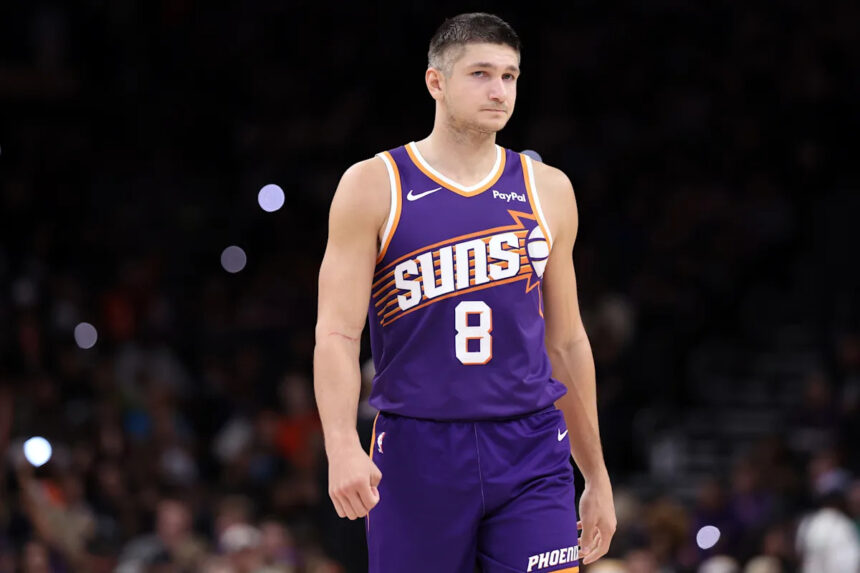
Grayson Allen’s Flashpoint: Ejection Mars Suns’ NBA Cup Exit, Rekindles Reputation Debate
The NBA In-Season Tournament, designed to inject mid-season drama, delivered a moment of pure, unscripted intensity on Wednesday night. In a critical quarterfinal matchup, the Phoenix Suns’ quest for Las Vegas glory was derailed not just by the Oklahoma City Thunder’s brilliance, but by a familiar, controversial flashpoint involving Grayson Allen. The guard’s ejection for a violent shove on Chet Holmgren became the defining moment of the Suns’ 123-115 loss, reigniting conversations about his on-court persona and its impact on a team with championship aspirations.
- A Hard Screen, a Harder Shove, and an Immediate Reckoning
- From Duke Villain to Phoenix Contributor: The Grayson Allen Conundrum
- Ripple Effects: How the Ejection Swung the Game and What’s Next
- Expert Analysis: Reputation, Responsibility, and the Playoff Crucible
- Conclusion: A Costly Shove with Lasting Implications
A Hard Screen, a Harder Shove, and an Immediate Reckoning
The incident unfolded with cold, calculated force. Midway through the third quarter at a raucous Paycom Center, Allen attempted to navigate a screen set by the towering Chet Holmgren. What happened next was beyond standard physical playoff-style basketball. Allen, rather than fighting over or under the pick, extended both arms with clear, forceful intent, delivering a two-handed shove directly into Holmgren’s torso. The 7-foot rookie, caught completely off guard, was sent flying backward to the hardwood.
The arena erupted. Players from both teams quickly swarmed the spot, with Thunder players rushing to defend their rising star and Suns players moving to intervene. Through the brief scrum, Allen’s reaction was telling: he simply turned and walked away, a detached figure amidst the chaos he created. Officials and coaches swiftly restored order, but the verdict was inevitable. After review, the play was deemed a Flagrant 2 foul, triggering Allen’s immediate ejection from the game.
While the altercation was contained, the reaction from Oklahoma City’s leader, Shai Gilgeous-Alexander, spoke volumes. Amazon Prime Video’s slow-motion replay captured SGA, who was behind the play, witnessing the shove. His expression—a mix of disbelief, anger, and visceral reaction—perfectly encapsulated the moment’s severity. It was the silent, powerful condemnation that often resonates louder than any shouted insult.
From Duke Villain to Phoenix Contributor: The Grayson Allen Conundrum
For anyone who has followed Grayson Allen’s career, the play had a hauntingly familiar feel. His tenure at Duke was famously punctuated by multiple tripping incidents, earning him a reputation as a player who operated on the edge—and often over it. His transition to the NBA involved early hard fouls and a suspension, but in recent seasons, particularly with the Suns, the narrative had begun to shift.
This season, Allen has been a revelation for Phoenix, evolving into a critical 3-and-D starter alongside their superstar trio. His statistical contributions are undeniable and career-best:
- Career-High Scoring: Averaging 16.9 points per game on elite shooting splits.
- Elite Floor Spacing: Shooting a remarkable 46.7% from three-point range, leading the NBA.
- Vital Role Player: Providing much-needed defense and ball movement (3.9 APG) in a top-heavy lineup.
He had, by many accounts, matured into a reliable, winning player. Yet, Wednesday’s shove was a stark reminder that the old triggers remain. The play was not a basketball move; it was an act of frustration—a response to being physically bested by a screen—that crossed a clear line. It forces a difficult question: is this type of incident an unavoidable relic of Allen’s competitive fire, or a dangerous liability that can sink a team in a crucial moment?
Ripple Effects: How the Ejection Swung the Game and What’s Next
The basketball consequences of Allen’s ejection were immediate and severe for the Suns. He was not having a stellar shooting night (3-of-9 for 10 points), but his presence as a floor-spacer and defensive irritant was vital against the Thunder’s dynamic offense. His departure created a cascade of problems:
- Defensive Rotations Strained: Phoenix’s wing defense, already challenged by SGA and Jalen Williams, was stretched even thinner.
- Lost Shooting Gravity: Without Allen, the Thunder could more aggressively help off the perimeter, clogging driving lanes for Kevin Durant and Devin Booker.
- Momentum Surge: The incident and subsequent free throws galvanized Oklahoma City and their home crowd, fueling the run that ultimately secured their trip to Las Vegas.
For the Suns, the loss extends beyond a missed $500,000 player bonus and a trip to the semifinals. It represents a squandered opportunity to build cohesion and prove their contender mettle in a high-stakes environment. For Allen, the league will likely review the play for potential further discipline, though the Flagrant 2 and ejection may suffice. The more significant penalty is the immediate revival of his controversial reputation, a narrative he has worked years to shed.
Expert Analysis: Reputation, Responsibility, and the Playoff Crucible
This incident underscores a harsh reality in professional sports: reputation precedes you. Because of his history, Allen’s actions are viewed through a different lens. A player without his past might have received the benefit of the doubt on a “hard basketball play.” For Allen, there was no such grace period; the officials and the public saw a pattern recurring.
From a team-building perspective, this is a critical moment for Suns Head Coach Frank Vogel and veteran leaders like Kevin Durant. Allen’s value is immense, but his volatility introduces an unpredictable risk factor. In the NBA playoffs, where series swing on single possessions and composure is paramount, can the Suns afford a player who might gift an opponent free throws, momentum, and a man-advantage at a pivotal juncture?
The Suns’ front office acquired Allen for his toughness and shooting, but they must now manage the fine line between “edge” and “liability.” Internal conversations about channeling his intensity will be as important as any game plan. For Allen, the path forward requires a profound demonstration of control. The best way to permanently rewrite his story is through consistent, high-level, and clean play on the league’s biggest stages—something this ejection denied him and his team a chance to pursue in the NBA Cup.
Conclusion: A Costly Shove with Lasting Implications
Grayson Allen’s shove of Chet Holmgren lasted less than two seconds, but its impact will linger. It directly altered the course of an elimination game, contributed to the Suns’ exit from the NBA Cup, and forcefully dragged his complicated past back into the spotlight. While his on-court evolution this season is real and valuable, Wednesday night proved that old habits—and the perceptions they create—can resurface with devastatingly poor timing.
The Phoenix Suns are built to win a championship. Achieving that goal requires not just talent, but discipline and availability. Allen has shown he possesses the former in spades. The remainder of this season will be the ultimate test of whether he can fully master the latter. For Oklahoma City, the moment served as a fiery baptism into high-stakes basketball, a test of resilience they passed with flying colors. For the Suns and Grayson Allen, it was a stark, costly reminder that in the pursuit of hardware, sometimes the hardest screen to get around is your own reputation.
Source: Based on news from Yahoo Sports.