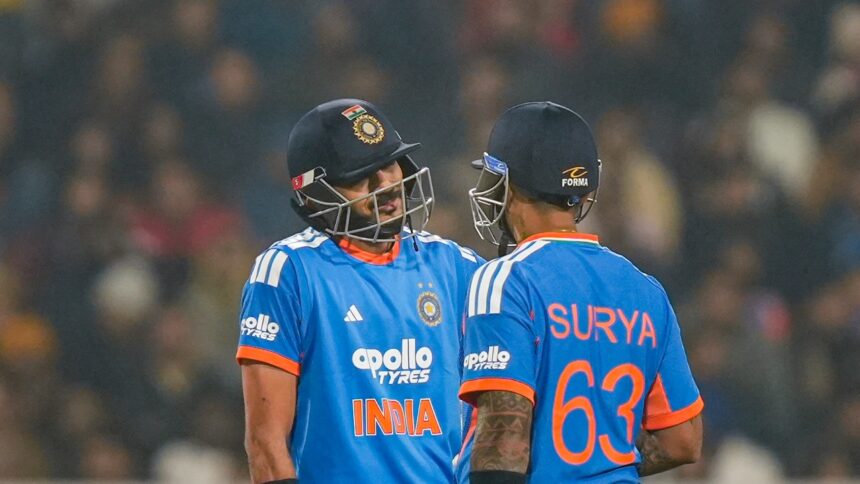
Suryakumar Yadav Defends Axar Patel’s No. 3 Gamble After India’s Mullanpur Meltdown
The second T20I between India and South Africa in Mullanpur was a tale of two gambles. One, Quinton de Kock’s fearless assault from ball one, paid off spectacularly. The other, India’s startling decision to promote Axar Patel to No. 3 in a mammoth 214-run chase, unraveled just as quickly. In the aftermath of a 51-run defeat that leveled the series 1-1, Captain Suryakumar Yadav stood firmly behind the team’s bold, if baffling, tactical call, sparking a firestorm of debate among fans and pundits alike.
The Mullanpur Collapse: A Gamble Gone Wrong
Chasing a daunting 214, India’s innings required a foundation of intent and stability. The early loss of Shubman Gill brought Axar Patel, primarily known as a spin-bowling all-rounder who bats in the lower middle-order, to the crease with just 6 runs on the board. The move, a clear directive from the think tank led by head coach Gautam Gambhir, was a shock tactic aimed at disrupting South Africa’s plans. However, the ploy backfired. Axar, visibly uncomfortable in the unfamiliar role against high pace, managed just 5 runs off 7 balls before skying a catch off Marco Jansen. His dismissal, followed quickly by Suryakumar’s own, left India reeling at 51 for 3 in the PowerPlay, a hole from which they never recovered despite Tilak Varma’s classy 62.
South Africa’s bowling attack, led by Jansen’s crucial early blows, exploited the pressure perfectly. The decision to send Axar seemed to ignore both the match situation and the player’s natural game, ultimately becoming a pivotal moment in the match.
Suryakumar’s Defense: The Logic Behind the Left-Field Move
At the post-match presentation, Suryakumar Yadav provided insight into the team’s rationale, framing it as a proactive, rather than reactive, strategy.
- Match-up Strategy: Suryakumar highlighted the plan to exploit the right-hand, left-hand combination early against South Africa’s right-arm pace duo of Jansen and Gerald Coetzee.
- Axar’s Current Form: The captain pointed to Axar’s confident batting form in the nets and his recent performances, suggesting the team had faith in his ability to take on the attack.
- Intent in PowerPlay: The core idea was to maintain a left-right pair and aggressively target the fielding restrictions, a modern T20 staple. “We wanted to attack in the Powerplay, and Axar has been batting well,” Suryakumar stated.
He defended the outcome, stating, “Sometimes it works, sometimes it doesn’t.” This explanation underscores a high-risk, high-reward philosophy that is increasingly common in the data-driven world of T20 cricket, where pre-conceived plans often trump in-the-moment adaptation.
Expert Analysis: Calculated Risk or Tactical Misstep?
While Suryakumar’s logic has merit in theory, its execution in this specific context is highly questionable. Analysts are dissecting the move from several angles:
The Case Against the Promotion:
- Disruption of Batting Order: It pushed a proven anchor like Tilak Varma, who scored 62, and a dynamic player like Shivam Dube down the order, forcing them to bat under even more severe scoreboard pressure.
- Axar’s Role Clarity: Axar has excelled as a finisher for India, with a specific skill set suited to the final overs. Placing him at No. 3 against raw pace with fielders up asked him to play a completely foreign game.
- Ignoring the Match Context: After a blistering de Kock innings, the chase required calculated aggression, not a high-wire experimental pinch-hit that risked a crucial early wicket.
The Potential Silver Lining:
Some argue this is the essence of Gambhir’s coaching philosophy—unorthodox, fearless, and aimed at breaking conventional molds. In a long series, testing such strategies can provide valuable data and keep the opposition guessing. The failure in Mullanpur might be a lesson that informs a successful move in a more critical game, like a World Cup knockout.
Series Implications and Predictions: How India Responds
This defeat sets up a tantalizing remainder of the five-match T20I series. The Mullanpur experiment, while costly, reveals India’s intent to explore their options aggressively. Here’s what to watch for:
- Batting Order Stability: Will India revert to a more traditional lineup, or will we see another left-field promotion? The form of Tilak Varma makes a strong case for him to secure the No. 3 spot.
- South Africa’s Momentum: De Kock’s form is a massive boost for the Proteas. Their pace attack has shown it can exploit any hint of indecision at the top.
- The Dew Factor: Its absence in Mullanpur played into South Africa’s hands. Teams will now be even more keen to win the toss and chase in the remaining games.
Prediction: Expect India to stabilize their top order but continue with flexible, aggressive roles for players like Dube and Rinku Singh in the middle. The series is now perfectly poised at 1-1, transforming it into a best-of-three contest. India’s response to this tactical stumble will define their character and provide a clearer picture of the team’s direction under the new Gambhir-Suryakumar partnership.
Conclusion: A Lesson in Fearless Cricket
India’s loss in Mullanpur and the subsequent defense of the Axar Patel promotion is more than just a post-match controversy. It is a statement of intent. Under its new leadership, the Indian T20I team is signaling a willingness to embrace extreme tactical flexibility, accepting that such boldness will occasionally lead to public failures. While the execution was flawed and the timing debatable, the underlying principle—to never die wondering—might be the necessary ethos for a team building towards future global championships.
The true test now lies not in abandoning this aggressive mindset, but in refining it. Learning to distinguish between a calculated risk and a desperate punt is what separates good teams from great ones. As the series moves forward, all eyes will be on how Captain Suryakumar Yadav and his think tank adapt, proving whether the Mullanpur experiment was a one-off misadventure or the first glimpse of a radically new, and ultimately successful, Indian T20 blueprint.
Source: Based on news from India Today Sport.