From “Band-Aid Man” to Houston Rocket: The Unforgettable Saga of Derrick Chievous and No. 3
In the sprawling tapestry of the Houston Rockets, a franchise adorned with the jerseys of legends like Hakeem Olajuwon, Moses Malone, and James Harden, certain threads are woven with quieter, yet indelible, color. The history of Rockets jersey numbers is a journey through over 500 players and 52 distinct digits, a numeric chronicle of fleeting rookies, steady role players, and immortal icons. Today, we pull on one of those more obscure threads: the number 3. While it would later gain fame in Houston, its first chapter belongs to a player as unique as his nickname—Derrick “Band-Aid Man” Chievous. His tenure was brief, his stats unspectacular, but his story is a compelling snapshot of an era and a testament to the diverse characters who have briefly called Houston home.
The “Band-Aid Man” Arrives: A First-Round Pick with Flair
When the Houston Rockets selected Derrick Chievous with the 16th overall pick in the 1988 NBA Draft, they weren’t just acquiring a basketball player; they were importing a campus legend. At the University of Missouri, Chievous was a scoring machine, finishing as the school’s all-time leading scorer—a record he still holds today. But his legacy was defined by his peculiar, now-iconic habit of wearing band-aids on his legs during games, a superstitious practice born from a minor college injury that became his trademark. The “Band-Aid Man” was born.
The Rockets of the late 80s were in a state of transition. The Twin Towers era of Ralph Sampson and Hakeem Olajuwon had fractured, and the team was rebuilding around a young, transcendent Olajuwon. They needed scoring punch and athleticism on the wing. Chievous, a 6-foot-7 forward with a smooth, slashing style and a proven collegiate scoring pedigree, seemed to fit the bill. His selection represented hope—a new piece for a puzzle the front office was desperately trying to solve.
Key Facts About Chievous’ Rockets Tenure:
- Draft Position: 16th overall in the 1988 NBA Draft.
- College Legacy: University of Missouri’s all-time leading scorer (2,580 points).
- Nickname Origin: “Band-Aid Man” for his habit of playing with adhesive bandages on his legs.
- Rockets Era: Played during a transitional period centered on a young Hakeem Olajuwon.
Analysis of a Short-Lived Houston Career
Derrick Chievous’s NBA career, particularly his time in Houston, never quite matched the prolific output of his college days. As a rookie in the 1988-89 season, he appeared in 61 games, starting 10, and averaged 7.0 points and 2.4 rebounds in just over 15 minutes per game. The flashes of the Missouri star were there—a crafty drive, a soft mid-range jumper—but consistency at the NBA level proved elusive. The following season, his role diminished slightly, averaging 5.5 points in 13 minutes per game across 43 appearances before a mid-season trade.
Expert analysis of his game suggests Chievous was a ‘tweener in an era less forgiving of the designation. He possessed the size of a small forward but lacked the elite outside shooting (he attempted only 31 threes total in Houston) to stretch the floor. His game was best suited to creating his own shot off the dribble, a skill that required more offensive responsibility than a role player alongside a dominant force like Olajuwon typically received. Defensively, he faced the steep challenge of guarding bigger, stronger, and faster NBA wings night after night.
Yet, to judge Chievous solely by his stat line is to miss the point of his place in Rockets lore. He represented a specific draft gamble, a talented scorer whose unique style didn’t seamlessly translate. His time in Houston coincided with the final years of the Don Chaney coaching era and the dawn of the Rudy Tomjanovich regime, a period of foundational change. Chievous was a piece of that foundation, even if he wasn’t the cornerstone.
The Trade and Legacy: A Brief, But Memorable, Numeric Footnote
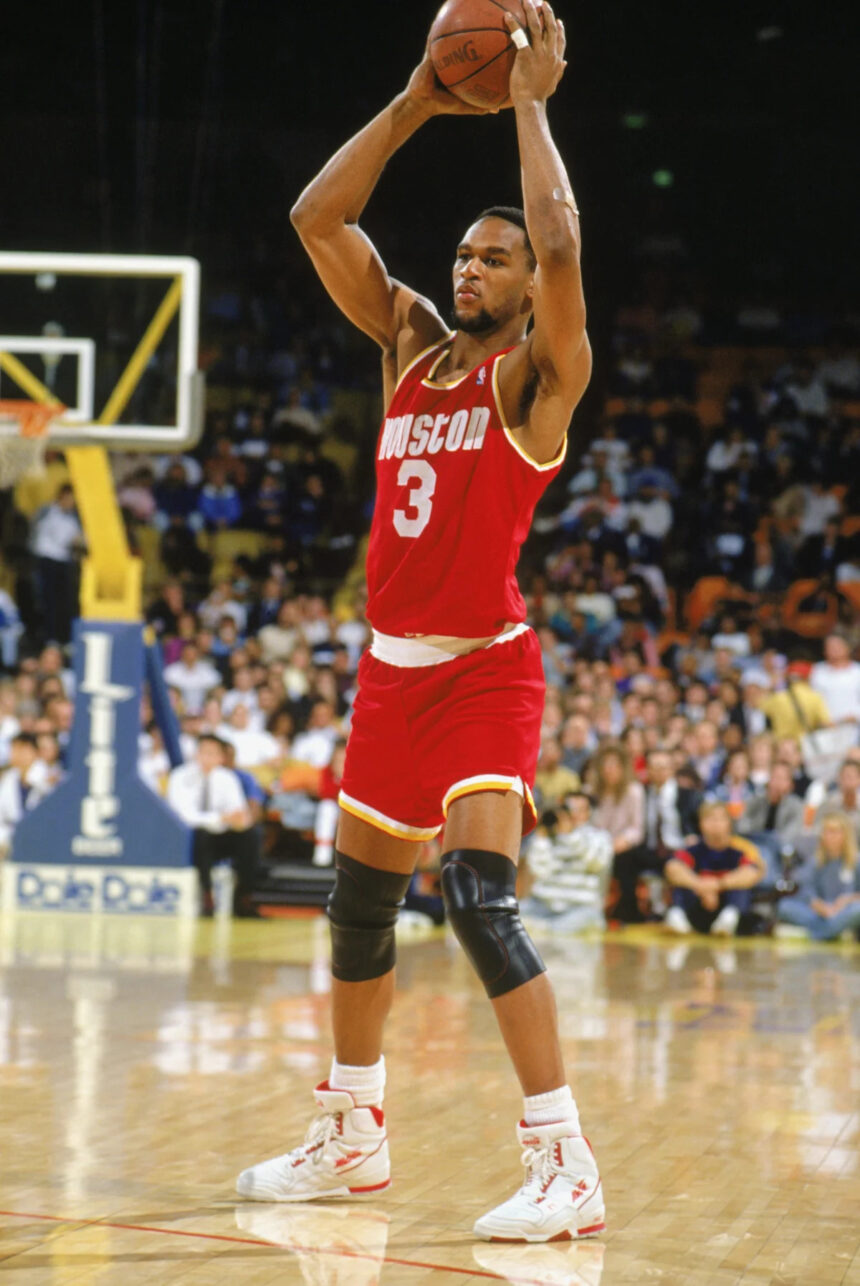
In February of 1990, the Derrick Chievous chapter in Houston closed. He was traded to the Cleveland Cavaliers, bringing his Rockets career to an end after just 104 games. The trade marked the end of the “Band-Aid Man” experiment, but it did not erase his entry in the franchise’s numeric ledger. As the second of 19 players to ever wear No. 3 for the Rockets, Chievous holds a distinct place as a pioneer of the digit.
His legacy is twofold. First, he is a prime example of the countless players who pass through an NBA franchise—high draft picks with immense promise whose careers take a different path. They are not busts so much as reminders of the razor-thin margin between collegiate stardom and NBA longevity. Second, and perhaps more importantly for fans of team history, Chievous is a character. In a league now often homogenized by analytics and system play, players like the Band-Aid Man—with their visible quirks and unmistakable trademarks—added a layer of personality and folklore.
The number 3 jersey in Houston would lay dormant for a few years after Chievous, waiting for its next claimant. It would eventually find more lasting fame on the backs of players like Steve Francis and, later, Kevin Porter Jr., each defining the number in their own, more impactful way. But Derrick Chievous was the first significant wearer, the one who set the initial, quirky precedent for what it meant to be a Rocket in the No. 3.
Conclusion: Honoring Every Thread in the Fabric
The exercise of tracing a jersey number’s history is more than a statistical rundown; it’s an archaeological dig into a team’s soul. For every retired number hanging in the rafters of the Toyota Center, there are dozens like No. 3, with stories woven from brief tenures, unrealized potential, and unique human interest. Derrick Chievous’s story is precisely why this history matters. He wasn’t a franchise legend, but for two seasons, he was a Houston Rocket, a first-round pick carrying the hopes of a fanbase, and a player whose college legend preceded him in the form of those famous band-aids.
As the Rockets continue to build their future, with new players inevitably donning old numbers, remembering figures like Chievous enriches our understanding of the franchise. It reminds us that the path to greatness is paved with trials, experiments, and fascinating individuals who, for a moment, shared the same court and the same numeric identity as the icons. The Band-Aid Man’s Houston tenure may have been a footnote, but in the complete history of the Rockets’ 52 jersey numbers, it is a footnote written with unmistakable style—a small, adhesive strip of character on the robust body of NBA history.
Source: Based on news from Yahoo Sports.