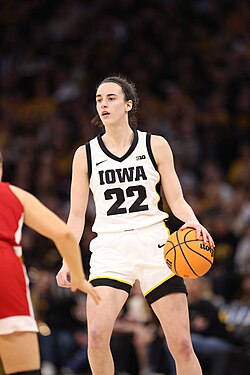
Caitlin Clark: The Algorithm of Excellence in a Human Form
In the high-definition, slow-motion replay era of sports, we’ve become accustomed to seeing the extraordinary. Yet, every so often, an athlete emerges whose performances are so consistently, mind-bendingly brilliant that they defy our standard frameworks of appreciation. We reach for new language, grasping for metaphors that can contain their genius. With Caitlin Clark, the basketball phenom who has rewritten the record books and captivated a nation, the most fitting descriptor feels almost borrowed from science fiction: This has to be AI. It’s not a literal accusation, but a cultural shorthand for witnessing a player whose decision-making, range, and creative flair operate on a seemingly pre-programmed level of perfection. But to dismiss her as a mere basketball automaton is to miss the profound human artistry at work. Clark isn’t artificial intelligence; she is the culmination of a rare, natural intelligence for the game, forged in gyms and manifested in moments of breathtaking audacity.
Deconstructing the “Code”: The Clark Operating System
When fans exclaim “She’s an AI!” they are pinpointing specific, quantifiable aspects of her game that feel superhuman in their consistency and execution. It’s the absence of observable error, the processing speed, and the flawless output that triggers the comparison.
First, there is the processor-speed vision. Clark sees the game not in frames, but in predictive algorithms. She receives a pass, and before the ball has settled into her hands, her internal CPU has already scanned the court, calculated defender trajectories, and identified the optimal scoring or passing solution—often one invisible to everyone else in the arena. This results in no-look passes that hit teammates in stride and cross-court lasers that bend the geometry of the defense.
Second, her shooting range is a bug in the game’s physics engine. In basketball video games, players sometimes discover a “cheat code” spot on the floor where shots go in regardless of defense. Clark has turned nearly every spot over half-court into that zone. Her range isn’t just impressive; it’s system-breaking. It forces defenses to extend to illogical, unsustainable positions, creating cascading advantages for her team. The pull-up three from the logo isn’t a Hail Mary; it’s a calculated, high-percentage option in her arsenal.
Finally, there is the clutch gene as executable software. The most advanced AI is stress-tested for peak performance under maximum load. Clark’s performance in high-leverage moments—game-winners, deep tournament shots, record-breaking attempts—displays a chilling lack of variance. The pressure input does not create a faulty output. If anything, the efficiency seems to increase. This repeatable, flawless execution in chaos is what makes the “AI” label feel so apt to observers.
The Human Artisan Behind the Output
To label Clark’s genius as merely algorithmic is to ignore the soul, creativity, and sheer grind that fuel it. Her game is not cold calculation; it’s passionate, fiery, and deeply intuitive. The “AI” comparison captures the *what*, but obscures the *how*.
The Foundation is Unseen Labor. There is no software update for a work ethic. The muscle memory for her 30-foot jumpers was built with thousands of reps before and after practice. The passing touch was honed through endless drills and film study. What looks like pre-installed programming is, in reality, the deep neural network of the human brain, trained over a lifetime of deliberate practice.
Creativity Cannot Be Coded. An AI can generate a pass to the open player. It cannot invent the behind-the-back, full-court bounce pass in transition that Clark has made her signature. That is improvisational artistry. Her game is filled with these moments of spontaneous creativity—a hesitation move, a unexpected scoop shot, a heat-check shot selection that defies conventional wisdom. These are the hallmarks of a human artist, not a machine following its own code.
Emotional Intelligence as a Catalyst. Clark plays with a palpable, competitive fire. She energizes her teammates, engages with crowds (both friendly and hostile), and uses emotion as fuel. This emotional layer—the trash talk, the iconic “you can’t see me” wave, the raw celebrations—adds a variable no AI could replicate. It makes her performances not just efficient, but compellingly human.
The WNBA and Beyond: The “Clark Effect” Goes Live
Now drafted into the WNBA, the “Caitlin Clark AI” is being uploaded into a new, more powerful league. The question is no longer about collegiate defenses; it’s about how her unique operating system will adapt and evolve against the world’s best professionals. The early returns show the same disruptive potential.
- Immediate System Impact: From her first preseason game, Clark’s gravity altered the floor. Defenses, even those stocked with All-Stars, are forced into impossible choices: guard her tightly 30 feet from the basket and surrender driving lanes, or sag off and watch her launch.
- Market Disruption: The “Clark Effect” is real. Ticket sales have skyrocketed for her games, television ratings have shattered records, and merchandise flies off shelves. She is a one-woman economic stimulus package, forcing a rapid reevaluation of the WNBA’s market potential.
- The Evolution Challenge: Opponents will have more length, athleticism, and film to study. The league will test her physically and mentally. The fascinating next chapter is watching her game evolve in real-time. How will she add new “patches” to her software—improved defense, mid-range game, playmaking against switching schemes?
Conclusion: The Perfect Synthesis of Art and Algorithm
So, is Caitlin Clark AI? The metaphor is brilliant because it captures the awe of her consistent, data-defying excellence. She operates with a processor’s efficiency and a sniper’s precision. But the metaphor breaks down where humanity begins. She is not a pre-programmed machine; she is a basketball savant whose “code” was written in sweat, passion, and an innate, unteachable love for the game.
Caitlin Clark represents the perfect synthesis. She possesses the calculative mind of a chess master and the creative soul of a playground legend. She is both architect and artist, analyst and assassin. To watch her is to witness the future of basketball—a future where deep basketball IQ, limitless range, and artistic flair merge into one unstoppable force. The “AI” label is a testament to our struggle to comprehend her greatness. But her true legacy will be that of a human who redefined what is possible, inspiring a generation to not just watch the game, but to imagine its next evolution. She isn’t artificial intelligence. She is, quite simply, a new basketball intelligence.
Source: Based on news from Yahoo Sports.
Image: CC licensed via commons.wikimedia.org