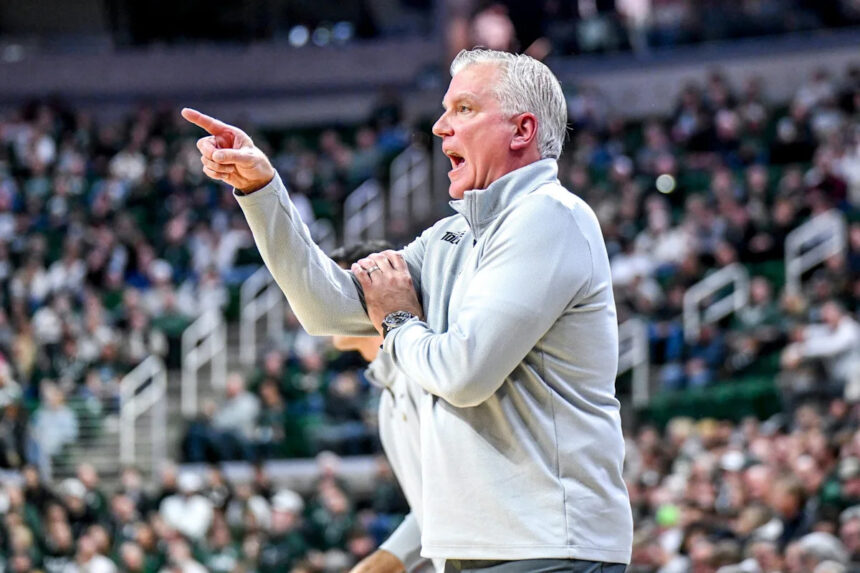
Beyond the Scoreboard: What Toledo’s Tod Kowalczyk Revealed About Michigan State’s Elite Culture
In the brisk arithmetic of college basketball, a 92-69 final score tells a simple story: a dominant win for Michigan State, a sobering loss for Toledo. But in the quiet moments after the final buzzer, when the stats sheets are being folded and the arena empties, a deeper narrative often emerges—one of respect, access, and the vast chasm between college basketball’s aristocracy and its aspiring contenders. Following the Spartans’ commanding victory, Toledo head coach Tod Kowalczyk didn’t just offer post-game platitudes. He delivered a raw, gracious, and revealing assessment that peeled back the curtain on what makes a program like Michigan State truly elite, and the immense value for a team like his just to share the floor.
The Privilege of the Challenge: A MAC Coach’s Plea
For fans of Power 6 conferences, the non-conference schedule is often viewed through a lens of entertainment and resume-building. For a program like Toledo in the Mid-American Conference, it’s a high-stakes exercise in opportunity and survival. As Kowalczyk candidly admitted, securing a game against a titan like Michigan State is a feat in itself.
“I begged Tom (Izzo) for this game, I begged him,” Kowalczyk stated, a confession that underscores a reality often invisible to the casual observer. Top programs have limited non-conference slots and face immense pressure with nothing to gain and everything to lose in a perceived “buy game.” A loss is catastrophic for their tournament profile; a win is simply expected. This dynamic makes coaches understandably selective.
Yet, as Kowalczyk’s pursuit highlights, Tom Izzo remains an outlier in his willingness to “play anybody in the country, any place, any time.” This isn’t just bravado; it’s a core tenet of Izzo’s philosophy that benefits both his own team’s toughness and the broader ecosystem of the sport. For Toledo, this game was far more than a line item. It was a benchmark, a recruiting tool, and an invaluable experience for players who dream of testing themselves on the biggest stages.
A Stark Assessment: Starry-Eyed in the Spotlight
Kowalczyk’s critique of his own team was as pointed as his praise for the Spartans was effusive. He didn’t blame the talent gap or officiating; he went straight to the mentality, identifying the intangible edge that separates great teams from good ones.
“Really disappointed how we played in the first half. We played starry-eyed, lacked toughness,” he said. This “starry-eyed” admission is profound. It speaks to the aura of the Breslin Center, the reputation of the Spartan program, and the speed and physicality that can’t be fully simulated in practice or MAC play. For a half, Toledo wasn’t just playing a basketball team; they were confronting a legacy, and it showed.
His analysis then pivoted to the relentless machine his team faced. “Michigan State is good, they are so good. When they make shots like they did tonight, they are hard to defend.” This wasn’t a coach making excuses. It was an expert recognizing a higher level of operation. He saw the synergistic effect of MSU’s defensive pressure fueling their transition offense, and the compounding difficulty when elite athletes also knock down perimeter shots. Kowalczyk saw the blueprint of a Final Four contender executing at peak efficiency.
Grace in the Portal Era: Coaching Beyond the Roster
Perhaps the most telling moment of Kowalczyk’s press conference came when discussing a player who was no longer his own: Michigan State freshman guard Sonny Wilson. Wilson, a Toledo native, initially committed to the Rockets before decommitting and ultimately landing with the Spartans via the transfer portal—a modern college basketball saga that often leaves behind bitterness.
Kowalczyk, however, flipped the script. “I’m happy for Sonny Wilson. I know the question was heading towards losing him (to the portal), and I always want the best for him. His leadership is great. He is a team-first player.” In an era where player movement is often met with public friction, this was a stunning display of grace and genuine mentorship. It revealed a coach prioritizing a young man’s journey over his own roster’s “what ifs.” Furthermore, his specific praise for Wilson’s leadership and team-first attitude offered a subtle scouting report on what Izzo is cultivating in his young guard: the very Spartan DNA of toughness and selflessness.
This moment transcended the game. It highlighted:
- The human element often lost in high-stakes recruitment.
- Kowalczyk’s own character and the culture he builds at Toledo.
- The validation of Izzo’s recruiting eye, not just for talent, but for players who fit a specific, demanding culture.
The Izzo Effect: Why These Games Matter for the Spartans
While the immediate benefit for Toledo is clear, Kowalczyk’s comments inadvertently made a compelling case for why Izzo’s scheduling philosophy is vital for Michigan State’s long-term success. These games are not mere formalities. They are cultural rehearsals.
When a respected opposing coach identifies a “lack of toughness” in his own team compared to the Spartans, it confirms that MSU’s identity is being successfully projected. These early-season games against well-coached, hungry mid-majors like Toledo serve as critical stress tests. They expose flaws in a relatively low-risk environment, teach young players how to handle being the “prize,” and reinforce the non-negotiable standards of effort that define March success.
Kowalczyk’s starry-eyed observation is exactly what Izzo wants his own team to instill. It’s a psychological advantage forged in November. The Spartans didn’t just win a basketball game; they enforced their will and validated their reputation, a currency that pays dividends in conference play and the NCAA tournament.
Conclusion: A Loss That Illuminates More Than It Diminishes
The final score from the Breslin Center will quickly fade into a season ledger. But the post-game reflections from Tod Kowalczyk will resonate far longer. They provided a rare, dual-lens view into the hierarchy of college basketball. From one angle, we saw the immense challenge and opportunity for the mid-major, fighting for visibility and a chance to measure itself against the gold standard. From the other, we saw the sustained power of a program built on toughness, culture, and a fearless scheduling ethos by Tom Izzo.
Kowalczyk’s honesty about begging for the game, his frustration with his team’s momentary awe, and his graciousness toward a player who got away, painted a picture of a sport that is fiercely competitive yet deeply interconnected. For Michigan State, the victory was a demonstration of their formidable ceiling. For Toledo, the loss was a lesson in the price of admission to the elite level. And for everyone listening, Kowalczyk’s words were a reminder that sometimes, the most insightful analysis of a powerhouse doesn’t come from its own circle, but from a respected adversary who looked it squarely in the eye and came away in awe of the view.
Source: Based on news from Yahoo Sports.