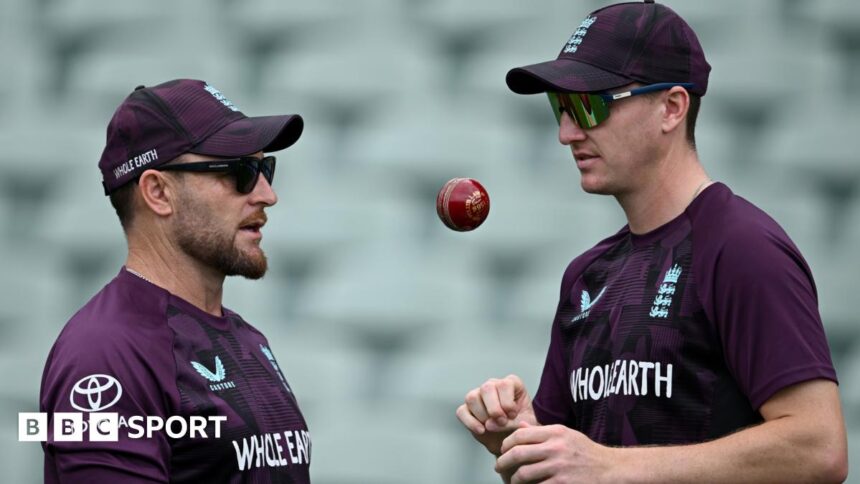
A Changing Man, or Change the Man? Brendon McCullum’s Reckoning in Sri Lanka
The humid Colombo air hangs heavy with more than just the promise of rain. As England’s white-ball squad prepares for six crucial matches against Sri Lanka, a different kind of storm is brewing—one of accountability, culture, and the very soul of ‘Bazball’. The architect of England’s red-ball revolution, Brendon McCullum, now finds himself at a white-ball crossroads, with the actions of a young star and the ghosts of a horrific Ashes forcing a stark reckoning: does he change the man, or does the man need to change?
The Ripple from Wellington: A Night Out That Echoed in the Ashes
On the eve of an ODI in Colombo, Harry Brook found himself explaining an incident from the eve of an ODI in Wellington. The symmetry is damning. The ripples of Brook’s night out, where he was reportedly “clocked” by a nightclub bouncer, have travelled 7,000 miles and several months, washing up at the feet of the England management. While the incident itself was minor, its timing and symbolism were catastrophic.
It occurred just before England touched down in Australia for an Ashes series that would become an all-timer of a shambles. Dropped catches that defied belief, batting collapses dressed as bravado, bowling plans that seemed devised in a panic—the series was a catalogue of regrets. Brook’s misdemeanour, a moment of slapdash off-field judgement, came to typify the very slapdash approach to regaining the urn that followed. It wasn’t the cause of the failure, but it was a perfect, prescient symptom of a mindset problem.
The Bazball Paradox: Freedom vs. Folly
McCullum and Ben Stokes’s great gift to English cricket was liberation. They unshackled talent, preached positive intent, and built a fortress of unwavering public support. This philosophy, however, contains a inherent paradox. When does fearless become feckless? When does freedom tip into folly? The Ashes exposed the fine line.
The challenge for McCullum now is governance. The ‘Bazball’ culture cannot be a blanket pardon for a lack of professional discipline. As one senior figure within the game noted, “The best teams play with freedom, but they are built on foundations of ruthless professionalism.” For the T20 World Cup, beginning February 7th, England must find that balance. This Sri Lanka series is the first real test of whether lessons have been learned, or if the recklessness is baked in.
- Key Question: Can the environment of unconditional support also demand ultimate accountability?
- The Leadership Test: Stokes and Jos Buttler must embody this new equilibrium.
- For Brook: This tour is about proving his maturity matches his immense talent.
Sri Lanka: The Crucible for World Cup Credentials
These six white-ball games are far more than warm-ups. They are a diagnostic tool for McCullum and the selectors. In the spinning, suffocating conditions of Sri Lanka, mental clarity is as important as skill. The squad must demonstrate:
Strategic Adaptability: The cavalier six-hitting that works in Rawalpindi must be tempered with nuance in Colombo. Can they build innings, manipulate fields, and play the situation?
Unbreakable Composure: Off-field composure feeds on-field composure. The distractions are myriad in Sri Lanka—heat, humidity, turning pitches, vocal crowds. The focus must be absolute.
Collective Responsibility: The Ashes failure was a team meltdown. Here, we need to see a team where each player is their brother’s keeper, both in execution and in professional standards. The horrific Ashes series must become a reference point for what they are not, not a pattern they repeat.
Prediction: A Culture Refined, Not Redefined
So, what will McCullum choose? To change the man—publicly reprimanding Brook, instilling draconian curfews, and tightening the leash—or to trust that the man, and the group, have changed themselves?
The prediction here is for a third way: McCullum’s reckoning will lead to a refinement, not a redefinition. The core philosophy of positive, aggressive cricket will remain untouched. However, the supporting infrastructure of that philosophy will be hardened. Expect:
- A more steel-edged tone in private from McCullum and Stokes, linking personal discipline directly to team trust.
- A spotlight on Brook not as a scapegoat, but as a symbol of evolution. His runs will be celebrated, but his professional conduct will be implicitly under review.
- A team that plays with the same bold heart, but with a colder, sharper cricketing brain. The recklessness of the Ashes will be replaced by a calculated aggression.
The Sri Lanka series may be won or lost on the field, but its true success will be measured in the subtle shifts of attitude and responsibility observed from the sidelines.
Conclusion: The Legacy on the Line
Brendon McCullum’s legacy was forged in a breathtaking summer of Test revolution. It is now being tested in the quieter, more complex arena of cultural maintenance. The T20 World Cup is the immediate goal, but the stakes are larger. Can the exhilarating culture he built also be a durable, winning one? Or is it destined to be a brilliant, fleeting flame that burns bright but lacks the oxygen for long-term success?
The answers begin in Colombo. Not just in the scoreboard, but in the demeanour, the decision-making, and the discipline of his players. This is not about changing one man like Harry Brook. It is about proving that every man in that squad has changed enough to turn the regret of the past into the glory of the future. The reckoning is here.
Source: Based on news from BBC Sport.