Hydration Halts: How Mandatory Water Breaks Will Redefine the 2026 World Cup
The beautiful game is about to take an unprecedented pause. In a landmark decision that will alter the rhythm of the world’s most-watched sporting event, FIFA has confirmed that every single match at the 2026 World Cup will feature mandatory three-minute hydration breaks at the 22-minute mark of each half. This isn’t a suggestion or a weather-contingency plan; it is a universal rule, applied in the cool evening of Seattle as surely as in the midday sun of Dallas. As the tournament expands across North America’s vast and climatically diverse landscape, this policy represents a profound shift in philosophy—prioritizing athlete physiology over uninterrupted spectacle. The era of strategic hydration is here, and it will change how the game is played, coached, and won.
The Heat is On: The Unforgiving North American Stage
The 2026 World Cup was always going to be a logistical and environmental challenge. Stretching from the Pacific to the Atlantic, across three nations and sixteen host cities, the tournament will be played in the furnace of a North American summer. Meteorologists and sports scientists are not just warning of heat; they are forecasting a perfect storm of extreme conditions. Players could face sweltering humidity in Houston and Atlanta, arid, baking heat in Kansas City and Philadelphia, and the ever-present threat of wildfire smoke in Vancouver or disruptive hurricane patterns along the Gulf and Atlantic coasts.
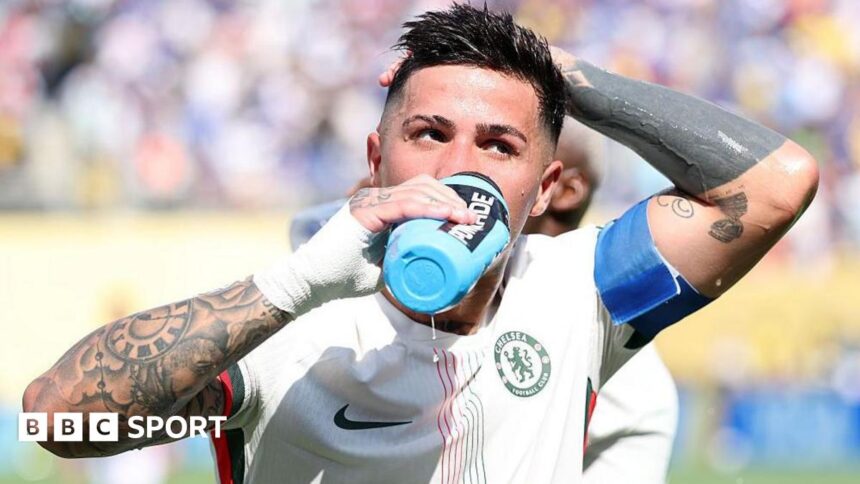
The complaint from Chelsea’s Enzo Fernandez during the 2022 Club World Cup in Abu Dhabi—”The heat killed us… it was impossible to play”—was a stark warning heard by governing bodies. FIFA’s move to institutionalize hydration breaks, regardless of the specific match-day weather, is a direct response. It acknowledges that player welfare cannot be a game-day negotiation. “To ensure equal conditions for all teams, in all matches,” is the official line, but the subtext is clear: the climate crisis is now a central fixture in tournament planning. This isn’t just about water; it’s about player welfare as a non-negotiable pillar of the modern game.
Beyond a Sip of Water: The Tactical Ripple Effect
To view the hydration break as merely a chance for players to drink is to underestimate its potential impact. In a sport where margins are razor-thin, these structured pauses will become mini halftime team talks, injecting a new layer of strategy into the heart of each half. Coaches will no longer have to wait until the break to correct tactical flaws or alter approaches. The game will now be segmented into four distinct quarters, each with its own pre-planned strategy.
- Tactical Re-sets: A team under intense pressure at the 22-minute mark gets a vital chance to regroup, reorganize their defensive shape, and break the opponent’s momentum.
- In-Game Coaching: Managers and assistants will swarm the touchline, delivering pointed instructions, showing tablets with video clips, and making crucial positional adjustments.
- Medical Interventions: Physios can quickly assess niggling injuries, administer preventative strapping, and monitor players for signs of heat stress without using a substitution.
- Set-Piece Redesign: Crucially, these breaks will occur just before the typical flow of a half intensifies. Teams renowned for set-pieces will have dedicated time to rehearse and clarify routines for corners or free-kicks in the ensuing period.
The team that best utilizes these 180 seconds of stoppage time may find a decisive edge. The break could benefit the underdog seeking to disrupt flow, or the tactical mastermind with a plan for every phase. It will certainly test a referee’s ability to manage the restart and maintain control.
Predictions: Who Wins and Who Loses in the New Rhythm?
This fundamental change will create winners and losers. Nations and coaches who adapt proactively will thrive, while those who see it as a mere inconvenience could suffer.
The Potential Winners:
Teams from CONCACAF nations (USA, Canada, Mexico) and other regions accustomed to high-heat, high-humidity conditions may have an inherent physiological and psychological adaptation. More significantly, coaches with deep squads and a high-pressing style could weaponize the breaks. They can instruct their teams to exert ferocious pressure in the 20-minute sprints leading to the hydration stop, exhausting opponents who then have only a short window to recover. Conversely, tactically flexible managers like a Pep Guardiola or a Roberto De Zerbi (should they be in charge of national teams) will likely devise intricate plans for each segment, turning the game into a chess match with more moves.
The Potential Challenges:
Teams that rely on flow and sustained momentum—often those with technically gifted players who control the game through possession—may find their rhythm consistently interrupted. Older squads or players with lower stamina may struggle if the breaks simply allow fresher, younger opponents to recover equally. Furthermore, the pressure on medical and performance staff will skyrocket. Their role in advising coaches on real-time physical data—who is fading, who needs attention—during these breaks will be critical.
A Necessary Evolution for the Global Game
FIFA’s mandate is a definitive step into a new era of sports science. It signals that the “macho” ethos of playing through any condition is being replaced by a data-driven, health-first approach. While purists may lament another stoppage in play, the reality of a 48-team tournament in potentially dangerous climates leaves little room for nostalgia. The breaks are a pragmatic shield against heatstroke, cramping, and diminished performance that protects the tournament’s quality as much as its participants.
Looking beyond 2026, this policy sets a powerful precedent. It will be studied by domestic leagues in hot climates and may become standard for all summer tournaments. The conversation has irrevocably shifted from *whether* to intervene for player safety to *how* to best implement that intervention.
The 2026 World Cup will be remembered for its scale, its host nations, and its stars. But history may also mark it as the tournament where the game finally, formally, paused for breath. When the referee’s whistle blows on that first mandatory break in June 2026, it will sound not just for water, but for a smarter, safer, and more strategically complex future for football. The world will watch, and the sport will never be quite the same.
Source: Based on news from BBC Sport.