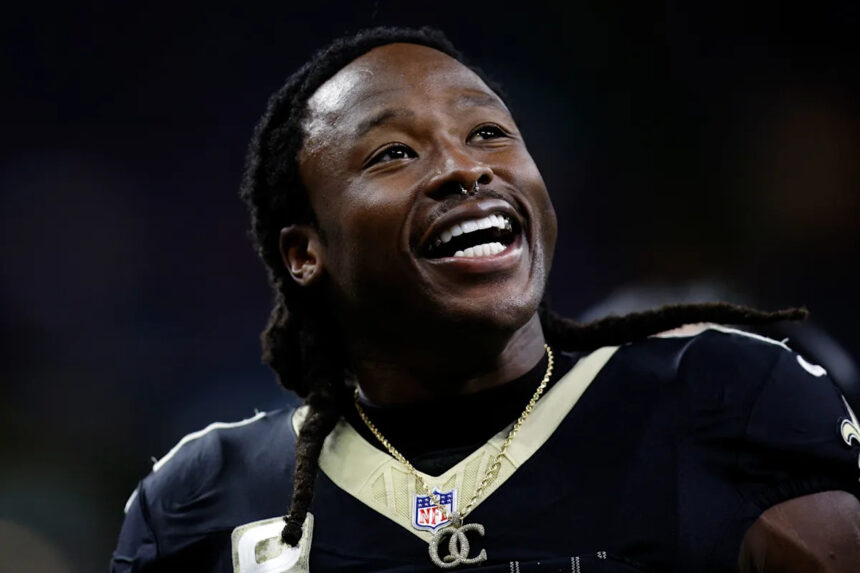
Alvin Kamara Breaks Silence on Saints Signing Travis Etienne Jr.: “Ain’t Nothing But Some Help”
For the first time in nearly a decade, the New Orleans Saints backfield has a new alpha—or at least a new co-star. When the Saints inked former Jacksonville Jaguars running back Travis Etienne Jr. to a four-year, $48 million contract on the opening day of free agency, the NFL world immediately turned its attention to the man who has defined the position in New Orleans since 2017: Alvin Kamara.
- Kamara on Etienne: “I Couldn’t Be Happier”
- The Saints’ Clear Message: Kamara’s Days as the Lone Star Are Numbered
- Expert Analysis: Can Kamara and Etienne Coexist—and Thrive?
- What Kamara’s 2026 Hopes Reveal About His Mindset
- Conclusion: The Saints Are Building a Backfield for the Future—and Kamara Is On Board
The signing sent shockwaves through the league. Kamara, now 30 years old and entering his ninth season, is coming off a resurgent 2024 campaign in which he rushed for 1,005 yards and eight touchdowns while adding 543 receiving yards. But the Saints’ front office clearly saw the writing on the wall: the future needed a jolt, and Etienne—just 26 years old with 2,992 career rushing yards and 21 touchdowns—represented a long-term investment.
Rather than bristle at the competition, Kamara did something unexpected. He celebrated.
Kamara on Etienne: “I Couldn’t Be Happier”
During a Monday evening appearance on The Set YouTube show, hosted by his former teammate and current Miami Dolphins left tackle Terron Armstead, Kamara addressed the Etienne signing with a refreshing dose of candor. The running back dismissed any notion of tension or a looming power struggle.
“I think a lot of people are thinking this is like beef or something when moves like this happen,” Kamara said. “And it’s like, ‘Man, I couldn’t be happier.’ Like, one, my boy got paid, and two… ain’t nothing but some help in the backfield. That’s the name of the game.”
Kamara’s perspective is rooted in experience. He knows what it looks like when a backfield duo clicks at an elite level—because he lived it. From 2017 to 2020, Kamara and Mark Ingram formed one of the most destructive one-two punches in NFL history. Ingram rushed for 4,553 yards and 38 touchdowns during their four seasons together, while Kamara added 4,080 yards on the ground and 34 scores. Through the air, they combined for 3,447 receiving yards and 27 touchdowns.
“I think me and Mark set the bar very high,” Kamara told Armstead. “That’s what efficiency looks like on a very high level.”
Now, with Etienne in the fold, Kamara is being asked to revisit that blueprint. The question is whether the Saints can replicate that magic with a new cast of characters—and whether Kamara’s willingness to share the load will extend past the 2025 season.
The Saints’ Clear Message: Kamara’s Days as the Lone Star Are Numbered
Let’s not sugarcoat the business side of this move. The Saints did not hand Travis Etienne Jr. $48 million—with $28 million guaranteed—simply to be a third-down specialist or a change-of-pace back. They invested in a lead back who can carry the offense for the next four years. That timeline directly overlaps with the final stretch of Kamara’s current contract, which runs through the 2026 season.
Speculation regarding Kamara’s future in New Orleans has been swirling for months. The Saints flirted with cap hell, restructured deals, and watched the running back market depreciate. Kamara’s base salary for 2025 is $10.5 million, but his cap hit balloons to nearly $18 million. That’s a heavy number for a player who will turn 31 in July—especially when the team just committed top-tier money to a younger back.
Here’s what the signing of Etienne tells us about the Saints’ 2026 outlook:
- Transition planning is already underway. Etienne’s contract runs through 2029. He is the franchise’s long-term investment at running back.
- Kamara’s role will evolve. Expect a reduction in carries, but an increase in high-leverage usage: third downs, red-zone packages, and creative passing-game deployments.
- 2026 is the pivot point. If Kamara remains on the roster past 2025, it will be on a restructured deal—likely at a reduced salary—or as a complementary piece to Etienne.
Kamara, to his credit, is embracing the shift. During the same interview, he referenced the Ingram era as a model for how to handle a crowded backfield.
“That’s what efficiency looks like on a very high level,” Kamara repeated, drawing a direct line from the Ingram partnership to what he hopes to build with Etienne.
Expert Analysis: Can Kamara and Etienne Coexist—and Thrive?
On paper, the Kamara-Etienne pairing is tantalizing. Both are explosive, versatile, and capable of breaking a game open from any spot on the field. But the NFL is littered with star-studded backfields that never quite clicked. Chemistry, usage, and ego all play a role.
Let’s break down the strengths each back brings to the table:
- Alvin Kamara: Elite vision, elite pass-catching ability, and a proven track record in the Saints’ system. He remains one of the best in the league at making defenders miss in space. In 2024, he forced 48 missed tackles—tied for sixth among all running backs.
- Travis Etienne Jr.: Home-run speed, breakaway acceleration, and a more traditional between-the-tackles game than Kamara. Etienne averaged 4.8 yards per carry in 2023 and has 1,200-plus scrimmage yards in each of his last two healthy seasons.
The key difference between this duo and the Kamara-Ingram tandem is stylistic overlap. Ingram was a bruising, downhill runner who wore down defenses. Kamara was the slippery, explosive complement. With Etienne, the Saints have two players who prefer to operate in space—which could create schematic challenges for offensive coordinator Klint Kubiak.
However, Kamara’s willingness to adapt cannot be overstated. He has already proven he can thrive in a split backfield. The question is whether he can sustain that production as his physical tools begin to decline. Ingram’s production dropped sharply after age 30, and Kamara will face the same inevitable curve.
My prediction: The Saints will use a 60-40 split in favor of Etienne by midseason 2025, with Kamara handling most of the third-down work and red-zone touches. If Kamara stays healthy and accepts that role, he can still be a valuable asset—especially in 2026, when the Saints will likely ask him to take a pay cut or face release.
What Kamara’s 2026 Hopes Reveal About His Mindset
During the interview, Kamara also touched on his personal goals for the 2026 season—a year that many around the league believe could be his last in New Orleans. While he didn’t offer a specific timeline, his tone suggested a player who is at peace with the uncertainty.
“I’m just focused on winning,” Kamara said. “If I’m here, I’m here. If I’m somewhere else, I’m somewhere else. But I know what I can do. And I know what I can bring to a team.”
That pragmatic outlook is a far cry from the fiery, emotional Kamara who once bristled at questions about his workload. The maturation is evident—and it may be the very reason the Saints felt comfortable bringing in Etienne without fear of a locker-room fracture.
Kamara’s hope for 2026 is simple: to be on a roster that competes for a championship, whether that’s in New Orleans or elsewhere. He understands that the Saints’ decision to sign Etienne was not personal. It was business. And in the NFL, business rarely waits for sentiment.
“Ain’t nothing but some help in the backfield,” Kamara repeated. “That’s the name of the game.”
Conclusion: The Saints Are Building a Backfield for the Future—and Kamara Is On Board
The New Orleans Saints made a loud statement on the first day of free agency: they are not content to ride the past into the future. Signing Travis Etienne Jr. to a $48 million contract signals a shift in philosophy, a bet on youth, and a recognition that the running back position needed an injection of explosive talent.
But Alvin Kamara is not standing in the way. Instead, he is drawing on the lessons of his own storied career—specifically the partnership he forged with Mark Ingram—to welcome the new addition with open arms. If the Saints can replicate even a fraction of that old magic, their backfield could once again become the engine of the offense.
The 2025 season will be a proving ground. Can Kamara and Etienne coexist without stepping on each other’s toes? Can the offensive line hold up? Can the Saints’ passing game take enough pressure off the run? These are the questions that will define New Orleans’ season—and Kamara’s final chapter with the franchise.
One thing is certain: Alvin Kamara is not done yet. And with Travis Etienne by his side, the Saints’ backfield just got a whole lot more dangerous.
Source: Based on news from Yahoo Sports.