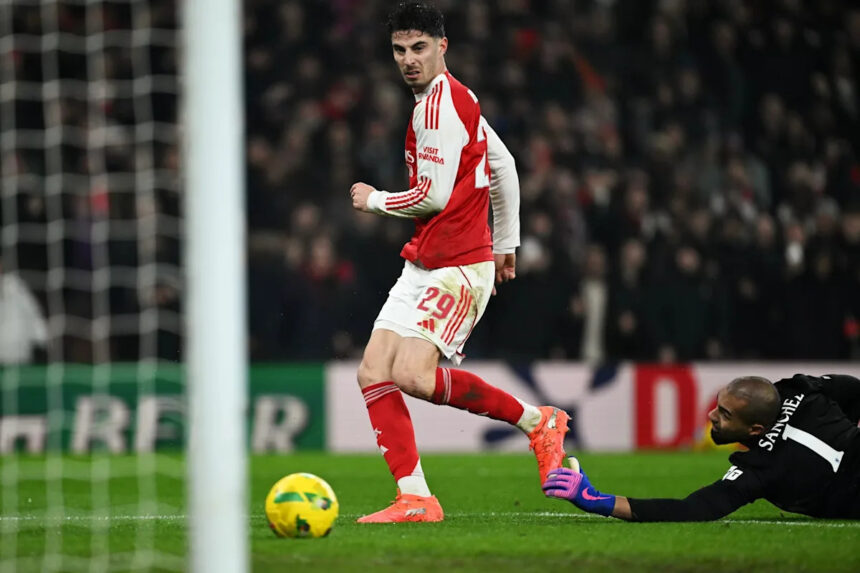
Kai Havertz Haunts Chelsea as Arsenal’s Late Strike Seals Wembley Return
In the hushed, tense theatre of a semi-final, where every breath is held and every mistake magnified, it is often the narrative that delivers the final, poetic blow. At the Emirates Stadium, under the glare of a season-defining night, Kai Havertz, the former Chelsea blue, emerged as Arsenal’s unlikely hero in stoppage time, sending the Gunners to their first Carabao Cup final since 2017 with a solitary, devastating strike. A match starved of clear-cut chances, defined by tactical caution and defensive rigidity, was ultimately decided by a moment of pure, unscripted drama, proving that in football, the past always has a way of rewriting the present.
A Tactical Stalemate and the Weight of Expectation
From the first whistle, the contours of a classic, cagey cup tie were evident. Both Mikel Arteta and Mauricio Pochettino, aware of the colossal prize at stake, set their teams up with a premium on control and a fear of the critical error. The midfield became a congested battleground, with space at a premium and attacking ventures often dying out before they reached the penalty area.
Chelsea’s best early opportunity came not from intricate build-up, but from Arsenal’s rare lapse. A loose touch from the usually impeccable William Saliba fell to Liam Delap, but with the goal beckoning, the young forward could only scuff his effort wide. It was a moment that summed up the half: promise snuffed out by imprecision. Arsenal’s response was muted; their first attempt of note a left-footed curler from Piero Hincapié that required a smart save from Robert Sánchez. The pattern was set—a game of chess where both kings were stubbornly protected.
- Cagey Opening: Both teams prioritized defensive structure over attacking flair, leading to a first half with minimal goalmouth action.
- Critical Miss: Liam Delap’s failure to convert Chelsea’s biggest chance set a tone of profligacy.
- Midfield Battle: The engine room was fiercely contested, with creativity largely stifled by disciplined pressing and positioning.
The Decisive Moment: Havertz Writes His Redemption Arc
As the clock ticked into added time, a penalty shootout seemed an inevitable conclusion to the stalemate. Both sets of fans braced for nerve-shredding spot-kicks. Then, Arsenal found a final surge. A move built on persistence rather than pure artistry saw the ball break to Kai Havertz inside the Chelsea box. With the composure of a man silencing a thousand doubts, the German international steadied himself and guided a precise, low finish beyond Sánchez and into the far corner. The Emirates erupted, a cathartic release of tension, while Havertz’s muted celebration spoke volumes of respect for his former club and personal vindication.
This was more than just a winning goal. It was a symbolic moment for the player and the project. Havertz, whose integration at Arsenal has been a gradual process, chose the most pressurized moment possible to deliver his most important contribution yet. For Arteta, it was validation of his faith in a big-game player. For Chelsea, it was a cruel twist of fate, their former Champions League final match-winner becoming the architect of their cup demise.
Expert Analysis: What This Means for Arsenal and Chelsea
This victory is a monumental psychological boost for Arsenal. Reaching a Wembley final injects tangible success into a season with lofty ambitions, providing a platform to end their wait for domestic cup glory. The manner of the win—grinding, resilient, and finding a way—builds a different kind of squad character. They demonstrated they can win ugly, a trait essential for any team chasing multiple trophies.
For Chelsea, the defeat is a harsh lesson in the fine margins of elite football. Pochettino’s side competed well defensively but lacked the cutting edge and killer instinct in the final third. The question marks over their consistency and ability to win major knockout games persist. However, their performance was not one of collapse; it was one of being narrowly outlasted by a moment of individual quality from a familiar face.
Key Tactical Takeaways:
- Arsenal’s Defensive Solidity: The clean sheet, built on Saliba and Gabriel’s foundation, was the platform for the late winner.
- Chelsea’s Attending Struggles: Despite control in periods, they failed to create high-quality chances, highlighting an ongoing issue.
- Impact of Substitutions: The fresh legs introduced by both managers in the second half ultimately played into a more open, if still cautious, finale.
Road to Wembley: Predictions and Final Thoughts
Arsenal’s journey to the Carabao Cup final at Wembley will now shift focus to the showpiece event. The victory over Chelsea serves as a powerful statement of intent. They will enter that final not just as participants, but as a battle-hardened unit capable of surviving immense pressure. The experience within the squad, now augmented by this successful semi-final navigation, will be invaluable.
Chelsea, meanwhile, must use this pain as fuel. Their progress under Pochettino is visible, but results like this underscore the need for a clinical edge. The remainder of their season will be a test of their resilience and their ability to convert promising performances into silverware.
In the end, a semi-final that threatened to be forgotten for its lack of spectacle will be forever remembered for its dramatic conclusion. Kai Havertz’s late goal did more than just win a football match; it altered narratives, propelled a club to Wembley, and delivered a stark reminder that in football, history is written by those brave enough to seize a single, fleeting moment. Arsenal are Wembley-bound, their path carved by the unlikeliest of daggers, wielded by a man who once called the enemy home.
Source: Based on news from Yahoo Sports.