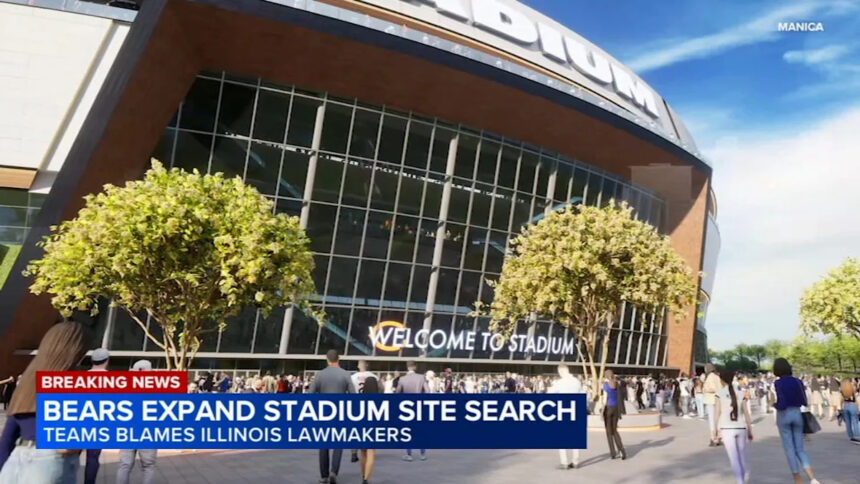
Chicago Bears Expand Stadium Search: From Arlington Heights to Chicagoland & NW Indiana
In a stunning shift that sends tremors through the worlds of sports, politics, and real estate, the Chicago Bears have officially broadened their hunt for a new stadium home. Team President and CEO Kevin Warren declared in a pointed open letter Wednesday that the organization is now looking beyond the long-presumed site of the shuttered Arlington Park racetrack to the wider Chicagoland region—including Northwest Indiana. This strategic pivot is not born of ambition, but of frustration, marking a critical juncture in a decades-long stadium saga and placing immense pressure on Illinois lawmakers to reconsider their stance or risk losing the state’s oldest franchise across state lines.
The Arlington Heights Impasse: A Deal Stalled by Taxes and Politics
For years, the narrative was clear: the Bears were destined for Arlington Heights. The team’s $197.2 million purchase of the 326-acre Arlington International Racecourse property in 2023 was a monumental statement of intent. Plans for a transformative, mixed-use stadium district promised economic revitalization for the northwest suburb. However, beneath the surface, a fundamental dispute festered: property tax certainty.
The Bears have consistently argued that to secure the massive private financing required to build a state-of-the-art stadium, they need predictable, reasonable property taxes on the undeveloped land. They contend that the current assessment, based on the property’s potential future value rather than its current state as a vacant lot, is prohibitive. Warren’s letter pulls no punches, stating that despite years of effort, the team has been unable to secure the necessary cooperation from Illinois lawmakers. The message from Springfield, according to Warren, was unequivocal: “We have been told directly by State leadership, our project will not be a priority in 2026.”
This political stalemate has forced the Bears’ hand. The infrastructure needs—roads, sewers, utilities—surrounding a massive development were always part of a hoped-for public-private partnership. With that partnership failing to materialize, the team is exploring its options, turning a once-exclusive courtship into an open search.
Northwest Indiana Enters the Chat: A Viable Contender?
The explicit mention of Northwest Indiana is the bombshell within the announcement. Cities like Hammond, Gary, or Whiting suddenly emerge as potential dark horse candidates. The appeal for the Bears is multifaceted:
- Tax Environment: Indiana generally boasts lower property taxes and a business-friendly government that might aggressively court a major NFL tenant.
- Geographic Reach: A stadium in NW Indiana remains within the core Chicago media market and is accessible to a massive swath of the existing fanbase, potentially drawing from South Side Chicago and south suburban Illinois.
- Available Land: The region has ample, less expensive tracts of land near major interstates and rail lines, possibly allowing for an even larger ancillary development.
However, significant hurdles exist. The symbolic weight of moving the “Chicago” Bears out of Illinois would be colossal, potentially fracturing the team’s identity and political goodwill. Traffic patterns, while already a challenge for Arlington Heights, would be reconfigured in a completely new way, and the perception of safety and convenience would be under intense scrutiny. Yet, for a team seeking leverage and a viable path to shovels in the ground, Indiana represents a powerful and credible alternative.
Expert Analysis: Leverage Play or Genuine Pivot?
Sports economists and stadium experts are divided on the immediate interpretation of Warren’s move. Is this a masterful negotiation leverage play to galvanize Illinois action, or a sincere acknowledgment that the Arlington dream is dying?
“The Bears have played this with remarkable patience,” notes Dr. Marc Ganis, a sports business consultant familiar with NFL projects. “Warren’s letter is carefully worded to express genuine frustration while leaving the door open. By saying ‘this is not about leverage,’ he’s actually amplifying the leverage. He’s telling Springfield, ‘We’re past bluffing. We have to have a Plan B, and we’re now actively building it.’”
The timing is also critical. With state legislatures planning their budgets years in advance, the 2026 dismissal signals a long roadblock. Kevin Warren, hailed for his role in building U.S. Bank Stadium in Minneapolis, was brought in to execute a project. His reputation is tied to delivering a new stadium, not just negotiating for one. This expansion of the search feels like the pragmatic move of an executive determined to find a solution, not just win a point.
Furthermore, the NFL is watching. The league prefers stability but ultimately supports franchises securing the most advantageous stadium deals possible. A move within the same media market, while rare, is not unprecedented. The potential for a lakefront-style district in Indiana could be enticing from a league perspective.
Predictions and Ramifications for Chicago and Illinois
The coming months will define the future of the Chicago Bears for the next half-century. Several scenarios are now in play:
- Scenario 1: The Wake-Up Call: Illinois lawmakers, facing public pressure and the stark reality of losing a cultural institution, broker a last-minute deal for Arlington Heights. This remains the cleanest, most popular solution for the majority of fans.
- Scenario 2: The Chicago Hail Mary: Mayor Brandon Johnson’s administration re-enters the fray, potentially reviving concepts for a renovated Soldier Field or a new domed stadium on the Museum Campus or elsewhere in the city limits, funded by a complex web of tourism taxes.
- Scenario 3: The Cross-Border Move: The Bears secure a transformative package from Indiana, leading to a groundbreaking for “Chicago Bears Place” in a city like Hammond. This would be a political nightmare for Illinois governors present and future.
The ramifications are profound. For Chicago, losing the Bears to the suburbs was one thing; losing them to another state would be an indelible stain. The economic impact, while often debated, involves thousands of construction jobs, permanent hospitality roles, and regional prestige. For the Bears, a modern stadium with a roof is key to hosting Super Bowls, Final Fours, and year-round concert revenue—financial streams essential to competing in the modern NFL.
Conclusion: A Franchise at a Crossroads
Kevin Warren’s open letter is more than a press release; it is a watershed document. The Chicago Bears’ stadium pursuit has officially escalated from a local zoning issue to a multi-state, high-stakes political and economic battle. The team’s expansion of its search to the wider Chicagoland area and Northwest Indiana is a clear signal that the era of assuming the Bears’ future lies solely in Arlington Heights is over.
This move creates a tangible timeline and a palpable sense of consequence. The Bears have laid their cards on the table, revealing a hand that now includes a potential exit from Illinois. The pressure now shifts squarely to the political leadership in Springfield and Chicago City Hall. Will they rise to the occasion with a feasible, collaborative plan, or will they watch as a century-old piece of Illinois’ cultural fabric prepares to potentially plant its flag elsewhere? The search is on, and the clock is ticking louder than ever.
Source: Based on news from Yahoo Sports.