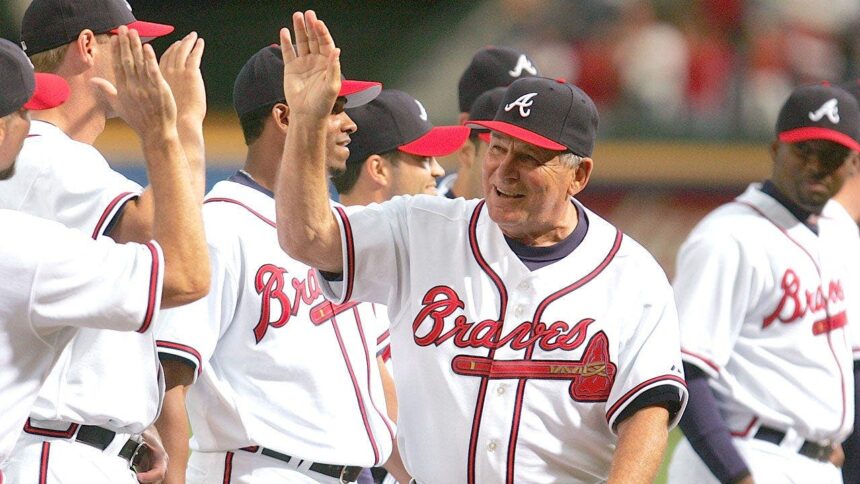
Bobby Cox Dead at 84: Remembering the Hall of Fame Manager Who Defined the Atlanta Braves Dynasty
The baseball world is mourning the loss of a true giant. Bobby Cox, the Hall of Fame manager who orchestrated the Atlanta Braves’ incredible run of 14 consecutive division titles and led them to a World Series championship in 1995, has died at the age of 84. The Braves confirmed the news on Saturday, sending a shockwave through the sport that reveres him as one of the greatest skippers in history.
As a sports journalist who has covered the game for decades, I can tell you this: Bobby Cox wasn’t just a manager; he was the architect of a dynasty. His passing marks the end of an era for the Braves franchise and for Major League Baseball as a whole. In a sport increasingly defined by analytics and front-office control, Cox represented the old-school art of managing men, building a culture, and winning with grace.
For the latest updates on this breaking story, check out the Fox News Flash top sports headlines right here on FoxNews.com. But for now, let’s dive deep into the legacy of the man who made Atlanta a baseball capital.
The Hall of Fame Legacy: More Than Just a World Series Ring
The Braves’ official statement called Cox the “best manager to ever wear a Braves uniform,” and that’s not hyperbole. His managerial legacy will never be matched. But what made him so special? It wasn’t just the 1995 World Series title, though that was the crown jewel. It was the sustained excellence.
Consider these facts that define his career:
- 2,504 career wins – fourth all-time in MLB history.
- 14 consecutive division titles (1991-2005) – a record that may never be broken.
- 1 World Series championship (1995) and five National League pennants.
- Inducted into the Baseball Hall of Fame in 2014 – the sport’s ultimate prize.
But numbers only tell part of the story. Cox’s genius was his ability to handle a clubhouse. He managed the Braves during the golden era of pitching—with Hall of Famers like Greg Maddux, Tom Glavine, and John Smoltz. Yet, he never let egos derail the mission. He was a player’s manager, fiercely loyal, and incredibly protective. He would take an ejection (and he had plenty—he’s fourth all-time in that category, too) to fire up his team, but he never threw his players under the bus.
As the Braves put it, “His wealth of knowledge on player development and the intricacies of managing the game were rewarded with the sport’s ultimate prize in 2014 – enshrinement into the Baseball Hall of Fame.” That enshrinement was a validation of a career spent building winners from the ground up.
Expert Analysis: How Bobby Cox Revolutionized the Modern Manager Role
From a tactical perspective, Cox was ahead of his time. In the 1990s, when power hitters and steroid-era slugging dominated headlines, Cox built his Braves on pitching and defense. He was one of the first managers to fully embrace a deep, specialized bullpen, using a closer (Mark Wohlers, then John Rocker, then John Smoltz) in a defined role. He also understood the value of platoon splits and defensive positioning long before the analytics boom.
But his true mastery was in player development. Cox managed the Braves farm system before taking the big-league job, and he never forgot that. He cultivated a pipeline of homegrown talent—Chipper Jones, Andruw Jones, Javy Lopez, and David Justice—that became the core of the dynasty. He knew when to trust a rookie and when to push a veteran. That balance is rare.
Prediction: As the next generation of managers takes over, we will see a resurgence of the “Cox model.” Young skippers like the Braves’ own Brian Snitker (a Cox protégé) or the Dodgers’ Dave Roberts will be studied for their ability to foster clubhouse chemistry while making in-game decisions. Cox proved that you don’t need to be a tyrant to win—you need to be consistent, fair, and prepared. Expect a wave of managerial hires in the coming years who cite Cox as their primary influence.
His impact on the city of Atlanta cannot be overstated. Before Cox arrived, the Braves were a middling franchise in a football-crazed town. He turned them into a national brand. The “Chop” became iconic. The 1995 World Series parade through downtown Atlanta was a celebration of a city that had finally arrived on the national sports stage.
The Human Side: Why Players Loved Bobby Cox
To truly understand Bobby Cox, you have to listen to the players who played for him. Chipper Jones, the Hall of Fame third baseman, often said Cox was like a second father. Greg Maddux credited Cox with giving him the freedom to pitch his own game. John Smoltz called him the best leader he ever had.
Why the universal love? Because Cox treated every player with respect, from the superstar to the 25th man on the roster. He never showed up a player in the media. He took the heat for losses. He was famously calm in the dugout, rarely showing emotion unless he was arguing with an umpire. That consistency created an environment where players could relax and perform.
One story sums it up: After a tough loss in the 1996 World Series, Cox didn’t scream or blame. He simply told his team, “We’ll get them tomorrow.” That quiet confidence was infectious. It’s why the Braves won 14 straight division titles—a streak that will likely never be equaled in the modern era of revenue sharing and free agency.
The Braves’ statement captured this perfectly: “Bobby was a favorite among all in the baseball community, especially those who played for him.” That’s the highest compliment a manager can receive.
Strong Conclusion: A Legend Who Defined an Era
Bobby Cox is gone at 84, but his legacy is eternal. He leaves behind a franchise that is still reaping the rewards of his leadership. The Braves won the World Series again in 2021, and you can bet that the culture of belief and resilience Cox instilled was a foundational part of that championship.
When you think of the Atlanta Braves, you think of the tomahawk chop, the pitching staff, and the 1995 title. But above all, you think of Bobby Cox. He was the steady hand, the brilliant strategist, and the beloved leader who made it all possible.
As the baseball community gathers to pay tribute, we are reminded that the game is better because of him. He taught us that winning with class is the only way to win. Rest in peace, Skipper. You earned it.
For more on this story and other breaking sports news, CLICK HERE FOR MORE SPORTS COVERAGE ON FOXNEWS.COM.
Source: Based on news from Fox Sports.