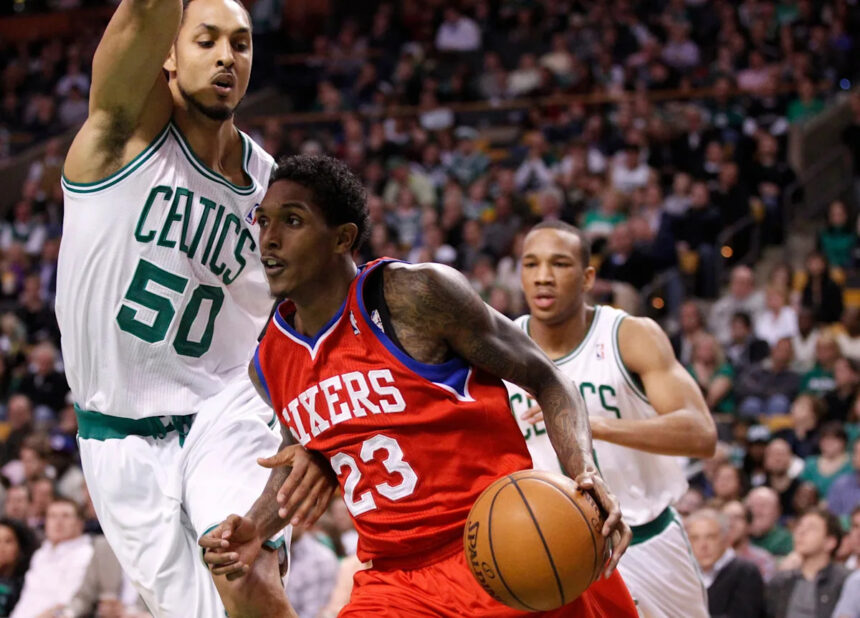
The Unlikely Legacy of No. 50: Ryan Hollins and the Boston Celtics Jersey History
In the storied annals of the Boston Celtics, a franchise defined by its 17 championship banners and 25 retired jerseys, history is often measured in dynasties and legends. From the parquet floorboards worn by Russell and Cousy to the modern brilliance of Pierce and Tatum, the Celtics’ narrative is one of basketball royalty. Yet, the true tapestry of a team is woven not just by its stars, but by every thread that contributes to the whole. This is the story of those threads—the jersey numbers worn by over 500 players. With 68 different numbers donned since the franchise’s BAA beginnings, each carries a unique lineage. Today, we focus on one of the most transient, yet emblematic, numbers in Celtics lore: No. 50, and the brief but distinct chapter written by big man Ryan Hollins during the 2012 season.
The Road Less Traveled to Boston
Ryan Hollins’ path to the Celtics was a quintessential NBA journey of resilience and adaptation. A lithe 7-footer out of UCLA, Hollins was selected with the 50th overall pick in the 2006 NBA Draft by the Charlotte Bobcats—a poetic foreshadowing of the number he would later wear in Boston. His early career was defined by movement: from Charlotte to Dallas, then to Minnesota where he had a career-best stint, and on to Cleveland. By the time the Celtics came calling in March of 2012, Hollins was a seasoned veteran known for his length, athleticism, and energy off the bench.
The Celtics of that era were in a fascinating transition. The “Big Three” era of Pierce, Garnett, and Allen was reaching its final, gritty stages. The team was built on defensive identity and veteran savvy, needing capable bodies to spell an aging frontcourt. In Hollins, they saw a player who could provide defensive minutes, set solid screens, and finish above the rim in limited action. His signing was a tactical move for a team eyeing another deep playoff run, a classic “Danny Ainge special” seeking undervalued utility.
Hollins in Green: A Season in the Shadows
Ryan Hollins’ tenure with the Celtics was brief—just 15 regular season games and 8 playoff appearances—but it occurred during one of the franchise’s most dramatic modern playoff pushes. He debuted on March 23, 2012, and instantly became part of the Celtics’ formidable second-unit defense. While his stat line was modest (2.8 points, 1.9 rebounds in 11.6 minutes per game), his impact was in the nuances.
- Defensive Versatility: Hollins’ 7-foot-2 wingspan allowed him to contest shots and switch onto multiple positions, a key asset in Coach Doc Rivers’ defensive schemes.
- Playoff Role Player: In the 2012 playoffs, which included epic battles against the Atlanta Hawks and Philadelphia 76ers and a grueling 7-game Eastern Conference Finals against the Miami Heat, Hollins was called upon to provide energy and fouls against opposing bigs. He was a body to throw at the likes of Al Horford and Chris Bosh.
- The Ultimate Teammate: Known for his positive demeanor and high motor, Hollins embraced the Celtics’ culture of accountability and sacrifice, fitting seamlessly into a locker room of strong personalities.
His most memorable moment in green likely came in Game 3 of the Eastern Conference Finals against Miami. With the Celtics needing a spark, Hollins played 12 intense minutes, grabbing 4 rebounds and providing a physical presence that helped Boston secure a crucial victory. It was a snapshot of his value: doing the unglamorous work that championship-contending teams require.
No. 50 in Celtics History: A Number of Journeymen
To understand Ryan Hollins’ place, one must look at the legacy of the number he wore. No. 50 is not one of the Celtics’ fabled numbers. It is a digit of transience, worn by only nine players in franchise history. Before Hollins, it was most notably worn by another towering center, Mark Blount, for parts of five seasons in the early 2000s. After Hollins, it would be worn by players like Tyler Zeller and, most recently, Luke Kornet.
This number represents a specific archetype in NBA and Celtics history: the backup center. These are the players who provide minutes, size, and often a specific skill set without the expectation of star production. They are essential cogs, the players who allow the stars to rest and who execute specific game plans. Ryan Hollins, in his short stint, perfectly embodied this spirit for the 2012 Celtics. He wore No. 50 not as a franchise cornerstone, but as a role-playing specialist, a piece acquired for a precise need during a championship window.
Analysis: The Value of the Ephemeral Celtic
From a historical and analytical standpoint, players like Ryan Hollins are critical to understanding team building. The Celtics’ legacy is built on the pillars of Russell, Bird, and Havelick, but it is cemented by the James Poseys, the Eddie Houses, the P.J. Browns—and yes, the Ryan Hollins. These players fill the gaps, absorb physical punishment in the playoffs, and allow the system to function.
Hollins’ game had clear limitations—he was not a prolific scorer or rebounder—but his athletic profile and defensive effort were exactly what that particular Celtics team needed. In the analytics-driven modern NBA, we might call him a “low-usage, high-energy rim-runner.” In 2012, he was simply a pro doing his job. His departure in the 2012 offseason to the Los Angeles Clippers was a predictable part of the NBA’s transactional cycle, especially for a team like Boston that was constantly retooling on the margins.
Conclusion: A Lasting Imprint on a Fabled Legacy
The history of the Boston Celtics is a mosaic. The retired numbers are the brilliant, central pieces that draw the eye. But the full picture only emerges when you appreciate the surrounding tiles—the varied hues and textures of players like Ryan Hollins. His time in Boston was a footnote in a career that spanned 9 seasons and 8 teams, and a blip in a franchise timeline measured in decades. Yet, for those 15 regular season and 8 playoff games in 2012, he was a Celtic. He contributed to a team that came within one game of the NBA Finals, battling LeBron James’ Heat in a classic series.
Ryan Hollins’ chapter in the No. 50 jersey is a testament to the depth of Celtics history. It reminds us that every number, even those far from the rafters, has a story. It’s a story of adaptation, specific utility, and the universal pursuit of fitting into something greater than oneself. In the endless chronicle of Celtics jersey numbers, the story of No. 50 and Ryan Hollins is not one of glory, but of grit—a perfectly valid and essential strand in the green and white cord that binds the past to the present.
Source: Based on news from Yahoo Sports.