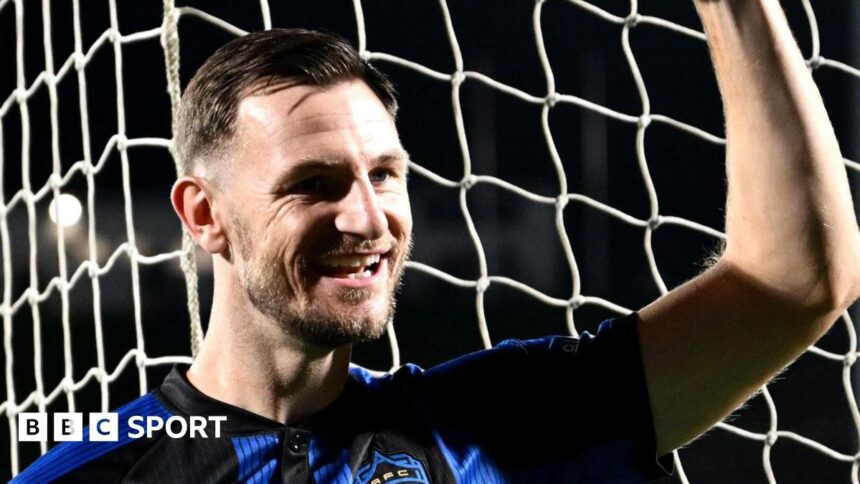
Braintree’s Tommy Smith Defies Gravity: Veteran Defender Named in New Zealand’s 2026 World Cup Squad
In a story that reads more like a Hollywood script than a football transfer window, 36-year-old Braintree Town defender Tommy Smith has been named in New Zealand’s 23-man squad for the 2026 FIFA World Cup. The call-up, announced early Tuesday morning, sees Smith join Premier League striker Chris Wood as the first New Zealanders in history to feature at two men’s World Cups. For a player who last represented his country in 2024—and who this season suffered relegation with Braintree from the National League—this selection is nothing short of miraculous.
The All Whites’ squad announcement sent shockwaves through the football world, not because of the quality of the squad, but because of the sheer improbability of Smith’s return. Sixteen years after starting all three group matches at the 2010 World Cup in South Africa, the veteran centre-half is back. And this time, he brings with him a story of resilience, a Premier’s Plate winner’s medal from Auckland FC, and a career arc that defies every conventional metric of modern football.
From Braintree Relegation to World Cup Stage: The Tommy Smith Paradox
To understand the magnitude of this selection, one must first appreciate the context. Braintree Town, Smith’s current club, were relegated from the National League this season. The Iron finished 23rd, conceding 78 goals in 46 games. Smith, the defensive anchor, played 38 of those matches. On paper, it is not the résumé of a World Cup defender. Yet New Zealand head coach Darren Bazeley saw something the numbers could not capture: leadership, experience, and an unbreakable bond with the international stage.
Smith’s journey is a study in contrasts. While his club form at Braintree was inconsistent—the team’s defensive record was the third-worst in the division—his performances for the All Whites in recent friendlies have been composed and authoritative. He has not played a competitive international since 2024, but Bazeley has consistently maintained that Smith’s “football IQ and positional discipline” are irreplaceable assets in a tournament setting.
“Tommy brings a calmness that you cannot coach,” Bazeley said in the squad announcement. “He has been in the fire before. He knows what it takes to defend for 90 minutes against world-class attackers. And he has the respect of every player in that dressing room.”
That respect was earned partly through Smith’s remarkable 2023-24 season with Auckland FC, where he won the Premier’s Plate—the trophy awarded to the A-League Men’s regular-season champions. That campaign, Smith was a pillar at the back, starting 27 matches and helping Auckland post the league’s best defensive record. It was that form, not his Braintree struggles, that convinced Bazeley to keep him in the international picture.
Chris Wood and Tommy Smith: A History-Making Duo
The headline statistic from this squad announcement is undeniable: Smith and Chris Wood (34) will become the first New Zealanders to play at two men’s World Cups. Both were part of the 2010 squad that famously held Italy to a 1-1 draw but failed to progress from the group stage. Wood was a raw 18-year-old striker then, still at West Bromwich Albion. Smith was a 22-year-old prodigy at Ipswich Town, earmarked for a big move that never quite materialized.
Now, 16 years later, they are the elder statesmen of a squad that blends youthful exuberance with tested experience. Wood, of course, remains New Zealand’s all-time leading scorer and a Premier League regular with Nottingham Forest. His inclusion was never in doubt. But Smith’s presence alongside him is the subplot that has captured the imagination.
“To share this moment with Chris is special,” Smith said in a brief statement. “We were kids in South Africa. We didn’t know if we’d ever get back. Now we’re the old men of the group. But we’ve got something to prove.”
The duo’s combined age—70 years—makes them the oldest outfield pairing in the squad. But Bazeley insists that age is an asset, not a liability. “In a World Cup, you need players who have seen it all. Tommy and Chris have seen everything. They will be our compass on the pitch.”
Expert Analysis: What Smith Brings to the All Whites’ Defense
From a tactical perspective, Smith’s selection is a calculated gamble. At 36, his pace has eroded. In the National League this season, he was consistently beaten by younger, quicker forwards. Against the likes of Kylian Mbappé (France), Vinícius Júnior (Brazil), or Bukayo Saka (England), a one-on-one sprint could be catastrophic.
However, World Cup football is not a track meet. It is a chess match played at high speed. Smith excels in the areas that matter most in tournament football: positional awareness, aerial dominance, and communication. He reads the game two or three passes ahead. He organizes the backline with the authority of a player who has captained at every level. And he is still a formidable presence in the box, winning 72% of his aerial duels in the National League last season.
Bazeley’s system is likely to deploy a low block with two holding midfielders, protecting Smith and his likely central defensive partner, Michael Boxall (Minnesota United). This setup minimizes the need for recovery pace and maximizes Smith’s ability to intercept and clear danger. It is the same formula that worked for Greece in 2004 and Costa Rica in 2014: absorb pressure, stay compact, and strike on the counter.
- Key Strength: Leadership – Smith has captained New Zealand in 14 of his 48 caps. He is the vocal anchor.
- Key Weakness: Recovery Speed – Against elite wingers, he will need support from full-backs and defensive midfielders.
- Key Asset: Set Pieces – Smith scored three goals from corners in the 2023-24 A-League season. He remains a threat.
Former New Zealand captain Ryan Nelsen (a Premier League legend with Blackburn Rovers and Tottenham) weighed in on the selection: “Tommy is one of the most intelligent defenders I’ve ever seen. He doesn’t need to be the fastest because he is never out of position. For a team that will spend most of its time defending in a World Cup, he is the perfect choice.”
Predictions: Can the All Whites Finally Escape the Group Stage?
New Zealand have never advanced past the group stage at a men’s World Cup. In 2010, they went undefeated (three draws) but finished third in a group that included Italy, Paraguay, and Slovakia. In 1982, they lost all three matches. This time, the draw—which will be confirmed in December—will determine their fate. But early projections place them in Pot 4, meaning they will face at least two heavyweights.
If Smith and Wood can replicate their 2010 form—defensive solidity and a clinical moment up front—the All Whites have a genuine chance. The squad is deeper than it was 16 years ago. Players like Liberato Cacace (Empoli), Joe Bell (Vikingur Reykjavik), and Ben Waine (Plymouth Argyle) provide quality in key positions. But the spine remains Smith and Wood.
Prediction: New Zealand will finish third in their group. They will earn one point—likely a draw against a lower-ranked European or African side—but will fall short of the knockout stages. However, Smith will start all three matches, and his performance will be praised as “vintage.” He will retire from international football after the tournament, having cemented his legacy as one of New Zealand’s greatest defenders.
Conclusion: A Story of Grit, Loyalty, and Second Chances
The narrative of Tommy Smith is not one of unbroken glory. It is a story of a player who fell from the Championship to the National League, who suffered relegation while his contemporaries played in the Premier League, and who was written off by pundits and fans alike. Yet when the call came from New Zealand, he answered. Not as a nostalgic gesture, but as a proven leader.
Braintree Town may be heading down to the National League South, but their captain is heading to the World Cup. That paradox is what makes football the most beautiful, unpredictable sport on the planet. Smith’s journey reminds us that form is temporary, but class—and the will to fight for your country—is permanent.
When the All Whites step onto the pitch in 2026, Tommy Smith will be there. Not as a relic of the past, but as a warrior for the present. And if he manages to keep a clean sheet against a global superstar, the story will be told for generations: the Braintree defender who refused to let his dream die.
Source: Based on news from BBC Sport.