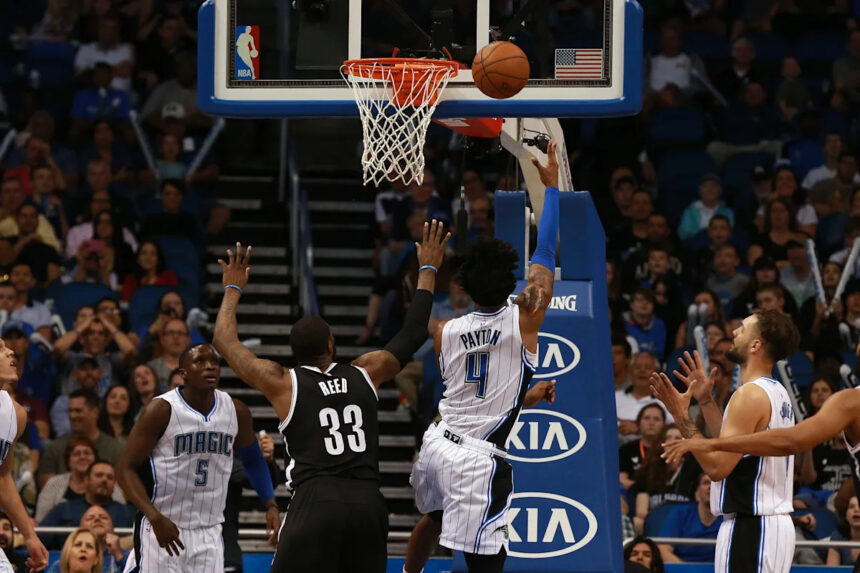
The Odyssey of No. 33: Willie Reed’s Fleeting, Fiery Moment with the Brooklyn Nets
In the sprawling, interconnected tapestry of the Brooklyn Nets franchise—a history that spans an ABA birth as the New Jersey Americans, triumphant Long Island eras, and a bold modern rebirth—some jersey numbers echo with the legacies of legends. Others whisper tales of the transient, players whose tenures were brief but whose stories are woven into the fabric of the team’s identity. The No. 33 jersey, worn by 22 different men in team annals, sits uniquely at this crossroads. It’s a number that carries the weight of a Hall of Famer in Alonzo Mourning and the unfulfilled potential of a phenom in Ben Simmons. But nestled between these seismic bookends is a chapter of pure, unadulterated hustle: the 2015-16 season of big man Willie Reed, a testament to perseverance and the raw, grinding reality of an NBA dream.
From Undrafted Obscurity to Brooklyn’s Blue-Collar Beacon
Willie Reed’s path to the Barclays Center was anything but linear. A standout at Saint Louis University, his collegiate career ended in a cloud of suspension, leading him to go unselected in the 2011 NBA Draft. What followed was a global basketball odyssey: the NBA D-League (now G League), a stint in the Dominican Republic, a season in Hungary, and a summer league invitation here and there. For four long years, Reed honed his craft in the shadows, his NBA dream sustained by sheer force of will and a relentless motor. When the Brooklyn Nets, then under the guidance of general manager Billy King and head coach Lionel Hollins, offered him a partially guaranteed deal in September 2015, it wasn’t a coronation; it was a final, desperate foothold.
Reed seized it. On a Nets roster caught between a win-now mentality built around Brook Lopez, Thaddeus Young, and Joe Johnson, and a bleak future devoid of draft capital, Reed carved out a role as an energy specialist. He was not a focal point of the offense, but he became a fan favorite for his unmistakable, all-out style of play. His game was built on a foundation of:
- Ferocious offensive rebounding and relentless put-back attempts.
- Protective rim presence as a shot-blocking threat off the bench.
- High-percentage finishing, leading the team in field goal percentage (56.8%) among players with significant minutes.
- Unmatched physical energy that often ignited the team and the home crowd during sluggish performances.
In just 10.9 minutes per game across 39 appearances, Reed averaged 4.7 points and 3.1 rebounds. The numbers were modest, but his impact was visceral. He played with a palpable hunger that resonated in Brooklyn, a borough that has always celebrated grit and determination.
Expert Analysis: Reed’s Role in a Franchise at a Crossroads
To understand Willie Reed’s season fully, one must contextualize the 2015-16 Nets. The team was a middling, 21-win squad, hampered by the infamous 2013 trade that had bled its future dry. The atmosphere was one of stagnation, not rebuilding. In this environment, a player like Reed was more than a deep-bench big; he was a symbol of alternative value creation.
From a tactical standpoint, Reed provided a different look behind the skilled, ground-bound Brook Lopez. Where Lopez was a finesse scorer and defensive anchor, Reed was pure verticality and chaos. His ability to switch defensively and protect the rim in short bursts was a useful tool for Hollins. Analytically, his per-36-minute stats—a robust 15.5 points, 10.2 rebounds, and 2.3 blocks—highlighted the productivity he packed into his limited opportunities. He wasn’t a star, but he was an exceptionally efficient role player whose skill set was perfectly suited for a specific, high-energy niche.
Most importantly, Reed represented the undrafted success story that front offices dream of finding. In a period where the Nets had little draft capital to infuse young talent, mining the G League and international circuits for contributors like Reed was essential. His tenure, though brief, was a successful proof of concept for the Nets’ developmental staff, demonstrating an ability to identify and cultivate raw talent that had been overlooked elsewhere.
The No. 33 Legacy: A Jersey of Contrasts and Unfinished Business
Placing Willie Reed within the lineage of Nets No. 33 is to examine a jersey number defined by extremes. He exists in the long shadow of Alonzo Mourning, who wore it with distinction during parts of the 2003-04 and 2004-05 seasons, bringing a legendary intensity and Hall-of-Fame pedigree to the swamp. Conversely, Reed’s story directly contrasts with the current occupant, Ben Simmons, whose tenure in No. 33 has been marked by immense expectation, injury, and offensive struggle.
Reed’s chapter is the pure, uncomplicated middle ground. He had zero expectation and maximized every ounce of his opportunity. His legacy with the number isn’t about statistics or longevity; it’s about the embodiment of the grind. He wore the same digits as a legend, but he represented the dream of every player fighting for a tenth roster spot, for a two-way contract, for just one more day in the league. In the numerical history of the franchise, Reed’s No. 33 is a badge of honorable, blue-collar service.
Prediction: The Lasting Impact of the “Willie Reed Archetype”
While Willie Reed’s Nets career ended after that single season—he parlayed his performance into a two-year deal with the Miami Heat, a classic case of a player performing well enough on a struggling team to earn a contract elsewhere—his impact on the franchise’s philosophy can be seen in hindsight.
The Nets’ subsequent front office regimes, particularly under Sean Marks, have heavily prioritized finding and developing undervalued talent, albeit often with higher-upside, skilled players than Reed. The focus on the G League, with the Long Island Nets as a true developmental arm, and the willingness to give chances to international players or those with unconventional paths, echoes the kind of scouting that identified Reed. The prediction here is that the archetype of the high-motor, culture-setting hustle player will remain a perpetual target for Brooklyn, especially as they cycle through competitive cycles. Players like Reed may not be stars, but they are essential glue guys who can change the energy of a game and a locker room. In the modern NBA, where roster construction is as much about chemistry as it is about talent, the value of a “Willie Reed season” is more understood and sought after than ever.
Conclusion: A Permanent Footnote of Passion
The Brooklyn Nets’ jersey history is a novel with 52 distinct subplots, each number a thread connecting decades and dynasties, obscurity and fame. Willie Reed’s ownership of No. 33 for the 2015-16 season is a short, powerful paragraph in that ongoing story. He was not a franchise-altering talent, but his journey from the hinterlands of professional basketball to the NBA hardwood is the essence of sports perseverance. In a forgettable season for the franchise, Reed provided memorable moments of pure effort. He reminds us that a jersey number is more than a digit; it’s a vessel for the dreams, struggles, and triumphs of every individual who wears it. Willie Reed’s No. 33, though worn for just a blink in franchise history, will forever represent the undeniable truth that in Brooklyn, heart and hustle earn a permanent place in the legacy.
Source: Based on news from Yahoo Sports.