Cameron Boozer Reveals Facial Fractures Suffered in Duke’s Elite Eight Battle with UConn
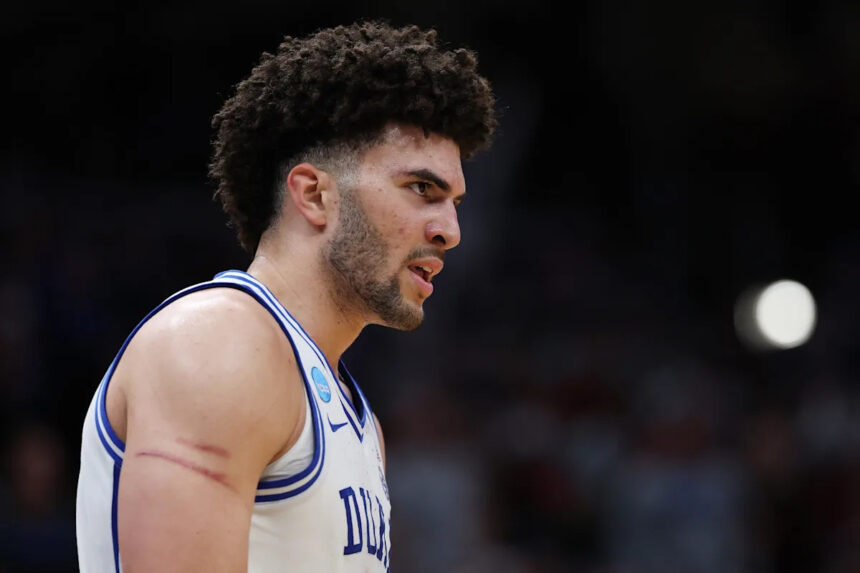
In a stunning revelation that casts Duke’s season-ending loss in a new light, Blue Devils superstar Cameron Boozer disclosed he played through multiple facial fractures during the NCAA Tournament. The news came not from a team press release or a post-game interview, but as Boozer stood at a podium on Sunday, accepting the highest individual honors in college basketball: The Associated Press and USBWA National Player of the Year awards. With the awards season spotlight shining brightly, Boozer offered a glimpse into the private pain he endured during his final collegiate game, showcasing a toughness that matches his transcendent talent.
A Champion’s Pain: The Injury Revealed in a Moment of Triumph
The scene was meant to be a pure celebration of a phenomenal sophomore season. Instead, Cameron Boozer turned it into a testament to his resilience. “I have a couple of fractures, but I’m all good,” Boozer stated matter-of-factly, shifting the narrative from individual accolade to team sacrifice. He indicated the injuries were around his left eye and occurred seemingly in the first half of Duke’s Elite Eight showdown with the eventual national champion UConn Huskies.
This disclosure answers unspoken questions from that fateful game. While Boozer’s stat line—17 points and 8 rebounds—was solid, those who watched closely might have sensed a slight deviation from his normally dominant, fluid self. The Huskies’ formidable defense, known for its physicality, now has a documented casualty. Boozer’s ability to not only stay in the game but to remain productive against the nation’s best team while dealing with such a painful injury instantly becomes part of his burgeoning legend at Duke.
Decoding the Impact: How the Injury Altered a Championship Quest
Expert analysis of the Elite Eight contest now requires a significant recalibration. Playing with fractures around the eye socket is not a minor inconvenience; it affects depth perception, peripheral vision, and can cause disorienting pain with every jolt or impact. For a player whose game is built on precision, footwork, and basketball IQ, these are critical impairments.
Consider the context of the game:
- UConn’s defensive strategy is designed to overwhelm and physically punish opponents. Operating within that storm with a fresh injury required immense mental fortitude.
- Boozer’s shooting efficiency, a hallmark of his game, was undoubtedly challenged. The subtle alignment of a jump shot can be thrown off by pain and compromised vision.
- His defensive communication and awareness, key for Duke’s switch-heavy scheme, were likely hindered, potentially explaining some of UConn’s effective offensive stretches.
This is not to make excuses for the loss—UConn was the better team—but to highlight the extraordinary circumstances. Boozer’s performance, in retrospect, shifts from a very good game to a remarkably gutsy one. It underscores the “next play” mentality head coach Jon Scheyer instills, but it also raises a poignant “what if” for Duke’s championship aspirations.
Looking Ahead: NBA Draft Implications and Recovery Timeline
With the college chapter closed, all eyes turn to the NBA Draft, where Cameron Boozer is universally projected as a top-three pick. The immediate question from front offices will concern his health. Fortunately, facial fractures, while painful, are typically clean injuries with straightforward recovery paths.
Key points for NBA scouts and GMs:
- The injury is not related to his legs, knees, or back—a major positive for his long-term athletic projection.
- Modern medicine allows for excellent healing of such fractures without lasting structural issues.
- His decision to play through it demonstrates a competitive toughness and loyalty that teams covet, but also a maturity in now prioritizing the healing process.
Boozer is expected to be fully cleared for all pre-draft workouts and the NBA Summer League. If anything, this episode provides NBA teams with a new, valuable data point on his character. They aren’t just drafting a skilled 6’9” forward with a polished offensive game; they are drafting a competitor who refused to let his team down on the sport’s biggest stage.
The Legacy of a Warrior: Beyond the Awards and the Injury
Cameron Boozer’s Duke tenure, though just two seasons, will be remembered for brilliance and, now, for breathtaking toughness. His comments at the awards ceremony perfectly encapsulated his persona: “It hurt in the game, but I wish the outcome would have been better, but that’s not really what I’m here to focus on. We had a great year. Like I said, it’s an individual award, but I wouldn’t be here without my teammates and my coaches.”
In a moment designed for self-congratulation, he pivoted to team, to the battle, and to the future. This is the mark of a player who understands that legacy is about more than trophies and points per game. It’s about the respect earned in the trenches. By revealing his injury in this setting, Boozer subtly re-centered the story on the collective effort of the season and the shared disappointment of falling short, even as he personally reached the pinnacle of individual achievement.
His NBA future is blindingly bright. He possesses the size, skill, and now proven mettle to become a cornerstone for a franchise. The facial fractures will heal, leaving no visible scar on his game. But the memory of him accepting the sport’s top honors with a broken face will endure. It solidifies his reputation not just as a player of the year, but as a warrior of the year. As he transitions to the professional ranks, Cameron Boozer takes with him the ultimate badge of honor: the willingness to sacrifice everything for the chance at a championship, a quality that forever endears a player to a fanbase and signals to the NBA that he is built for the battles to come.
Source: Based on news from Yahoo Sports.