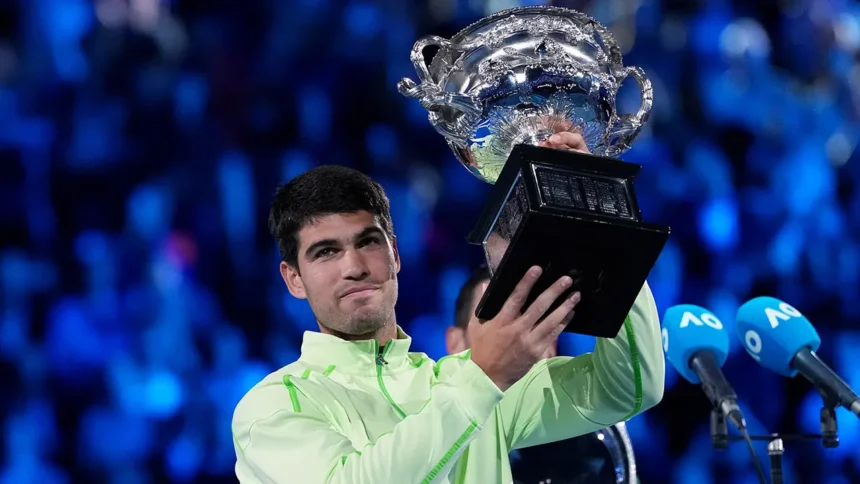
Carlos Alcaraz Etches Name in Immortality, Completes Career Grand Slam with Historic Australian Open Triumph
The torch, long held in a grip of iron, has been passed. In a seismic shift that reverberated through the very foundations of tennis history, Carlos Alcaraz conquered his final frontier, defeating the king of Melbourne Park, Novak Djokovic, 2-6, 6-2, 6-3, 7-5 to claim the 2026 Australian Open title. More than just a trophy, this victory crowns the 22-year-old Spaniard as the youngest male player to complete the career Grand Slam, an achievement that catapults him into a realm occupied only by legends. On a humid Sunday night at Rod Laver Arena, the future, so long prophesied, emphatically arrived.
A Rocky Start and a Resounding Response
For a set and a half, the narrative followed a familiar, daunting script. Djokovic, the 10-time champion here, was a metronome of precision and pressure. He broke Alcaraz’s serve early, suffocating the young Spaniard’s power with impeccable depth and absorbing his pace with unsettling ease. The 6-2 first-set scoreline felt like a statement of enduring sovereignty. The question hung in the air: Was the moment too vast, the opponent too immortal?
Alcaraz’s answer was a thunderous, unequivocal roar. Digging into the physical and psychological reserves that define champions, he began a breathtaking metamorphosis. The key shift was twofold:
- Aggressive Court Positioning: Alcaraz began stepping several feet inside the baseline to receive Djokovic’s second serve, robbing the Serb of time and dictating rallies from the first strike.
- Disruptive Variety: He masterfully blended his paralyzing power with feathery drop shots and net-rushing audacity, breaking Djokovic’s legendary rhythm.
The second set was a 6-2 masterclass in its own right, but in Alcaraz’s favor. The match had not just leveled; it had been fundamentally transformed.
The Moment of Truth: Seizing the Immortal Crown
The third and fourth sets were a showcase of high-stakes tennis at its absolute zenith. Djokovic, as he has done for two decades, raised his level, fighting off break points and unleashing his own breathtaking winners. Yet, Alcaraz, now playing with the liberated energy of a man who had shed his last remaining doubt, matched him shot for shot. The critical juncture came deep in the fourth set, with Djokovic serving at 5-6 to force a tiebreak.
In a breathtaking 12-minute game that will be replayed for generations, Alcaraz summoned the impossible. He saved two game points with fearless, line-painting forehands. On his third championship point, he elicited a final, forced error from Djokovic’s forehand wing. As the ball sailed long, Alcaraz collapsed onto the blue hardcourt, not in exhaustion, but in overwhelmed disbelief. The Australian Open, the one major that had eluded him, the one where he’d never passed the quarters, was his. The career Grand Slam was complete.
Expert Analysis: Decoding a Historic Changing of the Guard
This victory transcends a single match. It represents a paradigm shift in men’s tennis. Alcaraz’s triumph is built on a foundation that merges eras.
The Physical Phenomenon: Alcaraz’s explosive speed and power are a product of modern athletic training, but his deployment of it is uniquely intelligent. He uses his physicality not just to hit harder, but to create angles and opportunities that didn’t previously exist in a rally.
The Psychological Breakthrough:
- Overcoming the Djokovic Hurdle in Melbourne: Beating Djokovic here is the ultimate test. Alcaraz didn’t just beat him; he outlasted him mentally in the crucible of the fourth set, a feat few have accomplished.
- Conquering the Slam Mindset: Winning on clay (Roland Garros), grass (Wimbledon), and hard courts (US Open) showed versatility. Winning in Melbourne, under the unique pressure of completing the set, required a different kind of mental fortitude.
The Tactical Evolution: Alcaraz won this match not by out-Djokovic-ing Djokovic, but by being Alcaraz. His willingness to go for broke on big points, to use the drop shot as a weapon against the game’s greatest mover, and to constantly change spin and pace, represents the next evolution of tactical play.
The New Era: Predictions for the Alcaraz Dynasty
With this victory, Carlos Alcaraz doesn’t just join a club; he potentially redefines its future membership. At 22, with all four majors secured, the conversation shifts from potential to legacy.
Chasing the Numbers: The race for total Grand Slam titles is now unequivocally on. Djokovic’s record is the mountain, but Alcaraz has just proven he has the tools for the climb. His age gives him a temporal advantage no previous challenger has possessed in the “Big Three” era.
The Calendar Grand Slam: Holding all four majors at once, the sport’s rarest feat, is now a tangible, immediate goal for 2026. The confidence from this win makes him the favorite at Roland Garros and Wimbledon.
Elevating the Rivalries: This result firmly establishes the Alcaraz-Djokovic rivalry as the central axis of the sport. Furthermore, it raises the stakes for his battles with Jannik Sinner and others, as every match now carries the weight of defining an era.
Conclusion: A Champion Forged in the Fire of Greatness
Carlos Alcaraz’s 2026 Australian Open victory is more than a headline. It is a landmark moment, a historical pivot point witnessed by the world. He did not simply win a match; he completed a quest, overcame a personal hurdle of monumental proportions, and dethroned a legend on his most sacred court. In doing so, he didn’t just make history; he assumed control of tennis’s present and future. The era of wondering “if” he could achieve this is over. The new era, the Alcaraz Era, is now undeniably, thrillingly here. The sporting world watches, in awe, to see what heights this fearless young champion will scale next.
Source: Based on news from Fox Sports.