Carrick’s Manchester United Start is Promising, But Sutton Urges Patience in Judgment
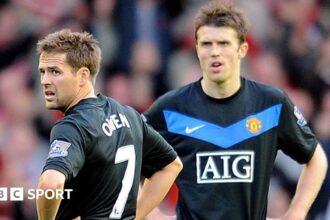
The whirlwind at Manchester United has, for a moment, found a calm eye. Since stepping into the breach following Ole Gunnar Solskjaer’s departure, Michael Carrick has steered the club to a vital Champions League victory over Villarreal and a disciplined, tactical 1-1 draw at Chelsea. The initial fanfare is positive, but as former Premier League striker and pundit Chris Sutton wisely cautions, the true measure of Carrick—or any potential successor—must be taken over a far longer horizon. In the reactive world of football, Sutton’s call for perspective is a necessary intervention.
The Carrick Effect: Stabilising a Listing Ship
Michael Carrick’s brief tenure has been defined by subtle but significant shifts. Gone, for now, is the chaotic, open play that characterized United’s final days under Solskjaer. In its place, a more pragmatic, structured approach has emerged. The draw at Stamford Bridge was a masterclass in defensive organization and tactical discipline, traits that had been sorely lacking.
Key immediate changes under Carrick include:
- A fortified defensive shape, often deploying a double pivot in midfield to protect the back four.
- The bold, but effective, decision to bench Cristiano Ronaldo against Chelsea for greater tactical fluidity without the ball.
- A clear attempt to simplify the game plan, focusing on core principles of shape and transition.
These are not revolutionary ideas, but they are evidence of a clear coaching mind addressing glaring problems. As Sutton acknowledged, it’s been a “brilliant start,” precisely because it has brought instant stability. However, managing a crisis is a different skill set from building a sustained, winning project over months and years.
Sutton’s Sage Advice: The Peril of the “New Manager Bounce”
Chris Sutton’s argument is rooted in the cyclical nature of football management. The “new manager bounce” is a well-documented phenomenon, where a change in voice and a simplification of message leads to an immediate uptick in performance and results. The question is always: what happens when that bounce subsides?
Sutton’s core thesis is that judging Carrick now is like reviewing a book after only the first chapter. The real challenges are yet to come: navigating a relentless fixture schedule, managing a squad with deep-seated inconsistencies, handling the immense pressure that comes with permanent status, and implementing a long-term football philosophy. Can Carrick, with his limited managerial experience, develop a team over a full season? Can he handle the transfer market and squad evolution? These are unanswered questions.
The interim period is a unique bubble. Expectations are temporarily lowered, and every positive result is a bonus. The true test of a Manchester United manager begins when the “interim” tag is removed, and the monumental task of rebuilding the club into a consistent force begins. Carrick deserves credit for his start, but the jury must rightly remain out.
The Bigger Picture: United’s Search is About More Than Results
While Carrick auditions, the Manchester United hierarchy is reportedly conducting a thorough search for a permanent manager. This process must look beyond short-term results. The club’s failures post-Sir Alex Ferguson have often stemmed from a lack of clear, long-term football identity.
The next appointment must be a cultural architect. They need to answer fundamental questions: What is Manchester United’s style of play in the modern era? How does the club develop youth within a superstar squad? How is the transfer strategy aligned with a tactical vision?
Carrick’s current pragmatic approach may be perfect for this moment, but is it the future? United must decide if they want a firefighter or a foreman. Sutton’s commentary implicitly underscores that the qualities needed for each role are vastly different. Judging Carrick on his firefighting skills alone would be a mistake if the job requires a master builder.
Predictions: What Lies Ahead for Carrick and United?
The immediate future holds more tests. The upcoming fixtures will reveal more about Carrick’s adaptability. However, several likely scenarios are emerging:
- Carrick secures the role until season’s end: This seems increasingly probable. If he maintains stability and secures a top-four finish, he will have completed his interim duty flawlessly.
- A permanent external appointment is made: This remains the most likely outcome. Names like Mauricio Pochettino and Erik ten Hag are linked because they offer proven, long-term project experience. Carrick’s stint becomes a valuable, respectable footnote.
- The wildcard: Carrick impresses enough to be considered permanent: This is a longer shot, but not impossible. If he delivers tangible success and demonstrates a compelling vision for the future, the board could be persuaded. This is where Sutton’s “longer period” of judgment becomes critical.
Regardless, Michael Carrick is enhancing his reputation. He is proving he can command a top-level dressing room and set up a team tactically. His future as a manager, whether at United or elsewhere, looks brighter today than it did two weeks ago.
Conclusion: Patience in an Impatient World
Chris Sutton has provided a crucial dose of realism amidst the understandable optimism surrounding Michael Carrick. The former midfielder’s start has been commendable, even impressive. He has restored dignity and structure to a team in disarray. For that, he warrants significant praise.
However, Manchester United’s problems were not created in a few weeks, and they will not be solved in a few weeks. The club’s destiny cannot be decided by a short, post-trauma honeymoon period. The rebuilding job at Old Trafford is a marathon, not a sprint. Judging Michael Carrick on this sprint does a disservice to the immense scale of the marathon ahead—and potentially to Carrick himself, who may or may not be the right man for that grueling distance.
The wisest course, as Sutton advocates, is to allow the picture to develop. Watch how Carrick handles adversity, rotates the squad, and evolves the play over the coming months. The true judgment on Michael Carrick, the manager, will come with time. For now, he is simply doing an excellent job as Manchester United’s trusted caretaker.
Source: Based on news from BBC Sport.