Chargers Clean House: Harbaugh Axes Greg Roman, Mike Devlin After Playoff Flop
The Los Angeles Chargers’ offseason of reckoning has begun with swift, decisive force. Two days after a humiliating 16-3 wild-card playoff loss to the New England Patriots, head coach Jim Harbaugh initiated a major offensive overhaul, firing offensive coordinator Greg Roman and offensive line coach Mike Devlin. The moves signal a clear message from Harbaugh: the stagnation of a talented offense, particularly in the brightest lights, will no longer be tolerated. This isn’t just a tweak; it’s a foundational shift aimed at unlocking the championship potential that has repeatedly been squandered.
The Final Straw: A Playoff Offense That Never Showed Up
For all the regular-season success—back-to-back 11-6 records—the Chargers’ offense developed a debilitating habit of vanishing in January. The wild-card round loss to the Patriots was a microcosm of the issue. Facing a stout but not invincible New England defense, the Chargers’ attack was anemic, managing only a single field goal. This followed a 2023 playoff exit where they scored just 12 points. In two postseason games under Roman, the unit mustered a total of 15 points. The philosophy that powered a physical running game during the season seemed to hit a predictable, unimaginative wall against playoff-caliber competition.
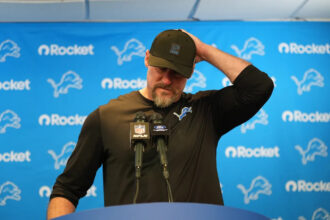
Harbaugh’s post-game press conference was a glaring red flag. When directly asked if Roman was the right person to call plays, Harbaugh notably withheld any vote of confidence. “Right now I don’t have the answers,” Harbaugh stated. “We’re going to look at that, at everything. It really falls on me that we weren’t at our best tonight.” The writing was on the wall. In the NFL, when a head coach “looks at everything” after such a performance, change is almost always imminent.
Analyzing the Fall of Greg Roman’s Chargers Tenure
Greg Roman’s hiring two years ago was hailed as a perfect marriage of philosophy. His reputation as a run-game savant, built on successful stints in San Francisco, Buffalo, and most notably with Lamar Jackson in Baltimore, aligned with Harbaugh’s desire for a physical, imposing identity. Initially, it worked. The Chargers established a potent ground attack, taking pressure off quarterback Justin Herbert. However, the limitations of the system became increasingly apparent.
- Predictability in Critical Moments: Roman’s schemes, while effective for manufacturing yards, often lacked the necessary passing game nuance and in-game adjustment against elite defenses. Play-action became less effective as teams dared the Chargers to win through the air from static sets.
- Underutilization of Justin Herbert’s Arm Talent: While designed to protect Herbert, the offense sometimes felt like a straitjacket for one of the league’s most gifted passers. The intermediate and deep passing game, Herbert’s specialty, was inconsistent and often an afterthought until the team was forced into obvious passing situations.
- Playoff Blueprint for Opponents: Opposing defensive coordinators found a formula: stack the box, challenge the Chargers’ receivers to win one-on-one, and force Herbert to be perfect from the pocket. In both playoff losses, that blueprint was executed flawlessly by the opposition.
The firing suggests Harbaugh believes the offense’s ceiling under Roman had been reached—and that it wasn’t high enough to win a Super Bowl.
The Cascading Effect: Offensive Line Woes and Mike Devlin’s Exit
The dismissal of Mike Devlin is intrinsically linked to Roman’s fate, but also stands on its own merit. An offensive coordinator’s run-centric system is only as good as the line executing it. Despite significant investment in the unit, the Chargers’ offensive line was inconsistent in 2024, struggling with pass protection at inopportune times and failing to consistently dominate in the run game when it mattered most.
Devlin, a former NFL lineman with coaching stops in New York, Houston, and Baltimore, was tasked with molding a group featuring high-priced veterans and high-draft-capital talent. The results were mixed. The Patriots’ loss, where Herbert was under constant duress and the run game averaged a paltry 3.0 yards per carry, was a final indictment. When a team’s core identity is physicality up front, and that front gets outmuscled in a playoff game, accountability is required. Harbaugh is clearly seeking a new voice and technique to revitalize this critical unit.
What’s Next for the Chargers’ Offense? Predictions and Possibilities
With these firings, Jim Harbaugh has unequivocally put the future of the Chargers’ offense—and by extension, Justin Herbert’s prime years—in his own hands. The upcoming hiring decisions will define his tenure. Expect the search to focus on two potential archetypes:
1. The Modern Pass-Game Innovator: Harbaugh may seek to balance his physical ethos with a coordinator who can maximize Herbert’s otherworldly passing ability. Names associated with the Shanahan/McVay coaching trees, which emphasize outside zone running married to sophisticated play-action and motion, will be hot rumors. This would represent a significant stylistic evolution.
2. The Harbaugh Disciple: Alternatively, he could double down on his philosophy by hiring a coordinator from his own trusted network, someone who understands “Michigan football” but can adapt it with more creative passing concepts for the NFL. The key will be finding someone who can install a system that is both physically punishing and unpredictably explosive.
Whoever is hired, the mandate is clear: build an offense that doesn’t just win in the regular season, but one that can adapt, evolve, and score points against the best defenses in the league when the season is on the line. The development of a more diverse, less predictable attack is no longer a luxury; it is an existential necessity for a team with Super Bowl aspirations.
Conclusion: A Necessary Shock to the System
The firing of Greg Roman and Mike Devlin is a painful but necessary admission from the Los Angeles Chargers: what they were doing wasn’t working when it mattered most. Jim Harbaugh, a coach who values loyalty, ultimately chose the harsh reality of production over personal affinity. This is the cold calculus of championship pursuits. For Justin Herbert, this reset represents hope—a chance to be unleashed within a system built for the modern NFL’s playoff crucible. For the Chargers, it’s a statement that the comfort of regular-season success is no longer enough. The pressure is now squarely on Harbaugh to nail the subsequent hires. If he does, this day will be remembered as the painful first step toward a Lombardi Trophy. If he doesn’t, it will be seen as another chapter of instability for a franchise forever on the cusp. The Chargers’ offensive identity is now a blank slate, and the entire NFL will be watching to see what Harbaugh draws upon it.
Source: Based on news from Yahoo Sports.