Lions’ Playoff Dream Ends in Controversy, But Team’s Response Reveals a New Identity
The scene was pure, unadulterated football chaos. With zero seconds on the clock and their season hanging in the balance, the Detroit Lions executed a play that will be debated in Michigan bars for years. A catch, a lateral, a quarterback sprint to the end zone, and a roar from the crowd that instantly morphed into a confused groan. Flags littered the field. After an interminable conference, the officials delivered their verdict: touchdown, but no touchdown. Offensive pass interference. Game over. Season, effectively over. In the crucible of that devastating moment, where blame was readily available and outrage was the expected currency, the Detroit Lions did something extraordinary: they took ownership.
A Gut-Wrenching Final Sequence and a Season-Defining Call
Down 16-13 to the Pittsburgh Steelers with time for one final play, the Lions dialed up a desperate heave. Jared Goff fired a pass to superstar receiver Amon-Ra St. Brown, who caught it short of the goal line. Immediately wrapped up, St. Brown lateraled the ball back to a trailing Goff, who dove into the end zone. For a fleeting moment, Ford Field erupted. The comeback was complete. The playoff pulse was strong.
But the officials saw infraction. The call was offensive pass interference on St. Brown, for a clear push-off against Steelers defender Cameron Sutton just before the catch. By rule, the penalty occurred during the play, so when it was enforced, the untimed down was erased. The game ended not with a celebration, but with a stunning, silent finality.
The call itself was, by the letter of the law, correct. St. Brown extended his arm and created separation. In a game filled with physical play, it was a penalty that is often let go. But not here. Not with everything on the line. The frustration for Lions fans wasn’t in the technical accuracy, but in the soul-crushing context.
A Refreshing Refusal to Blame: “That’s On Us”
In the aftermath of such a loss, the easy path is well-trodden. Coaches and players can offer veiled criticisms, bemoan the inconsistency of officiating, or hide behind the cloak of “we need to see the tape.” Detroit’s leadership took none of those routes. Instead, they offered a masterclass in accountability.
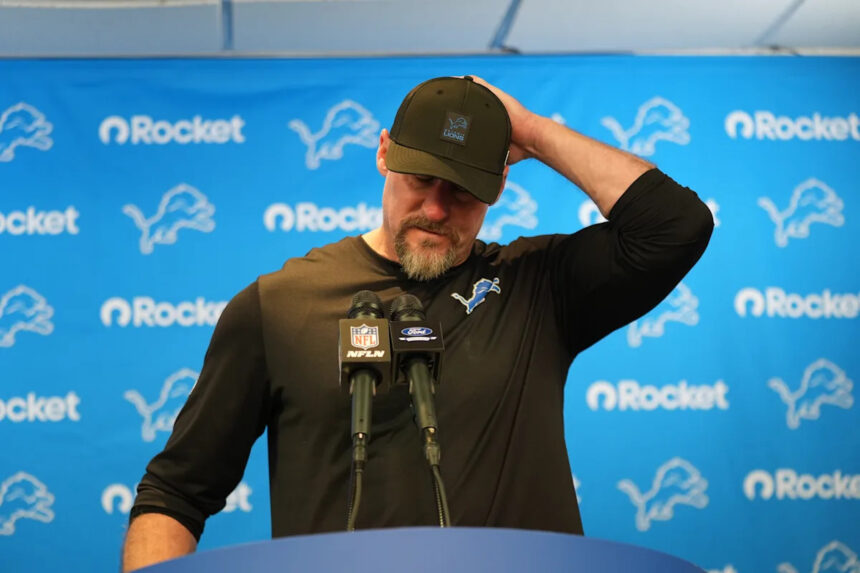
Head coach Dan Campbell, known for his fiery demeanor, was strikingly introspective. “We put ourselves in that position,” Campbell stated. “It never should have come down to that… That’s on us. I don’t ever want to put it in the officials’ hands.” This wasn’t coach-speak. This was a fundamental belief that the game is won or lost by the players and coaches on the field, not the officials in stripes.
Key players echoed this sentiment:
- Amon-Ra St. Brown didn’t debate the call: “I’ve got to be better… I can’t do that to the team.”
- Jared Goff focused on earlier mistakes: “We had chances to put that game away and we didn’t.”
- Veteran leaders pointed to missed opportunities, stalled drives, and the failure to contain Steelers’ QB Mason Rudolph as the real reasons for the loss.
This collective stance is a seismic shift for a franchise long associated with hard luck and “the same old Lions.” It signals a culture where internal accountability trumps external excuse-making.
Building a Contender: The Foundation is Stronger Than One Call
While the penalty ended the game, the Lions’ season wasn’t lost on that single play. The 2023 campaign, however, should be remembered for far more than its painful conclusion. This is a team that has clearly turned a corner. Under Campbell and General Manager Brad Holmes, the Lions have:
- Built one of the league’s most dominant offensive lines.
- Uncovered gems in the draft like St. Brown, Aidan Hutchinson, and Sam LaPorta.
- Developed an offensive identity that is both explosive and physical.
- Won the NFC North for the first time in decades, securing a home playoff game the previous season.
The loss to the Steelers exposed real areas for growth—specifically, a pass defense that struggled at critical moments and late-game execution that sometimes faltered. But the core of a perennial contender is undeniably in place. The maturity shown after this loss isn’t a sign of complacency; it’s the hallmark of a team that understands the margin for error in the NFL is razor-thin and that champions control what they can control.
Looking Ahead: What’s Next for the Gritty Lions?
The immediate aftermath is pain. A playoff opportunity was squandered. But the future in Detroit is brighter than it has been in a generation. The focus now shifts to the offseason, where the front office has capital and a clear mandate.
Prediction for the Offseason: The Lions will be aggressive in using both the draft and free agency to overhaul their secondary. Expect them to target a premier cornerback and add depth to the defensive line. The offense, already elite, may see tweaks, but the mission is clear: fortify the defense to match the offense’s potency.
The 2024 Lions will not be a surprise. They will be a target. The “grit” narrative will evolve into an expectation of excellence. The key question is whether this group can use the sting of this loss—a loss they owned—as fuel. If they can, then the heartbreak of Week 16 against the Steelers may be remembered not as an ending, but as the painful, necessary lesson that propelled them to a deeper run.
Final Analysis: In the NFL, culture isn’t built in victory parades; it’s forged in the fire of gut-wrenching defeat. The Lions had a ready-made excuse handed to them on a penalty flag. They chose instead to look in the mirror. That response tells you more about the direction of the Detroit Lions than any touchdown ever could. They are no longer the victims of fate. They are architects of their own future, and while this chapter ended in controversy, the story they are writing is one of undeniable promise and resilient character.
Source: Based on news from Yahoo Sports.