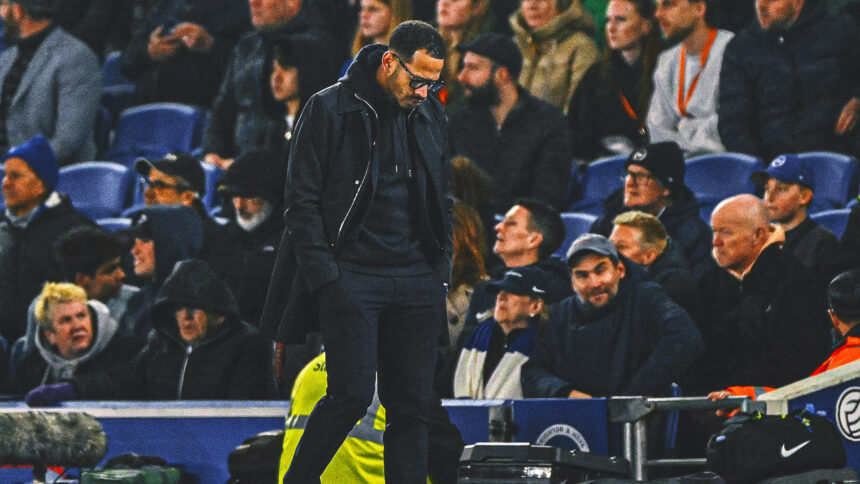
Chelsea’s Revolving Door Spins Again: Liam Rosenior Sacked After 117 Turbulent Days
The axe has fallen at Stamford Bridge with a brutal, familiar thud. In a move that shocks few yet underscores a deepening crisis, Chelsea Football Club has terminated the contract of manager Liam Rosenior after less than four months in charge. The decision, confirmed by the club on Wednesday, casts a long shadow over their imminent FA Cup semifinal at Wembley and raises profound questions about the direction of a club seemingly in perpetual turmoil. Rosenior’s tenure, the shortest permanent managerial stint in the club’s modern history, ends not with a bang, but with a whimper of goalless despair.
A Descent into Darkness: The Numbers Behind the Dismissal
The club’s official statement cited results and performances “below the necessary standards,” a diplomatic understatement for a collapse of historic proportions. Liam Rosenior’s final weeks were a statistical nightmare, a period defined by a crippling offensive drought that sealed his fate.
The decisive, damning run featured:
- Five consecutive Premier League defeats, a streak not seen at the club in over a decade.
- Zero goals scored across those five matches, highlighting a systemic failure in attack.
- A plummet from outside European contention to a mid-table scramble, with Champions League qualification now a distant dream.
- An atmosphere of palpable tension at Stamford Bridge, where the connection between team and supporters has eroded significantly.
This precipitous decline is a stark contrast to the club’s triumph in the Club World Cup just last year. The fall from world champions to a side incapable of scoring a league goal has been vertigo-inducing, exposing the fragile foundations upon which the current project is built.
Wembley in Chaos and a Billion-Dollar Dilemma
The timing of the sacking is as brutal as it is telling. With an FA Cup semifinal against Manchester City just four days away, the club has chosen to enter its most important match of the season under the interim stewardship of assistant Calum McFarlane. This decision risks destabilizing the squad at a critical moment, suggesting the hierarchy viewed the league form as an unrecoverable emergency.
Beyond Wembley, the financial stakes are astronomical. Missing out on the Champions League for a second consecutive season represents a catastrophic blow to the club’s Financial Fair Play calculations and prestige. For the ownership group led by Clearlake Capital and Todd Boehly, who have overseen a transfer spend exceeding one billion dollars, this is a nightmare scenario. Their project, built on acquiring young talent with high potential, is predicated on consistent top-level football and its associated revenue. The absence of Europe’s premier competition not only represents a huge financial hit but also makes retaining and attracting elite players exponentially more difficult.
The Rosenior experiment, a departure from their previous high-profile appointments, has backfired spectacularly. It leaves the owners facing a billion-dollar dilemma: double down on their data-driven, youth-centric model or pivot dramatically to secure immediate results.
Expert Analysis: A Failure of Vision or Execution?
From a tactical perspective, Rosenior’s Chelsea never established a coherent identity. Initially promising a more possession-based, progressive style, the team quickly devolved into a fractured unit. The much-vaunted attacking talent, assembled at great cost, looked disconnected and bereft of confidence. The defensive solidity he was known for instilling at previous roles never materialized, leaving the team vulnerable at both ends of the pitch.
However, to lay the blame solely at Rosenior’s feet is to ignore the wider structural issues. The sporting director-led model at Chelsea has created a disjointed squad with glaring imbalances. Managers are increasingly seen as head coaches, tasked with deploying a squad they did not build. When results sour, they are the most immediate and expendable component to change. This cycle is unsustainable and points to a deeper leadership vacuum in the football operations department.
Furthermore, the pressure from the ownership for immediate success, juxtaposed with a long-term squad-building strategy, creates an impossible tension. Rosenior, like Graham Potter before him, became a casualty of this fundamental contradiction at the heart of modern Chelsea.
What Comes Next? Predictions for a Pivotal Summer
With Calum McFarlane holding the fort until May, the search for a seventh permanent manager in five years begins in earnest. The next appointment will be the most revealing yet of the Boehly-Clearlake era.
- The Proven Winner Route: Names like José Mourinho (for a third stint) or Antonio Conte will be linked, representing a return to a tried-and-tested, instant-impact manager. This would signal a panic-stricken pivot from the project.
- The Project Coach: Chelsea may persist with their model, targeting a coach like Sporting’s Rúben Amorim or Germany’s Julian Nagelsmann, who are reputed for developing young players within a clear system. This requires patience the fanbase and ownership may not possess.
- The Wildcard: A move for a rising star like Ipswich Town’s Kieran McKenna would be a huge gamble, echoing the Rosenior risk on a slightly larger scale.
Regardless of who takes the helm, they will inherit a bloated, unbalanced squad and the immense weight of expectation from an ownership group desperate for a return on its unprecedented investment. The summer transfer window will be a frenzy of attempted exits and targeted arrivals, all under the dark cloud of no Champions League football.
Conclusion: A Club at a Crossroads
The sacking of Liam Rosenior is more than just another managerial change at a club notorious for them. It is a symptom of a profound identity crisis. Chelsea have become a case study in how not to run a football club in the modern era: chaotic recruitment, a lack of strategic patience, and a corrosive short-termism that has alienated players and fans alike.
The FA Cup now represents a last-ditch shot at salvation—a trophy and a route into the Europa League. But even Wembley glory would be a plaster on a gaping wound. The coming months will define the Clearlake-Boehly project. Will they learn from the brutal failure of the Rosenior chapter, or will they simply repeat the same mistakes with a new face on the touchline? For a club of Chelsea’s stature and investment, the current trajectory is not just disappointing; it is an existential threat. The revolving door has spun again, but this time, it feels like the entire house is shaking.
Source: Based on news from Fox Sports.