Closest I’ve Felt: Keely Hodgkinson Takes Aim at Athletics’ Most Sacred Record
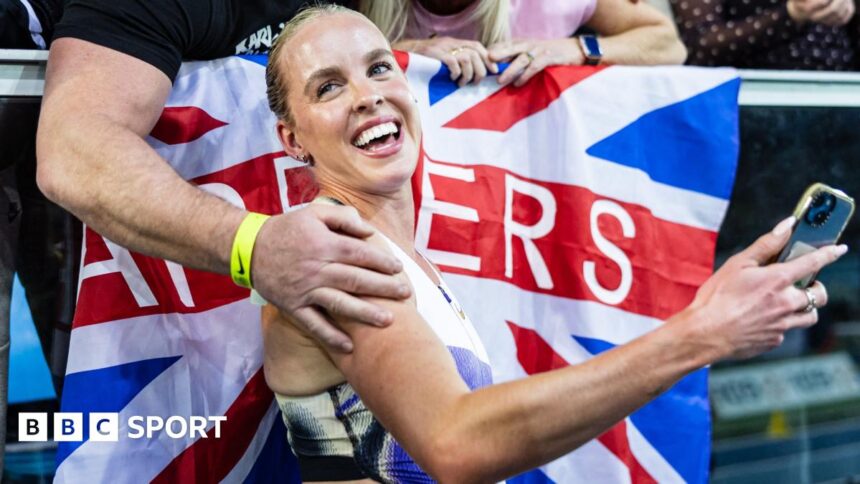
The air in Glasgow was electric, thick with the scent of resin and anticipation. On the track, Keely Hodgkinson moved with a serene, devastating purpose. When the clock stopped at 1:55.77, it wasn’t just another victory or another indoor world record shattered. It was a declaration. A signal fired across four decades of history, aimed squarely at the most formidable, longest-standing bastion in athletics: Jarmila Kratochvilova’s outdoor 800m world record of 1:53.28. In the aftermath, Hodgkinson’s words were not just confident; they were historic. “It’s the closest I’ve ever felt,” she stated. For a record that has weathered the storms of technological advancement, training revolutions, and generational talents, that simple phrase carries the weight of a seismic shift.
A Fortress of Time: The Legacy of 1:53.28
To understand the magnitude of Hodgkinson’s ambition, one must first comprehend the monument she seeks to topple. Set in Munich in July 1983 by Czechoslovakia’s Jarmila Kratochvilova, the women’s 800m world record is an outlier. It has stood for over four decades, surviving while every other track world record from that era has fallen. It is older than Hodgkinson herself. Kratochvilova, a powerhouse whose physique and prowess were as dominant as they were controversial in a different sporting era, carved a time that seemed etched in stone. Subsequent legends—Maria Mutola, Pamela Jelimo, Caster Semenya—have come agonizingly close, but none have breached the wall. The record has become more than a time; it is a psychological barrier, a testament to a singular, perhaps unrepeatable, performance. Its longevity speaks to its sheer, daunting perfection.
Breaking the Ice: The Indoor Record as a Catalyst
Hodgkinson’s demolition of the indoor world record (1:55.82) in Glasgow was not merely a seasonal highlight. It was a critical, psychological breakthrough. For an athlete, breaking a world record—any world record—is a process of self-conviction. It proves that the body can withstand the pace, the mind can navigate the pain, and the spirit can embrace the historic pressure.
- Technical Proof: Her indoor run demonstrated a masterful blend of strength and speed endurance, executing a near-perfect race strategy from the front.
- Psychological Leap: Moving from “chasing” to “holding” a world record alters an athlete’s identity. She is no longer a contender; she is a record-holder, a standard-bearer.
- The Bridge Outdoors: The indoor season serves as a high-stakes laboratory. The confidence and data gleaned from Glasgow provide an invaluable blueprint for the summer campaign.
“It just gives me confidence going into the outdoor season,” Hodgkinson confirmed. That confidence is the key ingredient needed to attack a record that has broken the will of others.
The Path to History: What Hodgkinson Needs to Conquer
Closing the two-second gap between her new indoor best and Kratochvilova’s outdoor mark is a monumental task. In the rarefied air of world-record attempts, tenths of seconds are canyons. However, Hodgkinson’s trajectory and toolkit suggest it is possible. Expert analysis points to several critical factors that could align for a historic run.
The Perfect Race Tactics: Hodgkinson has traditionally been a strong finisher. To run 1:53, she will likely need to commit to a blistering first lap, perhaps near 56 seconds, and defy physics by holding on. Her improved strength suggests she can now handle that suicidal pace.
The Right Conditions: A cool, still evening at a fast, sea-level track like Brussels or the Paris Olympic Stadium. A competitive field with rabbits willing to set the tempo is non-negotiable.
Peak Physical Form: Under coach Trevor Painter, Hodgkinson has shown steady improvement in her raw speed (a strong 400m PB) and her strength. An uninterrupted, healthy build-up to a targeted meet is essential.
The X-Factor: Rivalry: The presence of fierce competitors like Athing Mu and Mary Moraa could be the final catalyst. A fiercely contested race, rather than a solo time-trial, often produces the most extraordinary times.
More Than a Time: Cementing a Legacy
For Keely Hodgkinson, this pursuit transcends the clock. She speaks of breaking the record as something that will “cement her place as the greatest of all time.” This is a profound statement of intent. She already has Olympic and World Championship silver medals; the elusive gold is a primary target for Paris 2024. But an Olympic gold, while immortal, can be shared or succeeded. A world record, especially this one, is eternal. It would be an achievement that defines an era and elevates her from champion to legend. It would be the ultimate answer to the “what if” surrounding Kratochvilova’s era and a new benchmark for future generations. In a career already glittering, this is the final, gleaming pinnacle.
Prediction: When and Where History Could Be Made
While the athletics world will buzz with anticipation all summer, the stars are most likely to align in the 2024 or 2025 season. The all-consuming focus of the Paris 2024 Olympics may see Hodgkinson prioritize pure racing for gold over a record attempt. However, the heightened fitness and competitive fury of the Games could spontaneously produce the perfect storm. The more likely scenario is a deliberate assault in the summer of 2025. The pressure of an Olympic cycle is gone, and she can target a specific diamond league event with singular focus. Meetings like the Wanda Diamond League final in Brussels or the iconic Weltklasse in Zurich provide the stage, the competition, and the conditions where 1:53.27 becomes possible.
The final verdict? Keely Hodgkinson has never been better positioned. She has the speed, the strength, the coaching, the confidence, and now, the proven mentality of a world record-holder. The fortress has stood for 41 years, its walls seemingly impregnable. But history in athletics is written by those who dare to believe a barrier is not a limit, but a destination. Hodgkinson is not just knocking on the door; she has laid the blueprint for its demolition. The track world now holds its breath, waiting for the day when the starter’s pistol fires for a two-lap race that could finally rewrite one of sport’s last, untouched chapters.
Source: Based on news from BBC Sport.