Ollie Pope’s Last Stand: One Innings to Salvage His England Test Career
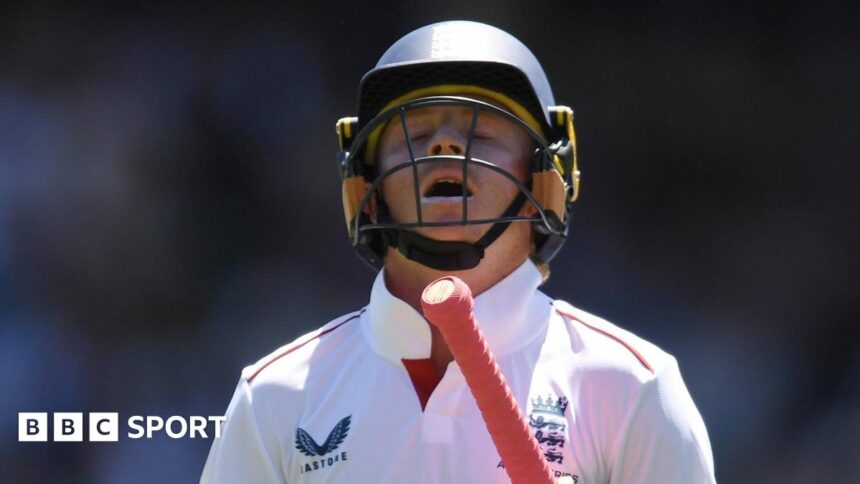
The walk from the Adelaide Oval square to the pavilion is a long one, especially under the scorching Australian sun. For Ollie Pope on day two of a crucial Ashes Test, it must have felt interminable. Having just flicked a careless shot straight to mid-wicket, the England vice-captain lingered, a portrait of crestfallen disbelief. As the Barmy Army’s groans subsided, a harsher reality set in for observers: this wasn’t just another dismissal. This felt like a final, golden opportunity slipping through his fingers, leaving his future at the highest level hanging by the thinnest of threads.
The Weight of Expectation and a Fatal Flaw
Ollie Pope’s career has been a narrative of prodigious talent perpetually on the cusp of full flowering. Touted as England’s next great batting hope since his maiden Test century in 2020, his journey has been one of false dawns and frustrating inconsistency. The vice-captaincy, bestowed upon him as a sign of faith in his cricketing brain and future, now feels like an anchor tied to a sinking ship. The central issue is no longer potential; it is a glaring technical deficiency that international bowlers have ruthlessly exploited.
Pope’s vulnerability outside the off-stump, particularly against pace, is the open secret in world cricket. His trigger movement across his stumps leaves him dangerously prone to being squared up, making him a prime candidate for edges to the cordon or, as seen in Adelaide, loose plays on the leg side as he tries to compensate. The shot that likely sealed his fate—a soft flick to Alex Inglis at mid-wicket—was the symptom of a deeper disease: a scrambled method under the intense pressure of Test match bowling.
- Technical Instability: A pronounced shuffle across creates imbalance and limits scoring options.
- Mental Scars: Repeated failures against high-quality pace breed doubt, leading to indecisive shots.
- Positional Mismatch: Often batting at No. 3, the most demanding slot, his flaws are exposed with the new ball.
The Crumbling Pillars of England’s “Bazball” Era
To understand the urgency of Pope’s situation, one must view it within the broader context of England’s Test revolution. The aggressive, fearless philosophy under Brendon McCullum and Ben Stokes has been built on a foundation of absolute clarity and unwavering confidence. Players are backed to the hilt, but the implicit contract is that they must deliver impactful performances. The style forgives low scores if they come quickly, but it does not forgive a repeated failure to construct an innings.
Pope’s recent record makes for grim reading. A prolonged run of low scores in the toughest conditions has transformed him from a cornerstone into a liability. In a team that thrives on momentum, a fragile top order undermines the entire project. The door he “unlocked for Australia” in Adelaide, as the pundits noted, wasn’t just about one wicket; it was about reinforcing a critical weakness the hosts could attack session after session. In the “Bazball” paradigm, there is no room for a passenger in the top three. Every player must be a potential match-winner, and Pope’s returns no longer justify the faith.
The Contenders Lining Up at the Door
International sport is merciless, and while one career flickers, others are blazing brightly in county cricket and on the fringes of the squad. Pope’s impending vacancy, should it arise, would not be met with a scarcity of options. England’s selectors are already looking at a new generation, and the pressure from below is intense.
Dan Lawrence, long in the wings, offers a similarly inventive strokeplay but with recent first-class hundreds under his belt. The uncapped Harry Brook is a run-machine whose aggressive style seems tailor-made for the current setup, and he is hammering down the door with monumental county scores. Even the notion of reshuffling the pack, moving Joe Root back to three and inserting a Jonny Bairstow or Ben Foakes higher up, is plausible. The point is this: England’s patience is a strategic choice, not an obligation without end. The queue of talented, in-form batsmen ensures that sentiment will play no part in the final decision.
One Innings, One Final Chance at Redemption
So, what comes next? The grim arithmetic of the international calendar suggests Pope’s next Test innings, whenever it arrives, will be a pure audition. It will be played under the microscope, with every defensive block and attacking shot analyzed not just for its value to the team, but for its validation of his continued selection. This is the brutal reality of elite sport.
To survive, he must deliver more than a pretty thirty or a brisk twenty. He needs a defining, match-shaping innings—a century under pressure, or a gritty, ugly fifty that steers his team out of crisis. It must be an innings that quiets the critics, not just with runs, but with the manner of their compilation. It must show a tangible, concrete adjustment to his technique and a fortified temperament. The alternative is a return to Surrey, not as England’s heir apparent, but as another “what-if” in a long line of talented players who couldn’t bridge the gap between county dominance and Test consistency.
Verdict: The End of an Era or a New Beginning?
Ollie Pope stands at the precipice. The talent that made him a teenage sensation is undeniable, but Test cricket is a graveyard of unfulfilled potential. The modern England setup has given him more rope than most regimes would, a testament to the belief in his sublime skill. That rope, however, has now run out. The Australian bowlers have blueprinted his dismissal, and world cricket has taken note.
His next knock will be the most important of his career. It is a binary proposition: salvation or oblivion. Will it be the innings that finally unlocks his true Test match pedigree, or the final, quiet whimper before a necessary but painful changing of the guard? As Pope walked off in Adelaide, he knew. The cricketing world now watches and waits, knowing that for one of England’s great hopes, there are no more tomorrows. There is only the next innings.
Source: Based on news from BBC Sport.