The Pickle Juice Prophecy: How a Cramping Carlos Alcaraz Forged an Epic Australian Open Victory
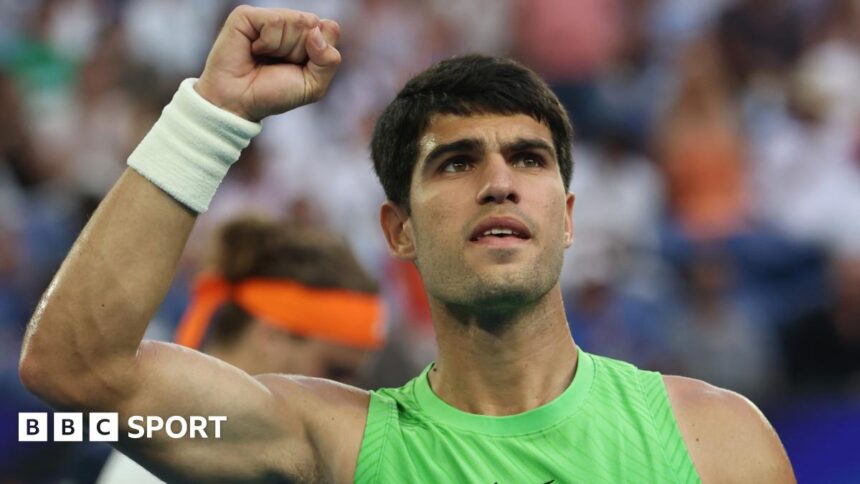
In the cathedral of Rod Laver Arena, where legends are carved from sweat and will, a new kind of miracle unfolded. It wasn’t a display of untouchable dominance, but a raw, visceral excavation of human spirit. Carlos Alcaraz, the effervescent world number one, didn’t just beat Alexander Zverev to reach his first Australian Open final. He survived himself. In a five-hour, twenty-seven-minute odyssey of pain, resilience, and unconventional remedies, Alcaraz transformed from a cramping, hobbled figure into a triumphant gladiator, winning 6-4, 7-6(5), 6-7(3), 6-7(4), 7-5. The scoreline is a mere footnote to the drama, a story that will be forever remembered for one bizarre, pivotal image: Carlos Alcaraz drinking pickle juice on the sport’s grandest stage.
The Collapse and the Controversial Cure
For two sets, Alcaraz was conducting a masterclass. His explosive power and dizzying variety had Zverev on the ropes, painting lines with forehands and disarming the German’s mighty serve. He was cruising, a set away from a straight-sets victory. Then, at 4-4 in the third, his body betrayed him. A sudden, violent cramp seized him. He pulled up, his movement reduced to a pained shuffle. His serve became a desperate push. The invincible phenom was suddenly, shockingly, vulnerable.
The ensuing medical timeout became a flashpoint. A furious Alexander Zverev argued with the chair umpire, believing the pause was unfairly timed as Alcaraz had not fallen between points. But in the player’s box, Alcaraz’s team reached for an old-school remedy. As the physio worked, the Spaniard took several swigs from a small bottle. The broadcast zoomed in. It wasn’t an electrolyte drink or water. It was pickle juice, a folk remedy touted by athletes for its high sodium and vinegar content, believed to trigger a neurological signal to stop muscle cramping.
In that moment, the match transformed. It was no longer just about forehands and backhands. It became a primal test of survival. “You have to learn to suffer,” Alcaraz has often said. This was his doctoral thesis.
A Mental Fortress Built in Real Time
Physically, Alcaraz was a shell. He lost the third set and, despite heroic efforts, the fourth in a tie-break. The momentum had utterly swung to Zverev, who was now the stronger, more mobile player. Yet, Alcaraz’s mind remained a fortress. This is where the expert analysis separates the great from the immortal. Alcaraz did not panic. He recalibrated.
- Strategic Surrender: He stopped chasing lost causes, conserving every ounce of energy for crucial points.
- Tactical Serving: His first serve became about placement, not power, aiming for high percentages to start points.
- Emotional Control: While Zverev’s frustration grew as he failed to put away the wounded champion, Alcaraz’s focus deepened, point by agonizing point.
He was playing chess while in physical checkmate. The fifth set was a war of attrition. Zverev, feeling the pressure of expectation, began to tighten. At 5-5, Alcaraz found one last reservoir of courage, breaking with a stunning passing shot. Serving for the match, the cramps threatened to return, but his spirit was now indomitable. One final forehand winner, and he collapsed to the court, not in pain, but in cathartic release.
What This Means for the Final and Beyond
This victory is more significant than simply reaching a final. It marks a profound evolution in Carlos Alcaraz’s career. He has always had the joy and the weapons. Now, he has proven he possesses the deepest, most unshakeable grit. For his opponent in the final, whether Daniil Medvedev or Jannik Sinner, this is a terrifying prospect. They will face a man who knows he can win even when he has nothing left to give physically.
Predictions for the final must now account for this new dimension. Alcaraz will recover, and with a day’s less rest than his opponent, his physical state is a question. But the mental edge he gained from this epic is immeasurable. He has walked through fire and emerged stronger. His game, built on explosive athleticism, will be tested, but his belief will be at an all-time high. He is no longer just the sport’s dazzling future; he is its iron-willed present.
A Legacy-Defining Night in Melbourne
Some matches are remembered for technical perfection. This one will be remembered for its humanity. The sight of Carlos Alcaraz drinking pickle juice will become an iconic snapshot of resilience. It was a perfect metaphor for the match itself: unconventional, jarring, but ultimately effective. He didn’t just overcome Alexander Zverev; he overcame the limits of his own body.
This Australian Open final berth is carved from something different than his Wimbledon or US Open triumphs. It is forged in vulnerability and sheer will. In years to come, when fans speak of Carlos Alcaraz’s career, this five-set epic will be the match cited as the moment he proved he could win ugly, win hurt, and win when all logic said he couldn’t. He didn’t just reach a final in Melbourne; he authored a legend, one painful, pickle-flavored sip at a time.
Source: Based on news from BBC Sport.