Defiant Dubois Sheds Quitter Tag to Write New Narrative
For a fighter whose entire brand is built on the promise of sudden violence, the irony was almost too painful to watch. The ‘Don’t Blink’ tagline was never meant to be taken quite so literally. Yet when Daniel Dubois crashed to the canvas within 10 seconds of the opening bell in Manchester — and again in the third round — suddenly every soul inside the Co-op Live Arena was paying very close attention. Not because of the power, but because of the fragility.
For years, Dubois has carried the label of a fighter who folds when things become uncomfortable. Opponents and fans alike have questioned his heart, mentality, and toughness. The whispers began after his infamous knee-take against Joe Joyce. They grew louder after a hesitant performance against Oleksandr Usyk. And they reached a fever pitch during fight week, when Fabio Wardley even joked that if Dubois was not a boxer, he would be a “bin man” — a cutting remark aimed squarely at Dubois’ perceived lack of fight IQ and grit.
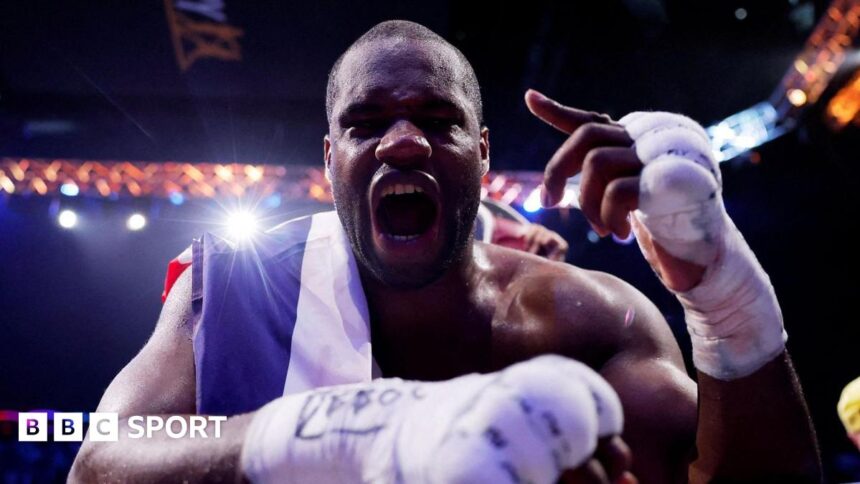
But Saturday night in Manchester was not the night the narrative ended. It was the night it was rewritten — not with a knockout, but with a stubborn, defiant refusal to stay down. This is the story of how Daniel Dubois finally shed the quitter tag, one painful round at a time.
The Knockdown That Changed Everything
Let’s be clear: getting dropped inside the first ten seconds of a heavyweight fight is a catastrophic start. In most cases, it signals a long night of survival, or a quick exit. Dubois had been here before. Against Joyce, he took a knee and never got back up. Against Usyk, he was outboxed and outclassed. The pattern was set. The blueprint was known.
But this time, something was different. When Dubois rose from the first knockdown, his eyes weren’t glazed. His legs weren’t rubber. He didn’t look for a way out. He looked for a way back in. The second knockdown in the third round — a brutal, clean shot that would have ended most careers — only seemed to sharpen his focus.
- First knockdown (Round 1): Dubois beat the count, reset his feet, and began to jab.
- Second knockdown (Round 3): He absorbed the shot, smiled through the blood, and clinched with purpose.
- Turning point: Instead of wilting, Dubois started landing his own power shots in the middle rounds.
This was not the same Daniel Dubois who took a knee in 2020. This was a man who had clearly spent hours in the gym working on his mental resilience as much as his physical conditioning. The composure he showed after those early scares was the kind of composure that defines champions — not the kind that gets you compared to a sanitation worker.
Rewriting the ‘Quitter’ Narrative
Boxing is a sport of memory, and the memory of Dubois’ previous failures has been a heavy anchor. The ‘quitter’ tag stuck because it was supported by evidence. Against Joyce, he had a legitimate hand injury, but the optics of taking a knee were devastating. Against Usyk, he was outclassed, but he also seemed to lack the fire to change the fight’s momentum.
In Manchester, Dubois faced a similar crisis. He was down on the cards. He had been hurt twice. The crowd was roaring for his opponent. Every fibre of his old self would have found a way to bow out gracefully. Instead, Dubois did something radical: he fought back.
By the seventh round, he was the aggressor. By the ninth, he was landing the cleaner, heavier shots. His jab, once a defensive afterthought, became a weapon. His right hand, always a threat, found its range. The man who was supposed to fold under pressure was now applying it.
Expert analysis: What we witnessed was not a technical masterclass. Dubois still has holes in his defence. He still loads up too much on his right. But what we witnessed was a psychological breakthrough. He proved that he can take a punch, recover, and win the rounds that matter. That is the kind of currency that buys a fighter a shot at the elite.
The result was a hard-fought, split-decision win that felt more valuable than any of his 22 stoppage victories. Because those knockouts came against journeymen and gatekeepers. This win came against a man who was trying to break him mentally, and Dubois refused to break.
What This Means for the Heavyweight Division
The heavyweight division is currently a game of musical chairs, with Tyson Fury, Anthony Joshua, and Oleksandr Usyk holding the most valuable seats. Dubois has been on the outside looking in, dismissed as a pretender with a glass jaw and a fragile ego. That perception has now shifted.
Key implications:
- Gatekeeper no more: Dubois has proven he can win a gruelling, ugly fight. That is a prerequisite for any serious contender.
- Marketability boost: A fighter who gets knocked down and gets back up sells tickets. The ‘Don’t Blink’ brand now has a new layer: resilience.
- Future matchups: A rematch with Joe Joyce is now a much more compelling narrative. A fight with Filip Hrgovic or a WBC eliminator is suddenly plausible.
But let’s not get carried away. Dubois still has significant weaknesses. His footwork remains clunky. He struggles with lateral movement. And against a pure boxer like Usyk, he would still be a heavy underdog. However, the mental transformation he displayed in Manchester changes the ceiling of his potential. A mentally tough Dubois is a dangerous fighter. A mentally fragile Dubois is a stepping stone.
He chose to be the former. And that choice could define the rest of his career.
Predictions: Where Does Dubois Go From Here?
If Dubois can build on this performance, the path forward is clear. He needs to stop relying solely on his power and start developing a more complete game. The good news is that he now has a blueprint for winning when the power doesn’t land cleanly. The bad news is that the division’s elite are a different level of test.
Three realistic next steps:
- Fight a top-10 contender: Someone like Murat Gassiev or Tony Yoka would provide a solid measuring stick. A win keeps him in the mix.
- Seek a rematch with Joyce: This is the money fight and the redemption story. If Dubois can beat Joyce, the quitter tag is officially dead.
- Stay active and improve: Dubois is only 26. He has time. But he must not squander this momentum by taking a soft touch.
My prediction? Dubois will fight one more domestic-level opponent before securing a WBC or WBA final eliminator. If he wins that, a world title shot is inevitable. And this time, he won’t just be there to make up the numbers. He will be there to prove that the man who got knocked down twice in Manchester is not the same man who took a knee in London.
Conclusion: A New Chapter for ‘Dynamite’
Daniel Dubois will never be the most polished boxer in the division. He will never have the footwork of Usyk or the ring IQ of Fury. But after Saturday night, he has something that cannot be taught: a refusal to quit. The ‘bin man’ joke from Fabio Wardley now feels like a relic from a different era. The quitter tag has been scrubbed from his record, replaced by a new narrative of defiance.
He was knocked down in the first ten seconds. He was knocked down again in the third. And he still won. That is not the story of a fighter who folds. That is the story of a fighter who finally understands what it takes to survive at the highest level.
The ‘Don’t Blink’ tagline may need a small update. Perhaps: ‘Don’t Blink. Because even when he’s down, he gets back up.’ And in the heavyweight division, that might just be the most dangerous quality of all.
Source: Based on news from BBC Sport.