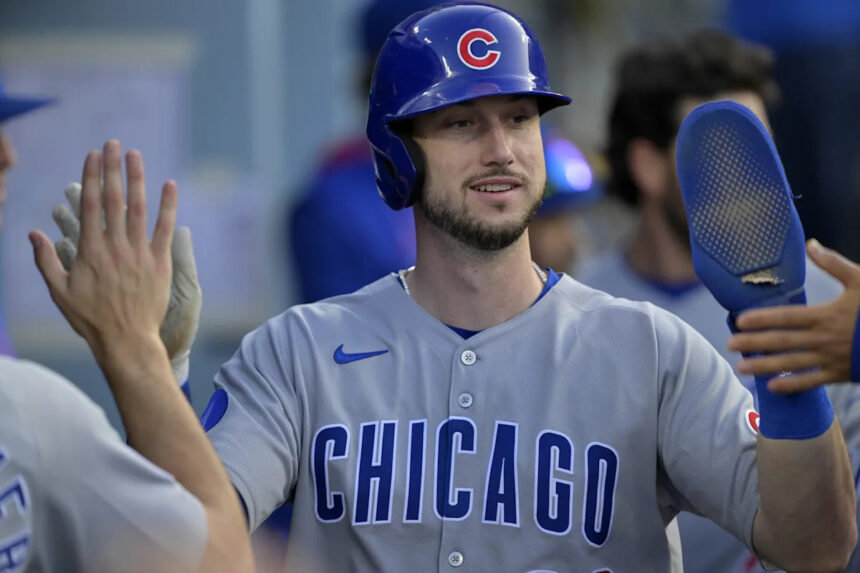
Dodgers Land Kyle Tucker in Record-Setting $240 Million Coup, Redefining MLB’s Financial Frontier
In the relentless arms race of Major League Baseball, the Los Angeles Dodgers have once again fired a salvo that echoes across the sport’s financial landscape. According to multiple reports, including an initial break from ESPN’s Jeff Passan, the Dodgers have secured star outfielder Kyle Tucker with a staggering four-year, $240 million contract. This move, plucking Tucker from a competitive field that included the New York Mets and Toronto Blue Jays, is not merely a transaction. It is a declaration, a further entrenchment of the Dodgers’ philosophy as the sport’s preeminent superpower, willing to pay a premium for稀缺 talent and further distort the market in the process.
The Anatomy of a Record-Breaking Deal
At first glance, the $60 million average annual value (AAV) stands as a monument in baseball history. It officially ranks as the second-highest nominal AAV ever, trailing only the unprecedented $70 million of teammate Shohei Ohtani. However, the devil—and the Dodgers’ financial ingenuity—is in the details. The contract employs the franchise’s now-signature blend of a massive signing bonus and long-term deferrals.
For the purposes of the competitive balance tax, the deal’s AAV is calculated at a reported $57.1 million. This nuanced figure is crucial. It pushes Tucker’s contract past the CBT hits of Juan Soto ($51 million) and, most notably, Ohtani ($46.1 million), making it the highest effective AAV in MLB history. The structure, featuring a $64 million signing bonus and $30 million in deferrals, mirrors the team’s recent dealings, such as with Blake Snell. It’s a mechanism that allows the Dodgers to manage immediate luxury tax implications while committing future dollars—a future now loaded with over $1 billion in total deferred salaries to ten players stretching to 2047.
- Reported Total: $240 million over 4 years
- Nominal AAV: $60 million (2nd-highest ever)
- CBT AAV: $57.1 million (Highest ever)
- Key Structure: $64 million signing bonus, $30 million deferred
- Beats Out: Juan Soto, Shohei Ohtani (for CBT purposes)
Why Tucker Commanded a Premium in a Thin Market
Kyle Tucker is an elite player—a consistent, homegrown Astros star with a sweet left-handed swing, 30-homer power, Gold Glove caliber defense, and savvy baserunning. But is he a $60-million-a-year superstar on the pure talent spectrum? The market, not just the player, dictated this price. Tucker’s free agency arrived at a perfect storm of scarcity and timing.
This offseason’s position player class was notably top-heavy. Beyond Tucker, the likes of Bo Bichette and Cody Bellinger represented the next tier. More critically, forecasts for the next two offseasons show a dearth of impact hitters available. In this context, Tucker wasn’t just another All-Star; he was a rare difference-maker, a franchise cornerstone in his prime (he’ll be 28 on Opening Day) hitting the open market. For a team like the Dodgers, perpetually in “win-now” mode, the opportunity cost of missing out was arguably greater than the financial cost of securing him. They paid not just for Tucker’s .800+ OPS and brilliant right field play, but for the certainty he provides in an uncertain future.
The Dodgers’ “Sticker Shock” Strategy Becomes the Standard
Another year, another jaw-dropping commitment from the Dodgers front office. The phrase “sticker shock” has become an annual tradition in Los Angeles, from Mookie Betts to Freddie Freeman to Ohtani, and now to Tucker. But this is not reckless spending; it is calculated, aggressive capital deployment. The Dodgers have leaned into their economic might with strategic gusto, using complex contract structures to smooth out their competitive balance tax hits while assembling a roster of historic depth and quality.
This approach creates a cascading effect across baseball. It resets the market for elite talent, putting pressure on other large-market teams to keep pace. The New York Mets and Toronto Blue Jays, Tucker’s other closest pursuers, are now forced to pivot to secondary plans, potentially overpaying for the next tier of available talent. The Dodgers’ willingness to set new financial precedents—first with Ohtani’s total value, now with Tucker’s AAV—continuously pushes the boundaries of what is possible, further stratifying the league between the haves and the have-nots.
Predictions: How Tucker Fits and What Comes Next
On the field, Tucker’s fit is seamless. He slots into the heart of a lineup that already features Betts, Ohtani, and Freeman, creating a murderers’ row for the ages. His left-handed power plays perfectly at Dodger Stadium, and his defensive prowess solidifies an outfield that can now feature Betts at second base more permanently. The Dodgers’ lineup, on paper, becomes arguably the most formidable in the modern era.
The larger predictions, however, revolve around the sport’s economics and the Dodgers’ own future.
- Immediate Pressure: The pressure to win a full-season World Series with this core becomes immense. Anything short of a championship will be viewed as a catastrophic failure.
- CBA Ramifications: The continued use of massive deferrals and the ballooning CBT payrolls will undoubtedly be a central issue in the next round of collective bargaining. Other owners will push for mechanisms to curb such strategies.
- The Deferred Bill Comes Due: While clever now, the $1 billion in deferred salaries represents a future financial anchor. The 2030s and 2040s will see the Dodgers paying for this era of excess, which could constrain future operations.
- Market Inflation: The next elite hitter to hit free agency, perhaps a Juan Soto extension or a young star in coming years, will now use Tucker’s $57.1 million CBT AAV as a starting point, not Ohtani’s.
In securing Kyle Tucker, the Los Angeles Dodgers have done more than acquire a five-tool All-Star. They have reaffirmed their identity as baseball’s ultimate aggressors, architects of a new financial reality where the record-breaking contract of yesterday is merely the baseline for today. The $240 million deal is a testament to Tucker’s talent and the market’s scarcity, but it is a louder testament to the Dodgers’ unwavering commitment to operate in a sphere all their own. The shock of the sticker price may fade, but the seismic impact of this signing on the league’s competitive and economic landscape will resonate for years to come.
Source: Based on news from Yahoo Sports.