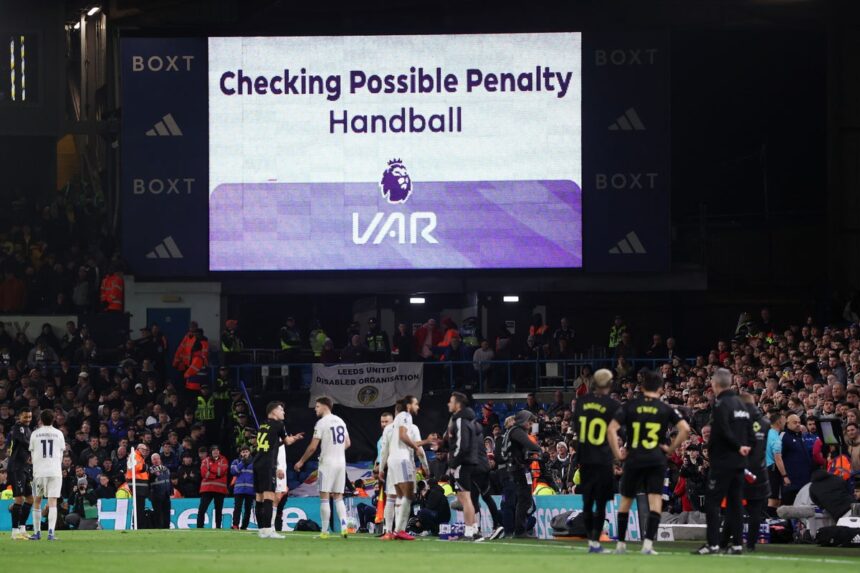
Championship Clubs Reject VAR Challenge System: Tradition Trumps Technology for Now
The relentless march of technology in football has hit a significant roadblock in England’s second tier. In a decisive move that underscores a deep-seated ambivalence towards video intervention, English Football League (EFL) Championship clubs have voted against introducing a Video Assistant Referee (VAR) challenge system for the upcoming season. This rejection of the proposed Football Video Support (FVS) model reveals a league at a crossroads, prioritizing pace, passion, and perceived purity over the pursuit of pixel-perfect officiating.
The Proposal: A “Manager’s Challenge” Model for the Championship
The rejected system was not a direct copy of the often-criticized VAR used in the Premier League. Instead, Professional Game Match Officials (PGMOL) pitched a more interactive model borrowed from other sports like cricket and tennis. The Football Video Support (FVS) system aimed to hand agency back to the dugout. The key mechanics were clear and designed to minimize disruption:
- Limited Challenges: Each manager would have been allocated two reviews per match to contest key decisions.
- Pitchside Review: Upon a challenge, the referee would consult the pitchside monitor, examining different camera angles before making a final call.
- Successful Challenge Retained: Crucially, if a manager’s challenge was correct, they would not lose that challenge, preserving their ability to contest another decision later in the game.
This model promised a middle ground: reducing game-stopping checks for every marginal offside while providing a mechanism to overturn clear and obvious errors in match-changing moments. It was presented as a potential solution to the divisive, opaque VAR processes that have plagued the top flight.
Why the Thumbs Down? Unpacking the Championship’s Rejection
Despite its theoretical benefits, the FVS system failed to win the hearts and minds of Championship clubs. The reasons for its rejection are multifaceted, rooted in the unique identity and economics of the division.
Cost and Consistency Concerns: Implementing any video technology is expensive. For many Championship clubs operating under significant financial strain, the outlay for the required camera infrastructure and technology was a major deterrent. Furthermore, questions lingered about consistency. Would the system be deployed in all stadiums, or would it create a “two-tier” officiating experience between wealthier and less affluent clubs? The integrity of the competition demanded a universal application, a potentially prohibitive cost.
The “Product” and Pace of the Game: The Championship sells itself on relentless intensity, high-stakes drama, and unbridled emotion. Many clubs feared that even a limited challenge system would interrupt the flow of the game, sterilizing the raw, fast-paced product that defines the league. The concern was that tactical challenges could be used to break momentum, akin to timeouts in other sports, fundamentally altering the sport’s rhythm.
Learning from the Premier League’s Woes: The Premier League’s VAR experience has served as a potent cautionary tale. The controversies surrounding subjective interpretations, lengthy delays, and a perceived erosion of spontaneous celebration have made many in the football pyramid wary. Championship clubs looked at the top-flight chaos and seemingly decided that the cure might be worse than the disease. The fear of replicating those controversies, even under a different model, was a powerful factor.
Preserving On-Field Authority: At its core, football has long cherished the finality of the referee’s whistle. There remains a strong traditionalist sentiment that human error, for all its frustrations, is an intrinsic part of the game’s narrative. By rejecting the challenge system, clubs have, for now, reaffirmed the primacy of the on-field official’s decision-making, for better or worse.
The Aftermath and Future Implications
This vote is not merely a postponement; it is a loud statement of intent from the Championship. The league has consciously chosen a different path from the Premier League, valuing its distinct character. However, the pressure for technological aid will not disappear.
The decision places immense focus on the standard of EFL refereeing. Without a technological safety net, the demand for consistent, high-quality officiating will be louder than ever. PGMOL will be under the microscope to ensure officials in the world’s most physically demanding league are supported through training and development.
This also sets a fascinating precedent for the domestic cup competitions. When Championship clubs host Premier League sides in the FA Cup, they will move from a world without video review to one where VAR is in operation. This incongruity could lead to heightened tension and accusations of unfairness, especially if a decisive, erroneous call goes against the lower-league side.
Conclusion: A League Defining Its Own Identity
The Championship’s rejection of the VAR challenge system is a landmark moment. It is a deliberate choice to embrace a perceived purity and relentless pace over technological intervention. In an era where football is increasingly dissected by algorithms and slow-motion replays, the second tier has planted a flag for human-centric, high-velocity drama.
This vote speaks to a league confident in its own brutal, beautiful product. The clubs have calculated that the cost, both financial and to the game’s spirit, is currently too high. While the quest for fairness is eternal, the Championship has declared that for the next season at least, its battles will be decided on the grass, by the players and the referee, with all the glorious imperfection that entails. The experiment may be revisited, but for now, the roar of the crowd will not be followed by the silent anxiety of a video check.
Source: Based on news from Yahoo Sports.