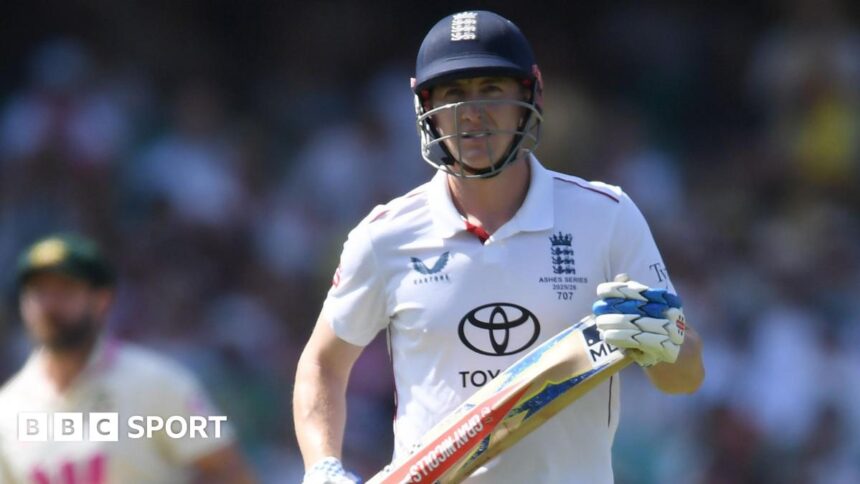
England’s New Captain Under Fire: Harry Brook Admits ‘Terrible Mistake’ as Leadership Era Begins in Turmoil
The mantle of England’s white-ball captaincy is meant to be a crowning achievement, a symbol of trust, maturity, and cricketing intellect. For Harry Brook, that mantle currently feels like a heavy cloak of scrutiny. In a startlingly candid admission, the newly appointed skipper has stated that fans have “every right to be annoyed” with him, following revelations of a nightclub altercation that casts a long shadow over the start of his tenure and the fragile state of English cricket.
A Captain’s Confession: The Wellington Incident Unpacked
The facts, as they have belatedly emerged, are damaging. On the eve of a crucial third ODI against New Zealand on November 1st, with Brook freshly installed as Jos Buttler’s successor, the young captain was involved in an incident outside a Wellington nightclub that resulted in him being punched by a bouncer. England lost the match the following day, and the tour concluded. Yet, the incident remained shrouded in secrecy until it was reported over two months later, coinciding with the dismal end of a 4-1 Ashes thrashing in Australia.
Brook’s public contrition is significant. He has not hidden behind PR platitudes. “It was a terrible mistake,” he stated, acknowledging the breach of responsibility. The England and Wales Cricket Board (ECB) handed down a fine and a final written warning, a severe sanction that underscores the seriousness with which they viewed the behaviour of their new leader. The delayed disclosure, however, raises separate questions about transparency within the camp during a period of intense public criticism.
- Event: Altercation with nightclub security in Wellington, New Zealand.
- Timing: Night before 3rd ODI, early in Brook’s captaincy.
- Outcome: Brook was punched; England lost the match.
- ECB Action: Financial penalty and a final written warning.
- Revelation: News broke publicly in January 2024, post-Ashes.
A Pattern of Problems: Noosa, The Ashes, and a Culture in Question
The Wellington incident cannot be viewed in isolation. It forms part of a deeply troubling narrative that engulfed England’s disastrous Ashes campaign. The tour was dogged by criticism of preparation and off-field conduct, most notably the decision to take a mid-series holiday in Noosa. There, players, including Brook, were photographed socializing in bars, an image that clashed violently with the on-field reality of being outplayed by a relentless Australia.
This sequence of events presents a critical problem for Brook and the ECB’s management: perception. The optics of a new captain, first in a nightclub altercation, then pictured drinking during a series defeat, suggest a leadership group struggling to align its actions with its responsibilities. For a team trying to rebuild after the retirement of Eoin Morgan’s transformative, yet disciplined, era, it hints at a fraying of professional standards. The public and pundit frustration Brook acknowledges is not just about one mistake; it’s about a pattern that implies the lessons of a humbling Ashes defeat are not being learned.
Expert analysis suggests this is a pivotal moment for the team’s culture. The transition from the relaxed, yet fiercely competitive, environment under Morgan and Buttler to a new era requires a recalibration. Brook’s actions, however minor they may seem in isolation, have become the focal point for a wider debate about discipline, focus, and what it means to represent England in an age of intense scrutiny.
The Leadership Crucible: Can Brook Forge Redemption?
Harry Brook now faces the ultimate leadership test. His technical prowess with the bat is unquestioned, but captaincy demands more. It requires setting an unassailable example. His frank admission of error is a powerful first step in damage control, demonstrating a level of self-awareness that is essential. However, words are cheap in elite sport; actions are the only currency that matters.
The path to redemption is clear but arduous:
- Impeccable Conduct: His off-field behaviour must now be beyond reproach. Every action will be viewed through the lens of this incident.
- On-Field Resurgence: He must lead from the front with the bat. A string of commanding, match-winning performances can begin to shift the narrative.
- Squad Discipline: He must actively mould the team environment. This means ensuring the collective focus is on cricket, not controversy, potentially making tough calls on squad culture.
- Re-engaging the Faithful: He must win back the trust of a disillusioned fanbase through consistent, professional leadership, both in victory and defeat.
The coming white-ball series, particularly the T20 World Cup defence in 2024, will be his proving ground. The ECB’s decision to stand by him suggests they see a future leader, but the “final warning” is unequivocal. The margin for error is now zero.
Predictions and The Road Ahead for English Cricket
Looking forward, this episode will either be the making of Harry Brook as a strong, chastened leader or the first chapter in a short, troubled captaincy. The prediction here is one of cautious optimism. Brook’s raw talent and his willingness to confront his mistake head-on, without excuse, are strong foundational qualities. The pressure, however, will be immense.
The broader prediction for England’s white-ball setup is a period of enforced maturity. The management will likely tighten protocols around off-field activities, especially on tour. The “work hard, play hard” ethos will be scrutinized and likely redefined with clearer boundaries. For a team that prides itself on its positive, attacking brand of cricket, rediscovering the professional bedrock that underpins it is the urgent task.
Furthermore, the incident may accelerate the need for clear separation between red-ball and white-ball leadership. The all-format captaincy model is grueling; adding the burden of managing a team’s culture and public persona across 12 months of the year is a Herculean task. Specialized leadership could be the structural change that emerges from this turmoil.
In conclusion, Harry Brook’s “terrible mistake” is more than a personal lapse. It is a symptom of a transitional period in English cricket where standards have appeared to slip. His candid admission of fault is commendable, but it is merely the opening sentence in a chapter he must write with his actions. The England captaincy is an honour that carries the weight of history and the hopes of millions. Brook now has the opportunity to transform this early crisis into a defining moment of growth, to prove that leadership is not about never failing, but about how you respond when you do. The eyes of a rightfully annoyed cricket-watching public are upon him, waiting to see which path he chooses.
Source: Based on news from BBC Sport.