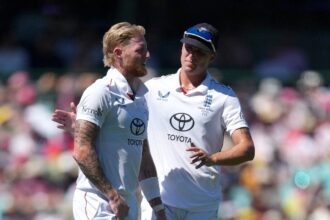
England’s Ashes Hopes Hang by a Thread After Melbourne Carnage
In a dizzying, chaotic, and utterly compelling display of pure, unadulterated Test cricket chaos, the Boxing Day Test at the Melbourne Cricket Ground witnessed a staggering 20 wickets fall on a breathless first day. By stumps, England’s Ashes campaign was teetering on the precipice of outright surrender, bowled out for a paltry 110 before Australia, in a dramatic twist of their own, stumbled to 61-4, holding a fragile lead of just 46 runs. This was not a day of subtle batting technique; it was a primal battle for survival on a green-tinged MCG pitch, and England, once again, were found desperately wanting.
A Morning Session of Mayhem: England’s Batting Collapses (Again)
The tone was set from the very first over. Under heavy cloud cover, the Australian pace attack, led by the relentless Pat Cummins and the resurgent Mitchell Starc, needed no second invitation. The MCG pitch, offering consistent bounce and significant seam movement, became a hunting ground. England’s top order, perhaps haunted by ghosts of tours past, played a familiar suite of shots ranging from the overly cautious to the recklessly aggressive.
Dawid Malan edged behind. Joe Root, the world’s number one batter and England’s lone beacon of resistance this series, fell for a duck, caught brilliantly by Cameron Green at gully. It was a moment that sucked the air from the travelling Barmy Army. What followed was a procession:
- Mitchell Starc (3/29) exploited the left-handers with vicious angle.
- Pat Cummins (3/35) was, as ever, metronomic and menacing.
- Scott Boland, the local hero, scripted a fairytale return with 2/1 from his first two overs, including the key wicket of Ben Stokes.
England’s batting collapse—losing 7 wickets for 66 runs—was a masterclass in how not to bat in Australian conditions. The dismissal of Jos Buttler, caught hooking recklessly at a Cummins short ball minutes before lunch, perfectly encapsulated a touring side seemingly incapable of learning from its repeated mistakes. All out for 110, their Ashes destiny was slipping away before the first day’s lunch had even been digested.
Australian Stumble Offers a Glimmer of Hope
If England’s innings was a tragedy, Australia’s reply began as a potential comedy of errors. The script of English humiliation was being rewritten, as James Anderson and Ollie Robinson, armed with the same helpful conditions, produced spells of supreme discipline. David Warner fell early, nicking Anderson to slip. Marcus Harris followed. Then, in a moment of sheer inspiration, Ben Stokes produced a miraculous one-handed catch at gully to dismiss the world’s premier batter, Steve Smith, for 16 off Robinson.
When Mark Wood’s raw pace shattered Travis Head’s stumps, the MCG was in a state of stunned silence. Australia, at 61-4, were reeling. The 20 wickets in a day statistic was no longer just about England’s frailty; it was a testament to a pitch with ample life and two bowling attacks willing to exploit it. England, against all odds, had clawed their way back into the contest. The deficit was a mere 46 runs. For the first time in the series, they had won a session outright.
Expert Analysis: Where Does This Leave the Ashes?
This manic day leaves the fourth Test fascinatingly poised, yet the broader context remains damning for England. Their first innings total of 110 is likely to be the decisive factor. Analysis of their batting reveals a chronic lack of adaptability. On a pitch demanding tight defence and judicious shot selection, England’s batters displayed a puzzling lack of game-awareness. The repeated mode of dismissal—edging behind or fishing outside off-stump—suggests technical flaws exacerbated by relentless pressure.
Conversely, Australia’s brief stumble proves they are not invincible. The late wickets expose a middle-order that can be got at if the ball is moving. However, with Marnus Labuschagne (31*) still at the crease and the dangerous Cameron Green to come, Australia’s lead of 46 already feels weighty. The Ashes tour for England now hinges on a miraculous turnaround. They must:
- Take the remaining 6 Australian wickets for under 100 runs.
- Produce a second innings batting performance of monumental character and skill.
- Hope the MCG pitch flattens out, a prospect that seems unlikely given its first-day venom.
The psychological damage of another sub-150 total, however, may already be irreversible.
Predictions for Day Two and the Series
Day two at the MCG promises to be even more tense and potentially decisive. The first hour will be absolutely critical. If England can remove Labuschagne and Green quickly, they could bowl Australia out for a lead of less than 100, injecting genuine belief into their campaign. However, if Australia’s pair weather the storm and push the lead beyond 150, the game will be effectively beyond England.
Given the pattern of the series and the evident fragility of England’s batting, the smart prediction is for Australia to establish a commanding lead. England’s second innings will be played under the immense weight of knowing a loss here surrenders the Ashes urn. It is the ultimate test of mental fortitude for a team that has shown little of it thus far.
Prediction: Australia will build a lead of 180-220. England will show more fight in their second innings, but the damage of day one will be too great to overcome. Australia will win the Test, retain the Ashes, and leave England to ponder a fundamental rebuild after another chastening tour down under.
Conclusion: A Day of Drama, But a Familiar Story
The Boxing Day Test at the MCG delivered a first day of pure, unscripted drama that will live long in Ashes folklore. Twenty wickets tumbling under the Melbourne sun is a rarity that highlights the glorious uncertainty of the sport. Yet, for all the late wickets that gave England a pulse, the overarching narrative remains unchanged. England’s first-innings 110 was a scorecard of crisis, a symbol of a team lost in strategy and execution.
While the door is technically ajar, the history of this series and the nature of this pitch suggest it will slam shut on England with brutal finality over the coming days. The Ashes urn is now shimmering on the horizon for Australia, waiting to be retained. For England, this hectic day in Melbourne feels less like a thrilling twist and more like the frantic, last-gasp thrashing of a campaign already drowning in deep, Australian waters.
Source: Based on news from BBC Sport.