Bruno Fernandes’ Painful Revelation: The Summer Saga That Tested His Manchester United Loyalty
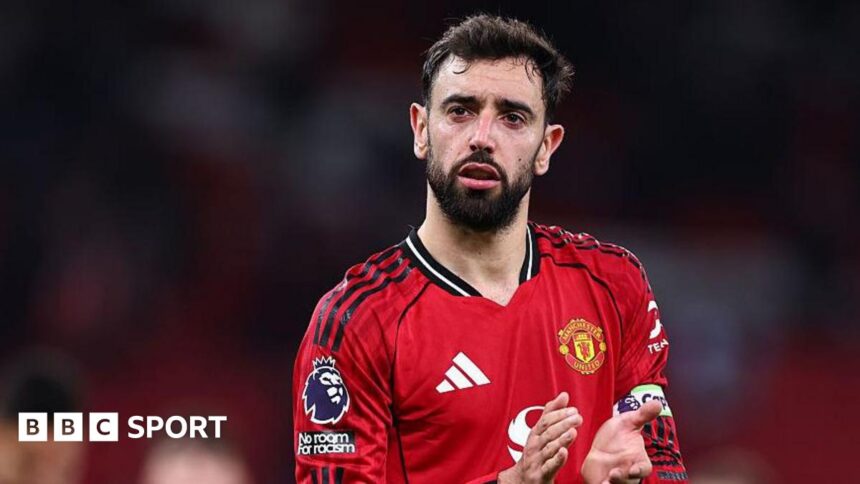
The image of Bruno Fernandes, armband taut on his sleeve, rallying his teammates at Old Trafford is one of the few constants in modern Manchester United’s turbulent era. As captain, his passion has been both celebrated and critiqued, but his commitment has rarely been questioned. Until now. In a startling admission, the Portuguese maestro has revealed a profound personal hurt stemming from last summer’s transfer window, exposing a fragile thread of trust between player and club that threatens to unravel the very leadership structure United is desperately trying to rebuild.
The Staggering Offer and the Stark Realization
In the summer of 2024, the gravitational pull of the Saudi Pro League was at its zenith. Among its prime targets was Manchester United’s captain. Al-Hilal, the Riyadh giants, presented an offer of seismic proportions: a transfer fee in the region of £100 million and a personal remuneration package that would have more than doubled Bruno Fernandes’ salary to a reported £700,000 per week. For a club under the new footballing operations of INEOS, navigating Financial Fair Play (FFP) constraints, the financial logic was coldly compelling.
Yet, for Fernandes, the episode was not about finance, but feeling. The 31-year-old has now articulated the emotional fallout, stating it “hurt” to comprehend that the club hierarchy “wanted me to leave.” This revelation is a critical piece of context often missing from dry transfer reports. It wasn’t merely that United were willing to listen—a standard practice for most clubs regarding any player—but that the player perceived an active desire from within Old Trafford to facilitate his exit. This perception, whether entirely accurate or not, has planted a seed of doubt in the captain’s mind at a time when the team can least afford it.
Expert Analysis: A Captain’s Value Beyond the Balance Sheet
From a purely analytical standpoint, United’s consideration of the bid is understandable. Fernandes, though still supremely influential, is entering a phase where his peak resale value begins a natural decline. A £100m fee for a 30-year-old (at the time) represents extraordinary business, freeing up vast resources for a squad rebuild under Sir Jim Ratcliffe and Omar Berrada. The Al-Hilal transfer proposal was a test of modern football’s priorities: pure asset management versus sporting integrity and leadership continuity.
However, the expert view must also weigh the intangible cost. Bruno Fernandes is not just a creative output machine; he is the emotional engine of the team. His durability is legendary—he was approaching his 300th Manchester United appearance—and in a squad plagued by inconsistency and injury, his presence is a tactical and psychological cornerstone. To even entertain losing that, especially without a remotely like-for-like replacement in the pipeline, signaled a potentially dangerous disconnect between the boardroom’s spreadsheet and the dressing room’s reality.
The situation exposes the complex duality of the modern club captaincy:
- Symbolic Leader: The on-field embodiment of the club’s spirit and fight.
- Financial Asset: A depreciating entry on the balance sheet, subject to cold, hard valuation.
Fernandes’ hurt stems from the collision of these two identities. He viewed himself as the former, only to discover the club was also, and perhaps primarily, assessing him as the latter.
The Fallout and Future: A Relationship at a Crossroads
Fernandes’ decision to reject the move, foregoing life-altering wealth, was a powerful statement of loyalty. But loyalty, once questioned, is never quite the same. His subsequent declaration in October that he will not discuss his future until after the 2026 World Cup is a masterclass in diplomatic deflection. It is a clear signal that his long-term commitment can no longer be assumed. It puts the onus squarely on Manchester United to re-convince their captain that he is central to their project.
This saga will have ripple effects. Teammates look to the captain for stability; if he feels disposable, what message does that send to the rest of the squad? Furthermore, it complicates United’s transfer strategy. Every potential signing, and their agent, will be aware that even the club captain was deemed expendable for the right price. This can undermine the very “project” United are trying to sell to new talent.
Key factors that will determine the path forward include:
- Sporting Direction: Can INEOS present a compelling, clear sporting vision that makes Fernandes feel essential?
- On-Field Success: Tangible progress and a potential trophy are the best salves for wounded pride.
- Contractual Security: With a contract until 2027 (plus an option), United hold the cards, but a new, improved deal may be necessary to fully mend fences.
Prediction: A Defining Chapter in the INEOS Era
The Bruno Fernandes saga is the first major litmus test of the new INEOS regime’s man-management and strategic clarity. Our prediction is that United will now move decisively to reaffirm Fernandes’ status as the untouchable cornerstone of their rebuild. The public courting of top-tier midfield talent like Frenkie de Jong or a younger prospect should be framed as complementing Fernandes, not replacing him. We anticipate a concerted “arm around the shoulder” campaign, likely culminating in a contract extension before the 2026 World Cup, designed to bury this episode and re-establish him as the face of the new United.
However, the genie of doubt is out of the bottle. Should the team struggle next season, or should another galactic offer arrive from Saudi Arabia or elsewhere, the “hurt” Bruno Fernandes felt will resurface. His loyalty, while still present, is now conditional on feeling valued. The captain has, in effect, issued a silent challenge to the owners: match my commitment with yours, not just in words, but in actions and project ambition.
Conclusion: More Than a Transfer Story
Bruno Fernandes’ revelation is far more than a juicy summer transfer tale. It is a profound insight into the soul of modern football, where legendary loyalty clashes with cut-throat commerce. That United’s captain felt wounded by his own club’s calculations is a damning indictment of the communication and culture that has festered at Old Trafford for years. His decision to stay, despite the hurt and the forsaken fortune, underscores a deep love for the club that the hierarchy must now reciprocate with more than just silence. How they respond will define not only Fernandes’ legacy but also the authenticity of the new era they promise. The trust has been fractured; the rebuild must now start with the man wearing the armband.
Source: Based on news from BBC Sport.