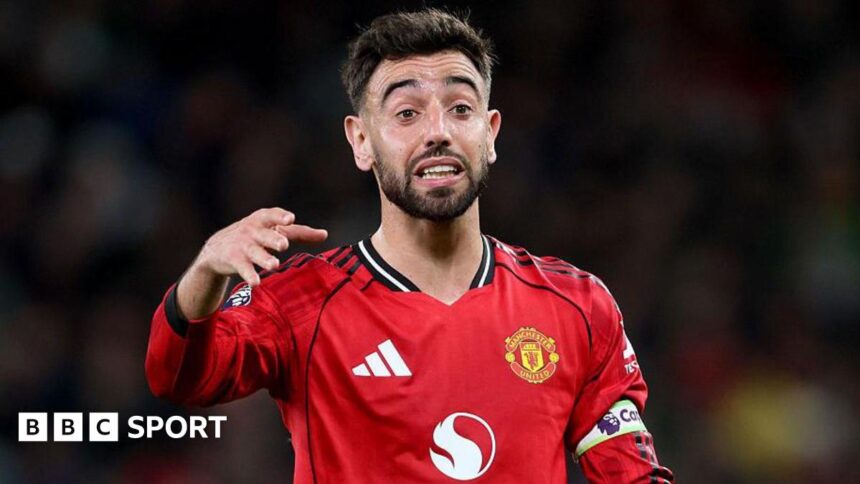
Bruno Fernandes Ballon d’Or Claim: Why Paul Pogba’s Man City Theory Has Teeth
In the high-stakes world of Premier League football, few debates are as polarizing as the true value of a player versus the system they operate in. Paul Pogba, never one to shy away from a headline, has thrown a verbal grenade into that very discussion. The former Manchester United midfielder, now plying his trade at Juventus, has made a bold claim that would send shivers down the spine of every Red Devil: Bruno Fernandes would be a legitimate Ballon d’Or contender if he played for Manchester City.
It’s a statement that cuts deep, not just because of the bitter rivalry between the two Manchester clubs, but because it touches on a painful truth that has haunted United for over a decade. Pogba, speaking on the Rio Ferdinand Presents podcast, argued that the Portuguese playmaker’s individual brilliance is being obscured by the collective mediocrity surrounding him at Old Trafford. “Bruno Fernandes, in other big clubs, is in the top three Ballon d’Or,” Pogba stated, adding that the 31-year-old is a “top player” who would “gain even more plaudits if he was surrounded by better players.”
This isn’t just idle gossip. It’s a deep, uncomfortable analysis of football’s ecosystem, where individual awards are often a reflection of team success. As Fernandes equalled Cristiano Ronaldo’s record by winning his sixth Premier League Player of the Month award for March, the question isn’t whether he is world-class—it’s whether he is being wasted. Let’s dissect Pogba’s theory, the data behind it, and what it means for the future of one of football’s most enigmatic talents.
The Pogba Paradox: Why His Opinion Carries Weight
Paul Pogba is a controversial figure, but his opinion on this matter is uniquely informed. He shared a dressing room with Fernandes for two and a half seasons at Manchester United. He knows the training ground dynamics, the tactical limitations, and the weight of the captain’s armband that Fernandes now carries. When Pogba says the system is failing the player, it’s not sour grapes—it’s a first-hand account.
“When you have players who run, who move, who give you solutions, it makes you a better player,” Pogba elaborated. “At United, it’s different. The system is different. The players are different.” This is the crux of the argument. Pep Guardiola’s Manchester City is a finely tuned machine of movement, positional rotation, and relentless pressing. Bruno Fernandes, with his Hollywood passes, late runs into the box, and set-piece wizardry, would be the ultimate cog in that machine.
Imagine Fernandes feeding Erling Haaland through balls, or exchanging quick one-twos with Kevin De Bruyne and Phil Foden. The assist numbers would be astronomical. Currently, Fernandes has 18 Premier League assists this season—just two shy of the all-time record jointly held by Thierry Henry and De Bruyne (20). He achieved this in a United side that has struggled for consistency, often playing without a recognized striker or with a constantly rotating front line. Put him in a Sky Blue shirt, and that record would already be dust.
- The De Bruyne Comparison: De Bruyne’s best assist season (20) came in a title-winning City side. Fernandes is matching that output in a team fighting for a Europa League spot.
- The Haaland Factor: A player of Haaland’s movement would turn Fernandes’s 18 assists into 28. The chemistry would be terrifying.
- The Tactical Freedom: At City, Fernandes would not be the sole creator. He would have less defensive responsibility and more license to roam into half-spaces.
Breaking Down the Ballon d’Or Math: Team Success vs. Individual Genius
The Ballon d’Or has historically been a team trophy disguised as an individual award. Since 2008, every winner except for Lionel Messi (in 2019 and 2021) and Luka Modric (2018) has won a major international trophy or the Champions League in their winning year. Karim Benzema won it off the back of a Champions League title. Rodri won it in 2024 after a treble-winning season with City and a European Championship with Spain.
Bruno Fernandes has none of that. He has a League Cup and an FA Cup to his name at United. He has never played in a Champions League final. His best individual season (2020-21) saw him score 28 goals and provide 17 assists across all competitions, but United finished second in the league and lost the Europa League final. That is simply not enough for a Ballon d’Or podium finish.
Pogba’s theory rests on the idea that Manchester City provides the ultimate platform. If Fernandes were pulling the strings for a team that wins the Premier League and reaches the Champions League semi-finals, his numbers would be impossible to ignore. The media narrative would shift. Instead of “Is Bruno too risky?” the headlines would read “Is Bruno the best creator in the world?”
Expert Analysis: Let’s look at the raw data. Fernandes is currently averaging 0.7 key passes per 90 minutes in the Premier League, with a pass completion rate of 78% in the final third. At City, under Guardiola’s positional play, his pass completion would likely rise above 85% due to shorter, safer passing options. But more importantly, his expected assists (xA) would skyrocket. Currently, his xA is around 0.45 per game. At City, with finishers like Haaland and Julian Alvarez, that number would likely push towards 0.7—world-class territory.
The Manchester United Reality Check: A Star Dimmed by Chaos
Of course, the flip side of this argument is that Fernandes himself is part of the problem. Critics point to his ball loss statistics—he leads the Premier League in possessions lost—and his tendency to force risky passes. They argue that his style of play is chaotic, which is why he fits a chaotic team like United.
But this is a chicken-and-egg scenario. Fernandes is forced to take risks because his teammates don’t make the runs. He has to attempt the 40-yard diagonal because the midfield is static. He has to shoot from distance because the striker is isolated. In a system like Guardiola’s, the risk is calculated. The chaos is controlled.
Consider this: Kevin De Bruyne also loses the ball frequently. He is often near the top of the “possession lost” charts. But because City’s press is so aggressive and their recovery rate so high, those turnovers rarely lead to dangerous counter-attacks. At United, a lost ball from Fernandes often results in a goal conceded because the defensive structure behind him is porous.
Pogba’s point is not an attack on United; it is a defense of Fernandes. He is saying that the environment is not conducive to winning the sport’s highest individual honor. And the numbers back him up. Since Fernandes joined United in January 2020, he has created more chances (over 500) than any other Premier League player. He has more goal involvements (goals + assists) than any other midfielder in Europe’s top five leagues in that span. Yet, he has zero Premier League titles, zero Champions League trophies, and zero Ballon d’Or nominations in the top five.
Prediction: Will Bruno Fernandes Ever Win the Ballon d’Or?
Realistically, the window for Fernandes to win the Ballon d’Or is closing. He is 31 years old. He is not going to suddenly move to Manchester City. He is the captain of Manchester United, and for better or worse, his legacy is tied to the club’s revival.
However, Pogba’s claim is a powerful thought experiment. It highlights the structural inequality in modern football. A player like Rodri wins the Ballon d’Or because he is the metronome for a perfect system. A player like Bruno Fernandes is overlooked because he is the firefighter for a burning house.
If United were to win the Europa League and Fernandes were to break the assist record (20), he might sneak into the top five of the Ballon d’Or voting. But to be in the top three? He would need a miracle—a deep Champions League run and a Premier League title challenge. Under the current ownership and with the current squad, that feels like a distant dream.
My prediction: Fernandes will never win the Ballon d’Or. But he will be remembered as one of the most statistically dominant midfielders of his generation. And every time he racks up another assist or another Player of the Month award, we will hear the echo of Pogba’s voice: “Imagine if he was at City.”
Conclusion: The What-If That Defines an Era
Paul Pogba’s comments are more than just a soundbite. They are a damning indictment of Manchester United’s inability to build a functional team around a generational talent. Bruno Fernandes is a top-tier footballer who has single-handedly dragged a mediocre squad to respectability. He is the Premier League’s most creative force, a leader by example, and a statistical outlier.
But football is not played on spreadsheets. It is played on the pitch, under the floodlights, surrounded by teammates. And right now, Fernandes is a Ferrari stuck in a traffic jam. Pogba’s theory is correct: in a blue shirt, with a proper structure, Bruno Fernandes would be a Ballon d’Or candidate. The tragedy for Manchester United fans is that we will likely never get to prove it.
As the season winds down and Fernandes chases Henry and De Bruyne’s assist record, remember this: he is doing it the hard way. He is doing it without a system, without elite movement around him, and without the luxury of playing for the best team in the league. And that, perhaps, makes him even more deserving of the recognition he craves.
Source: Based on news from BBC Sport.