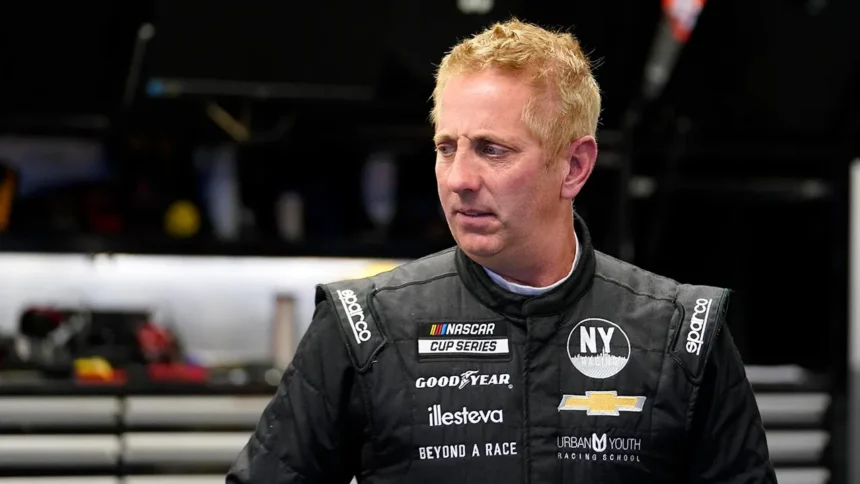
Newly Surfaced Video Captures Harrowing Final Moments of NASCAR Star Greg Biffle’s Fatal Plane Crash
A chilling piece of doorbell footage has emerged, casting a stark new light on the aviation tragedy that claimed the life of NASCAR legend Greg Biffle and his immediate family. The video, obtained by Bobby Renwick and verified by Storyful, provides a visceral, seconds-long glimpse into the catastrophic events at Statesville Regional Airport in North Carolina that silenced one of stock car racing’s most recognizable figures. The release of this footage has sent shockwaves through the motorsports community, transforming a distant news report into an unsettlingly immediate reality.
A Community’s Worst Fears Realized in Seconds of Video
The silent, grainy video begins with an unsettling normalcy—a quiet residential area near the airport. Suddenly, a fiery object, later confirmed to be the twin-engine plane registered to Biffle’s company, GB Aviation LLC, streaks downward into the frame. The aircraft, engulfed in flames, impacts the ground with devastating force before careening across the runway. A massive, rolling fireball erupts, painting the sky with an orange glow and leaving a trail of intense burning wreckage in its path. The sheer violence of the crash, captured from a neighbor’s doorstep, underscores the zero margin for error in aviation and the horrifying suddenness with which the lives of those onboard were lost.
For fans and colleagues who knew Biffle as a fierce competitor who walked away from spectacular crashes at 200 mph, the irony is cruel and profound. The safety of the racetrack, with its barriers, SAFER barriers, and HANS devices, offered no parallel in this private aviation incident. The video stands as a grim testament to the unpredictable nature of such tragedies.
Greg Biffle: A Legacy Forged on the Track
To understand the magnitude of this loss, one must look back at the storied career of Greg Biffle. A rare talent who captured championships in both the NASCAR Craftsman Truck Series (2000) and the NASCAR Xfinity Series (2002), “The Biff” was a cornerstone of the Roush Fenway Racing dynasty in the 2000s. His move to the premier Cup Series was marked by immediate success and a relentless, hard-nosed driving style.
- 19 Cup Series Wins: Including iconic victories at the Southern 500 at Darlington and the 2005 Pepsi 400 at Daytona.
- 2005 Championship Runner-Up: Finished a close second to Tony Stewart in one of the most competitive seasons in NASCAR history.
- The “16” Car: He became synonymous with the No. 16 Ford, a car he piloted to nearly all of his Cup victories and into the hearts of a dedicated fan base.
- Post-Racing Life: After stepping back from full-time competition, Biffle remained involved in the sport through broadcasting and part-time racing, while also focusing on his business ventures, including his aviation company.
Biffle was renowned for his mechanical savvy and no-nonsense approach, a driver who could feel what a car needed. His passing, alongside his family, represents the loss of a crucial bridge between NASCAR’s past eras and its present.
Expert Analysis: The Questions Surrounding Private Aviation Safety
While the National Transportation Safety Board (NTSB) investigation is ongoing, the release of this video inevitably fuels expert speculation. Aviation analysts reviewing the footage point to several immediate, though preliminary, observations.
The presence of an intense, in-flight fire prior to impact is a critical focal point. This suggests a potential catastrophic mechanical failure, possibly related to fuel, electrical systems, or an engine compartment fire. The fact that the aircraft was registered to GB Aviation LLC indicates Biffle was not merely a passenger but the owner and likely the pilot, a man familiar with his machine.
Safety experts emphasize that private aviation, while statistically safe, operates under a different risk profile than commercial travel. The importance of rigorous, continuous maintenance and pilot proficiency cannot be overstated. This incident will undoubtedly renew discussions within the racing and private aviation communities about:
- Enhanced Safety Protocols: For athlete-owned aircraft and travel schedules.
- Mechanical Vigilance: The paramount importance of maintenance for high-performance, privately-owned planes.
- Pilot Training for Emergencies: Specifically, handling in-flight fires and sudden, catastrophic system failures.
Predictions: A Lasting Impact on NASCAR’s Culture and Safety Dialogue
The ripple effects from this tragedy will be felt for years to come, both within the NASCAR garage and beyond. We can anticipate several key developments:
First, the NASCAR community will mourn collectively and profoundly. Biffle was a contemporary of legends like Dale Earnhardt Jr., Matt Kenseth, and Jeff Burton. His loss will be a unifying point of grief, likely honored with tributes at upcoming races, decals on cars, and moments of silence that carry the weight of a lost brother.
Second, the conversation around athlete travel will intensify. While many drivers utilize private planes for the grueling NASCAR schedule, this event may prompt teams and individuals to review their aviation partnerships, pilot standards, and aircraft choices. The sport may see a shift towards even more stringent vetting of private aviation providers.
Finally, Greg Biffle’s legacy will be cemented differently. He will be remembered not only for his gritty racing and championship pedigree but also as the face of a tragedy that sparked important safety conversations. His story will become a somber chapter in NASCAR’s history, a reminder of the risks that exist away from the spotlight of the racetrack.
Conclusion: More Than a Statistic, A Life Extinguished in a Fireball
The newly released video of the plane crash that killed Greg Biffle and his family is not just evidence for an investigation; it is a heartbreaking visual epitaph. It transforms cold facts into a human story of unimaginable final moments. While the NTSB report will eventually provide technical answers, it cannot fill the void left in the NASCAR world.
Greg Biffle’s legacy is now twofold: the roaring engine of the No. 16 Ford battling for a win at Michigan, and the silent, fiery descent captured in a doorbell camera. As the motorsports world grapples with this dual reality, the focus must remain on honoring a champion’s life, supporting the community he loved, and learning whatever lessons possible to prevent such a tragedy from ever striking again. The checkered flag may have fallen on his life, but the memory of his competitive fire will continue to burn in the annals of NASCAR history.
Source: Based on news from Fox Sports.