FIFA’s Grand Stage: Infantino, Trump, and Leaders Unite for 2026 World Cup Draw in D.C.
The opulent Concert Hall of Washington D.C.’s Kennedy Center for the Performing Arts has witnessed countless artistic premieres, but on Friday, it hosted a spectacle of a different kind: a global political and sporting summit. The 2026 FIFA World Cup Draw, a pivotal moment shaping the narrative for the biggest event in sports, became a powerful tableau of diplomacy, ambition, and stark political contrasts. At its center stood FIFA President Gianni Infantino, flanked not by star athletes, but by the commanding figures of former U.S. President Donald Trump, Mexican President Claudia Sheinbaum, and Canadian Prime Minister Mark Carney. This unprecedented convergence signaled that the 2026 tournament, spanning 16 cities across three nations, will be about far more than soccer.
A Draw of Destiny and Diplomacy
While the core function of the event was to determine the groups for the inaugural 48-team tournament, the proceedings were overshadowed by the weight of the political theater. The image of the four leaders—a former and potential future U.S. president, a historic Mexican leader, a Canadian economic heavyweight, and the world’s most powerful soccer bureaucrat—presented a potent symbol of North American collaboration. For FIFA and Infantino, this photo-op was a strategic masterstroke, lending geopolitical gravitas to an organization still working to rebuild its reputation after past scandals.
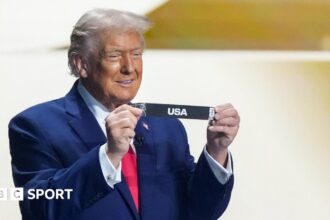
The presence of President Donald Trump, in particular, electrified the atmosphere. In an exclusive interview with Fox News’ Bill Melugin ahead of the draw, Trump shifted focus from the pitch to pressing domestic concerns. He directly addressed one of the most sensitive issues surrounding the 2026 games: urban security and crime in host cities like Atlanta, Los Angeles, and Philadelphia. “We’re going to make sure it’s safe,” Trump stated, framing the World Cup as an event requiring a firm hand. This pre-emptive strike on a potential vulnerability highlighted how the tournament is already being woven into broader political narratives ahead of the November election.
Infantino’s North American Gambit
For Gianni Infantino, the D.C. draw was the culmination of a long-term vision. His presidency has been defined by expansion—more teams, more tournaments, more revenue. The 2026 World Cup is the physical manifestation of that ambition. By standing shoulder-to-shoulder with the host nation leaders, Infantino achieved several key objectives:
- Legitimacy and Power: The visual association with heads of state reinforces FIFA’s authority and global standing.
- Commercial Assurance: Projecting a united front with political leaders reassures corporate partners and broadcasters of stability and support.
- Political Insulation: Aligning closely with host governments, particularly the U.S., provides a buffer against external criticism and operational hurdles.
Infantino’s remarks focused on unity and the transformative power of football. Yet, the subtext was clear: the success of this first-ever tri-nation World Cup is inextricably linked to his legacy. With the 2026 World Cup draw now complete, the logistical marathon begins, and Infantino has positioned himself as the central conductor of a continent-wide operation.
Trump’s Focus: Security as a Selling Point
The Fox News interview with Bill Melugin provided a stark preview of how the World Cup may be framed in the coming American political cycle. Trump’s comments on crime in host cities were not merely observational; they were a political pledge. By vowing to ensure safety, he implicitly positioned the event as a test of governance and law enforcement efficacy—themes central to his campaign platform.
This introduces a complex dynamic for FIFA and local organizing committees. While security planning is always paramount for mega-events, it now carries an added layer of political sensitivity. The performance of police and federal agencies in 2026 will be scrutinized not just through the lens of event management, but through the prism of domestic political debates. Trump’s intervention ensures that urban security will remain a headline topic, for better or worse, right up to kickoff.
Predictions: The Road to 2026
The draw has set the competitive stage, but the event in D.C. set the geopolitical and operational tone. Several key predictions can now be made:
- Hyper-Politicized Environment: The World Cup will be claimed as an achievement by whichever political party holds power in the U.S. in 2026, with constant commentary on security, infrastructure, and economic impact.
- Logistical Triumphs and Tensions: Seamless travel for fans across three countries will be a monumental challenge. Success will be hailed as a model of North American cooperation, while any failures will be magnified.
- Unprecedented Commercial Scale: With 48 teams, 104 matches, and the massive North American market, the 2026 tournament will shatter viewership and revenue records, further cementing FIFA’s financial dominance.
- A Legacy of Concrete Over Culture: Unlike past World Cups in soccer-mad nations, the legacy in the U.S. and Canada may lean more heavily on stadium upgrades and tourism metrics than on a profound transformation of domestic soccer culture.
Conclusion: A New Era of Sport and Statecraft
The 2026 FIFA World Cup Draw in Washington D.C. will be remembered less for the groups that were formed and more for the powerful alliance it displayed. Gianni Infantino successfully orchestrated a moment that fused FIFA’s sporting empire with the machinery of North American politics. The presence of Trump, Sheinbaum, and Carney was a clear declaration that this World Cup is a state project of the highest order.
As the focus shifts from the Kennedy Center to the stadiums from Vancouver to Guadalajara to Miami, the intertwined narratives of sport, security, and diplomacy will only intensify. The 2026 World Cup was always destined to be massive in scale. After the events in D.C., it is now clear it will be equally monumental in its political and cultural significance, a tournament where the battles off the field may captivate the world just as much as the drama on it.
Source: Based on news from Fox Sports.
Image: CC licensed via en.kremlin.ru