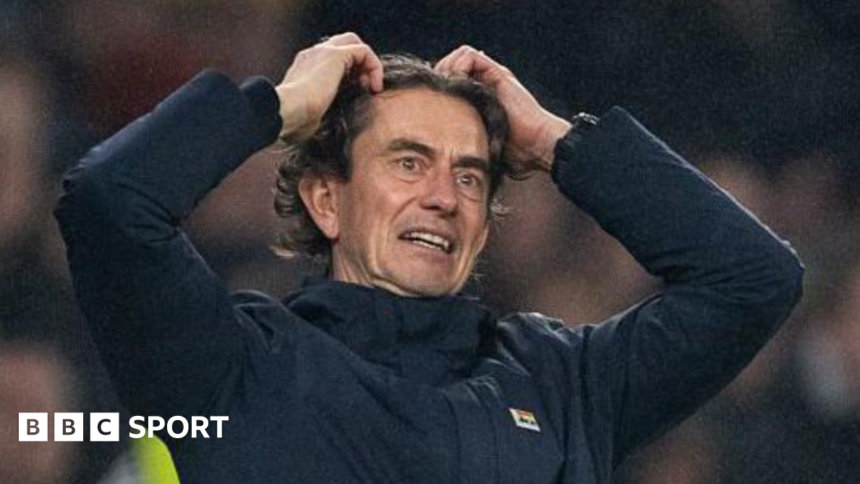
Frank’s Downfall: Inside the Struggle That Lost the Tottenham Dressing Room and Fanbase
The final whistle at St. James’ Park on Tuesday night didn’t just signal another Tottenham defeat. It was the death knell for an era. The 3-1 loss to Newcastle United, a performance devoid of tactical coherence and fighting spirit, was the last act of Thomas Frank’s turbulent tenure. In the cold light of Wednesday morning, a reluctant but resolute club hierarchy pulled the trigger. This wasn’t a snap decision born of one bad night; it was the culmination of a season-long unraveling, a story of a manager who lost the critical battle for belief—both in the dressing room and on the terraces.
A Reluctant Axe Falls: The Board’s Inevitable Decision
For months, the Tottenham Hotspur board, led by chief executive Vinai Venkatesham and sporting director Johan Lange, had stood in a defensive bloc around Thomas Frank. They were his biggest advocates, preaching patience and pointing to the structural challenges beyond the manager’s control. However, the sorry state of Tottenham’s season had become an inescapable reality. The team sat marooned in mid-table, playing a brand of football that was neither effective nor entertaining. The Newcastle debacle was a microcosm of the campaign: defensively porous, mentally fragile, and tactically outmaneuvered.
By Wednesday morning, the calculus had irrevocably shifted. Venkatesham, in conjunction with Lange, made the definitive call. The recommendation was then swiftly presented to the club’s ownership, the Lewis family. The decision, once unthinkable to the board, was now unanimous. The rationale was clear: the project was no longer salvageable under Frank’s leadership. The immediate nature of the sacking, devoid of the usual 24-hour speculation cycle, underscored how undeniable the evidence had become. There was no room for a final stand, no last-gasp plea for time. The connection was broken.
The Erosion of Trust: How Frank Lost the Dressing Room
Behind the scenes, the foundations of Frank’s authority had been cracking for months. While public statements maintained a facade of unity, sources close to the squad indicate a growing disconnect. Frank’s tactical message, once hailed as innovative, began to sound like a broken record to players who saw its flaws exploited weekly. Key figures in the squad reportedly grew frustrated with:
- Predictable In-Game Management: Substitutions and tactical shifts that consistently failed to change the momentum of matches.
- Strained Man-Management: A perceived inflexibility in dealing with different personalities, leading to a one-size-fits-all approach that alienated some.
- Declining Training Standards: A murmur that the intensity and detail in sessions had dropped, translating directly to confused performances on matchday.
This wasn’t a dramatic, headline-grabbing mutiny. It was a slow, corrosive leak of confidence. Players continued to play, but that vital extra percent—the willingness to run through brick walls for the manager’s plan—had vanished. The body language on the pitch told the story: shoulders slumped, communication fractured, and a palpable sense of inevitability when opponents scored. When a manager loses the core belief of his players, results like the Newcastle loss become a regularity, not an anomaly.
The Fanbase Revolt: A Chasm Too Wide to Bridge
If the dressing room disconnect was the internal cancer, the furious fanbase was the external fever. Tottenham supporters, renowned for their passion and patience, had reached a boiling point. Their ire, however, was uniquely directed. While Frank bore the brunt of matchday frustration, a more profound anger was reserved for the perceived detachment of the club’s ownership.
A widespread belief took hold that the Lewis family and the board were insulating themselves from reality, that the passionate protests and consistent critique of Frank’s tenure were being willfully ignored. This created a toxic dual resentment:
- Towards the manager for the dire football and results.
- Towards the owners for a perceived failure to listen and act.
This created an unsustainable atmosphere. The Tottenham Hotspur Stadium, a venue built for energy and intimidation, became a cauldron of anxiety and dissent. Every misplaced pass was met with a groan of expectation, every conceded goal a confirmation of a shared dread. Frank, once seen as a likable figure, became the symbol of the club’s stagnation. The board’s previous reluctance to act was interpreted by fans as arrogance, widening the chasm between the stands and the boardroom until the Newcastle result made it unbridgeable.
What Comes Next: Navigating the Tottenham Rebuild
The sacking is not a solution; it is an admission of a failed project and the first step in a daunting rebuild. The immediate task for Venkatesham and Lange is twofold: stabilize the season and identify a successor who can unite a fractured club.
The immediate predictions for Tottenham are:
- A caretaker manager, likely from within the existing staff, will be tasked with simply stopping the rot and restoring basic confidence until season’s end.
- The sporting director Johan Lange will immediately accelerate a global search for a permanent boss, with the profile likely skewing towards a clear communicator and a proven man-manager.
- The squad will undergo a significant evaluation this summer, with several players deemed to have downed tools facing uncertain futures.
Critically, the new appointment must be a unifying force. The next manager must possess the tactical acumen to organize a talented but bewildered squad, the charisma to re-engage a disillusioned fanbase, and the thick skin to operate under the microscope of a board that has just made a hugely difficult and public decision. They inherit not just a team, but a culture in need of repair.
Conclusion: A Cautionary Tale of Modern Management
Thomas Frank’s downfall at Tottenham is a stark, modern football parable. It proves that in today’s game, success is built on two pillars that are equally vital: results and relationships. Frank’s project crumbled because both collapsed simultaneously. The tactical plan stopped yielding points, which eroded player belief, which fueled fan discontent, which created a hostile environment, which further impacted performances—a vicious, inescapable cycle.
The board’s initial loyalty, while perhaps well-intentioned, ultimately became a liability. By the time they acted, the struggle to get players and fans onboard was already lost. The decision to sack Thomas Frank was not just a reaction to a loss to Newcastle; it was a belated acknowledgment that the very essence of his leadership—the ability to inspire and align a football club—had evaporated. For Tottenham, the path forward is fraught with challenge. The lesson for all is clear: in the high-stakes theatre of the Premier League, once you lose the room and the roar, there is rarely a way back.
Source: Based on news from BBC Sport.