Long Delays, Irate Managers, and Mixed Messages: Is VAR Bad for the Beautiful Game?
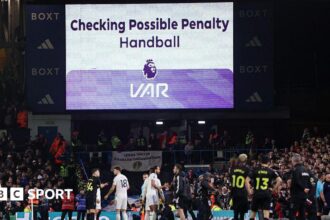
The stadium holds its breath. A goal is scored, celebrations erupt, but a faint, nagging doubt creeps in. Players glance nervously towards the referee, who presses a finger to his ear. The match is suspended, the joy is put on ice, and 50,000 fans are left staring at a giant screen displaying three dreaded words: “VAR CHECK.” This scene, now a staple of modern football, encapsulates the central tension of the Video Assistant Referee era: the pursuit of perfect justice versus the preservation of the game’s soul. As the season’s final VAR stats promise a long list of correct interventions, a more profound question lingers: at what cost does this clinical accuracy come?
The Promise of Perfection vs. The Reality of Disruption
When the Premier League’s end-of-season data is published, it will present a compelling, numbers-based defense of VAR. There will be a catalogue of offside goals correctly chalked off, mistaken identities rectified, and, as seen with Jorge Cuenca’s recently overturned penalty decision, clear and obvious errors erased. The system’s primary objective—to eliminate game-changing mistakes—will be statistically validated. Three crucial interventions from a single Sunday alone will be added to the ledger, proof that technology is making the sport fairer.
Yet, this quantitative success story ignores a qualitative crisis. The experience of watching football is being fundamentally altered. The raw, immediate explosion of emotion that defines the sport is now conditional, perpetually subject to a distant review. Correct decisions are being achieved, but the journey to that correctness is fraught with tension, confusion, and interminable waits that drain momentum and atmosphere from the live event. The process, however accurate, has become a spectacle in itself, and not a welcome one.
The Human Cost: Managers, Players, and the Eroded Spectacle
The frustration is palpable, echoing from the stands to the touchline. Former professionals and pundits have become the most vocal critics, articulating the unease felt by many fans. As Match of the Day pundit Danny Murphy starkly put it: “The problem is what it is doing to the games, to the spectacle, with the amount of time it takes to get there.” His critique hits the core issue: VAR is judged not just on its outcomes, but on its corrosive impact on the flow and feeling of the match.
This disruption manifests in several key ways:
- Irate Managers: The delayed and often opaque decision-making process leaves managers in a state of prolonged fury. Celebrations are halted, tactical momentum is lost, and the inability to get clear, timely explanations fuels a sense of powerlessness and public outrage.
- Stifled Celebrations: The spontaneous, primal joy of a goal is now the rarest commodity in football. Players and fans alike must first run a mental VAR check, turning elation into anxious hesitation. This psychological shift is perhaps the most significant cultural change VAR has wrought.
- Mixed Messages: The “clear and obvious error” standard remains hopelessly subjective. What one official deems clear, another sees as marginal. This inconsistency, especially around subjective handballs and fouls in the buildup, creates a narrative of unpredictability and unfairness, undermining the very authority VAR seeks to bolster.
The Jorge Cuenca incident is a microcosm. A penalty given, then overturned. While the final decision was correct, the interim period was one of high drama and confusion for both teams. The “spectacle” Murphy references isn’t just about entertainment; it’s about the integrity of a continuous, emotionally resonant sporting contest.
Can VAR Be Saved? Predictions for the System’s Evolution
VAR is not going away. Its foundational principle—using available technology to aid decision-making—is now embedded in top-tier sport. The question is not one of abolition, but of urgent evolution. The current model is clearly broken in its execution. Looking ahead, several predictions and necessary changes come into focus.
First, communication must be revolutionized. Rugby and cricket offer blueprints, where officials’ conversations are broadcast live. Bringing fans into the decision-making process demystifies it, builds understanding, and reduces conspiracy theories. The announcement of a decision to the stadium, as seen in some leagues, is a bare minimum that the Premier League must adopt immediately.
Second, the protocol needs a philosophical overhaul. A stricter reversion to the “clear and obvious” threshold is essential. This means:
- Empowering on-field referees to use the pitch-side monitor more proactively for subjective calls, making them the final arbiter.
- Applying a higher tolerance for marginal offsides, perhaps introducing a “thick line” or daylight rule to favor the attacker and restore the benefit of the doubt.
- Strictly limiting checks for “phase of play” offenses to only the most egregious and direct errors.
Finally, time limits for checks should be seriously considered. If a decision is not “clear and obvious” within 60-90 seconds of review, the original on-field call should stand. This would preserve the game’s rhythm and force officials to focus on the truly erroneous decisions.
The Final Whistle: A Tool, Not a Tyrant
The debate around VAR is, at its heart, a debate about what we value most in football. Is it the cold, flawless application of rules, or is it the passionate, imperfect, and flowing human drama that has captivated the world for over a century? The two are not mutually exclusive, but the current balance is wrong.
The end-of-season stats will tell a story of correct interventions, and that is a positive. But they will not measure the deflated celebrations, the simmering fan resentment, or the managers driven to distraction. They will not quantify the erosion of spontaneous joy. VAR was introduced as a tool to serve the game, but it has too often felt like the game now serves the VAR process.
The path forward requires humility from the game’s administrators. It requires acknowledging that while getting more decisions right is a noble aim, how you arrive at those decisions matters just as much. The system must be streamlined, humanized, and made transparent. It must become a swift, clear aid that supports the spectacle, not a slow, cryptic force that suffocates it. Otherwise, football risks winning the battle for perfect accuracy while losing the war for its own soul.
Source: Based on news from BBC Sport.