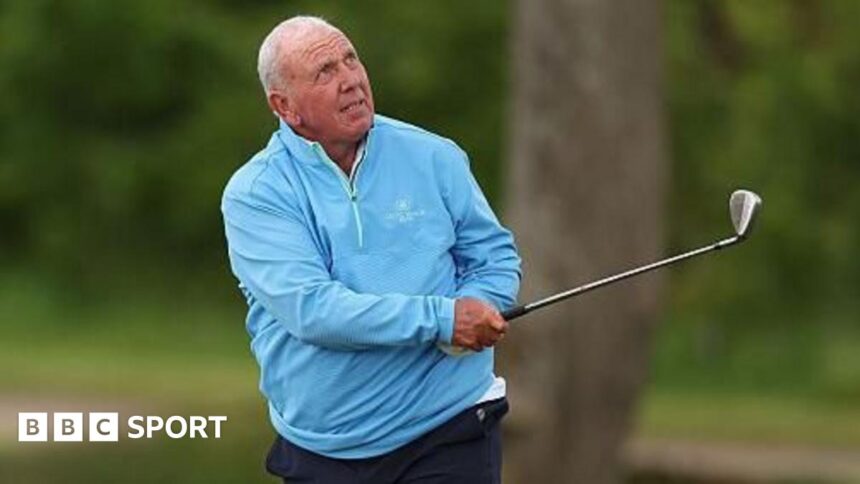
From 10% Survival Chance to Facing the World’s Best at the G4D Open: The Unbreakable Spirit of Richie Willis
Golf is a game of inches, angles, and mental fortitude. But for 68-year-old Richie Willis, the stakes have never been about birdies or bogeys. This week at the G4D Open, held on the sprawling fairways of Celtic Manor—a course Willis has called home for a quarter-century—the Welshman is playing for something far deeper. He is playing for life itself. Twenty-seven years after a catastrophic lorry accident on the old Severn Bridge left him with a 10% chance of survival, Willis will step onto the first tee on Friday to face the world’s finest golfers with disabilities. It is not just a comeback; it is a masterpiece of human resilience.
As a sports journalist who has covered major championships from Augusta to St. Andrews, I can tell you that no leaderboard has ever told a story like this one. Willis’s journey from the brink of death to the first tee of a global championship is a narrative that transcends sport. It is a raw, unfiltered testament to what the human spirit can achieve when the body says “no.” Let’s break down the man, the trauma, and the tournament that will define his legacy.
The Day the Severn Bridge Changed Everything
To understand the magnitude of Willis’s presence at the G4D Open, you must first understand the horror of August 1997. Willis was driving a lorry across the old Severn Bridge—a structure notorious for its narrow lanes and treacherous conditions in high winds. What happened next was a scene ripped from a nightmare. A catastrophic collision tore through the cab. When Willis looked down, he didn’t see his leg. He saw a void. His leg had been completely severed. His arm was mangled, the bones shattered beyond immediate repair.
Paramedics on the scene later told his family that the blood loss alone should have been fatal. The official prognosis was brutal: 10% survival chance. Willis spent months in intensive care, fighting infections, organ failure, and the psychological weight of waking up to a body that no longer matched the one he knew. Surgeons worked miracles to save his arm, but his leg was gone. For most people, that would be the end of the story. For Willis, it was the opening chapter of a new one.
“I remember lying in that hospital bed, thinking about the things I loved,” Willis told me in a quiet moment before practice. “Golf was one of them. I told myself: if I get out of here, I’m going to hit a ball again. I didn’t know how. But I promised.” That promise, made in a sterile room with beeping monitors, is what drives him onto the first tee this Friday.
Celtic Manor: A Sanctuary of Second Chances
There is a poetic symmetry to the venue. Celtic Manor has been Willis’s home club for 25 years. He knows every dogleg, every bunker, every subtle break on the greens. When the G4D Open—one of the premier global events for golfers with disabilities—announced its 2025 edition would be held here, Willis felt the stars align. “This is my backyard,” he said with a grin. “I’ve played these holes in rain, wind, and sunshine. The only difference this week is the crowd and the cameras.”
The G4D Open, sanctioned by The R&A and the DP World Tour, is no minor exhibition. It brings together the world’s best golfers with disabilities, including former Paralympians, amputees, and players with visual impairments or neurological conditions. The field is deep, competitive, and inspiring. Yet Willis’s story stands apart. He is not just competing; he is reclaiming a piece of his identity that was stolen on that bridge.
For Willis, the familiarity of Celtic Manor is both a comfort and a tactical advantage. He knows that the 2010 Ryder Cup course demands precision over power—a style that suits his adaptive game. Playing with a prosthetic leg and limited mobility in his arm, Willis has developed a unique swing that relies on timing and core rotation. “I can’t generate the same speed I used to,” he admitted. “But I know where to miss. I know where the ball will roll. That’s 20 years of muscle memory.”
Expert Analysis: What Willis Brings to the First Tee
As someone who has watched elite golfers crumble under pressure, I can tell you that Willis possesses a weapon that no amount of practice can teach: emotional resilience. The G4D Open will test every facet of his game, but the mental battle is where he excels. Let’s break down his competitive edge:
- Course Management: Willis’s deep knowledge of Celtic Manor means he can plot his way around the course like a chess grandmaster. He will avoid the riskier lines that tempt younger players, favoring conservative shots that keep the ball in play.
- Short Game Prowess: With limited power off the tee, Willis has honed his chipping and putting to a razor’s edge. He is a magician from 100 yards and in—a skill that can steal pars and birdies on a difficult layout.
- Stamina Under Duress: Walking 18 holes with a prosthetic is a physical ordeal. But Willis has trained relentlessly. His ability to stay sharp on the back nine, when fatigue sets in for others, could be his trump card.
That said, the field is formidable. Players like Kipp Popert (the reigning champion) and Juan Postigo bring world-class athleticism and tournament experience. Popert, in particular, is a phenom—a golfer with cerebral palsy who hits the ball with astonishing power and precision. Willis will need to play near-perfect golf to contend for the title. But predictions in this tournament are a fool’s game. The G4D Open is not just about the scorecard; it is about the stories behind every swing.
The First Tee Shot: A Moment of Reclamation
When Richie Willis stands on the first tee on Friday morning, he will not be thinking about the 10% survival chance. He will not be thinking about the severed leg, the mangled arm, or the years of rehabilitation. He will be thinking about the ball, the wind, and the fairway ahead. That single tee shot will be the culmination of 27 years of grit, pain, and unyielding hope. It will be a shot heard far beyond the boundaries of Celtic Manor.
“I’ve already won,” Willis told me, his voice steady. “Every time I step on a golf course, I’m winning. The G4D Open is just a bonus. I’m here to enjoy it, to show people that life doesn’t end when you lose a limb. It changes. But it doesn’t end.”
This is the essence of the G4D Open. It is a tournament that redefines what “elite” means. It is not about the perfect swing; it is about the swing that exists despite the odds. Willis embodies that ethos. He is a symbol for every person who has been told they cannot, that they should not, that they will not. He is proof that the human will is the most powerful club in the bag.
Strong Conclusion: The Legacy Beyond the Leaderboard
As the sun sets over Celtic Manor this weekend, the winner of the G4D Open will lift a trophy. But the true victory belongs to Richie Willis. Whether he finishes first or last, his presence on that course is a seismic event. He has turned a 10% survival chance into a 100% life lived with purpose. He has taken a tragedy and forged it into a testimony.
In my years covering sports, I have seen athletes win gold medals, break world records, and hoist championship trophies. But I have rarely seen someone walk onto a first tee with more courage than Richie Willis. He is not just a golfer; he is a beacon. The G4D Open is better because he is in it. And the world of golf—the world of sport—is richer for his story.
So watch the first tee shot on Friday. Watch the swing, the follow-through, and the walk down the fairway. You are not just watching a man play golf. You are watching a miracle in motion. From the Severn Bridge to the hallowed fairways of Celtic Manor, Richie Willis has proven that the game is never over—as long as you are willing to take the next shot.
Source: Based on news from BBC Sport.