From Ego-Ridden Team to Complete Package: Why PSG Pose the Ultimate Test for Arsenal
In the white-hot cauldron of the Allianz Arena, with a banner demanding to be “shot into the final,” Bayern Munich threw everything they had at Paris St-Germain. The atmosphere was electric, the pressure suffocating. Yet, when the dust settled, it was not the Bavarian giants who advanced. It was a transformed PSG—a team that once symbolized bloated egos and fractured dressing rooms—that delivered the hammer blow. And now, Arsenal must confront the complete package in the Champions League final.
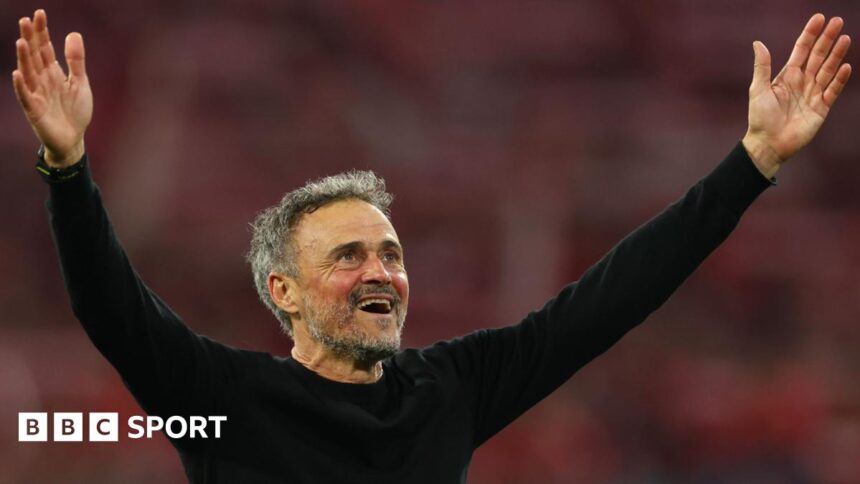
The narrative surrounding Paris St-Germain has shifted dramatically. Gone are the days of celebrity culture and tactical chaos. In their place stands a disciplined, ruthless machine, orchestrated by the master architect of modern football: Luis Enrique. His expertise at rebuilding a culture as well as a football team means that Mikel Arteta’s Gunners will face their sternest test yet, not just in terms of talent, but in psychological warfare and structural integrity.
The Death of the Galactico Era: How Luis Enrique Exorcised the Ghosts
For years, PSG was a byword for internal dysfunction. The infamous “three musketeers” of Neymar, Kylian Mbappé, and Lionel Messi created a circus of privilege, where defensive duties were optional and tactical discipline was a suggestion. The result? Embarrassing collapses in the Champions League, most notably the 6-1 defeat to Barcelona in 2017 and the 2-0 second-leg implosion against Real Madrid in 2022. The club was an ego-ridden team, not a cohesive unit.
Luis Enrique changed that with the precision of a surgeon. His first act was not to buy superstars but to sell the idea of the collective. He allowed Mbappé to leave, dismantled the star system, and replaced it with a system of stars. The result is a squad where the left-back, Nuno Mendes, is as celebrated as the goal scorer. The midfield is no longer a luxury item but a grinding engine of work rate, with Vitinha and Warren Zaïre-Emery pressing with the intensity of a pack of wolves.
This cultural reset is the primary reason PSG now stands as the complete package. They are no longer reliant on individual brilliance to bail out tactical negligence. They are a team that defends from the front, transitions with venom, and possesses the mental fortitude to absorb pressure. Witnessing them hold off Bayern Munich’s late siege—a side known for its relentless second-leg comebacks—was proof that the soft underbelly has been hardened into steel.
The Kvaratskhelia-Dembele Axis: Speed, Genius, and Clinical Execution
If the culture change is the foundation, the attack is the glittering weapon. The signing of Khvicha Kvaratskhelia from Napoli was a masterstroke that signaled a shift in philosophy. The Georgian genius is not a marketing tool; he is a pure footballer, a dribbler with the soul of a street player and the brain of a tactician. His performance in the semi-final second leg was a microcosm of his impact.
- Lightning Transition: In the third minute, Kvaratskhelia received the ball on the left flank. Instead of showboating, he drove directly at the Bayern defense, drawing two defenders before releasing a perfectly weighted pass.
- Clinical Finish: Ousmane Dembele, once considered a chaotic talent, has been reborn under Luis Enrique. He met Kvaratskhelia’s pass with a first-time lash that flew high past Manuel Neuer, silencing 75,000 Bayern fans.
- Defensive Contribution: What makes this duo terrifying for Arsenal is their work rate. Kvaratskhelia tracked back to win tackles in his own box. Dembele sprinted 60 yards to block a cross in the 89th minute. This is not the PSG of old.
Arsenal’s full-backs, whether it’s Ben White or Oleksandr Zinchenko, will face a relentless barrage of pace and trickery. The key battle will be the midfield supply line. If Arsenal can cut off the passes from Vitinha and Zaïre-Emery to the wide men, they can survive. But if PSG’s midfield finds time on the ball, the Kvaratskhelia-Dembele axis will create chaos.
The Tactical Chess Match: Arteta vs. Enrique
This final is a clash of two of football’s most obsessive tacticians. Mikel Arteta has built Arsenal into a high-pressing, possession-dominant side that thrives on structure. Luis Enrique has built PSG into a high-pressing, possession-dominant side that thrives on verticality and transition. The difference lies in the execution under pressure.
Arsenal’s Strengths:
- Set-Piece Prowess: The Gunners are the most dangerous team in Europe from dead-ball situations. Gabriel Magalhães and William Saliba are aerial threats that PSG’s defense, led by Marquinhos, must neutralize.
- Midfield Control: Declan Rice and Martin Ødegaard can dominate the tempo. If they can slow down PSG’s transitions and force them into a half-court game, Arsenal’s structure will hold.
PSG’s Edge:
- Counter-Attacking Velocity: While Arsenal likes to build slowly, PSG can explode in three passes. Kvaratskhelia, Dembele, and the returning Randal Kolo Muani (or Gonçalo Ramos) are lethal in space.
- Big-Game Experience: This PSG squad has been battle-hardened. They survived a 5-4 thriller in the first leg, then a 1-0 defensive masterclass in the second. They know how to win ugly.
The prediction here is not about talent, but about adaptation. Arsenal has not faced a team that combines elite pressing with elite counter-attacking speed in this competition. Liverpool posed a threat, but PSG’s defensive organization is superior. Luis Enrique will likely instruct his team to sit slightly deeper than usual, inviting Arsenal’s full-backs forward, then punishing the space behind them.
Why PSG Will Lift the Trophy: The Final Verdict
This is not the same PSG that choked against Manchester City in 2021. This is a team with a clear identity, a manager who commands absolute respect, and a squad that has bought into a philosophy of collective sacrifice. The “ultimate test” for Arsenal is not just about stopping Kvaratskhelia or Dembele; it is about breaking a psychological barrier. Arsenal has not won a Champions League title in their history. PSG has never won it either. One of these narratives will break.
The X-Factor: Luis Enrique’s Tactical Flexibility
In the semi-final, when Bayern pushed for an early goal, Enrique didn’t panic. He switched to a 5-4-1 mid-block, absorbing pressure and hitting on the break. He is a chameleon. Arteta, for all his brilliance, is more rigid. If PSG scores first, they will be devastating on the counter. If Arsenal scores first, PSG has the patience to wait for a single mistake—a hallmark of their new maturity.
Prediction: PSG 2-1 Arsenal
Arsenal will fight valiantly. Bukayo Saka will cause problems. Declan Rice will dominate the midfield for stretches. But PSG’s ability to win the game in a five-minute burst of transition football will prove decisive. Kvaratskhelia will create the opening goal, and Dembele will score the winner. The banner in Munich asked to be shot into the final. PSG obeyed. Now, they will shoot their way to glory.
Conclusion: The transformation of Paris St-Germain from an ego-ridden collection of stars into a disciplined, complete football team is the story of this Champions League season. They are the ultimate test for Arsenal because they represent everything the Gunners aspire to be: tactically sound, mentally tough, and capable of winning in any style. Luis Enrique has built a monster. And on the biggest stage, the monster will not be tamed.
Source: Based on news from BBC Sport.