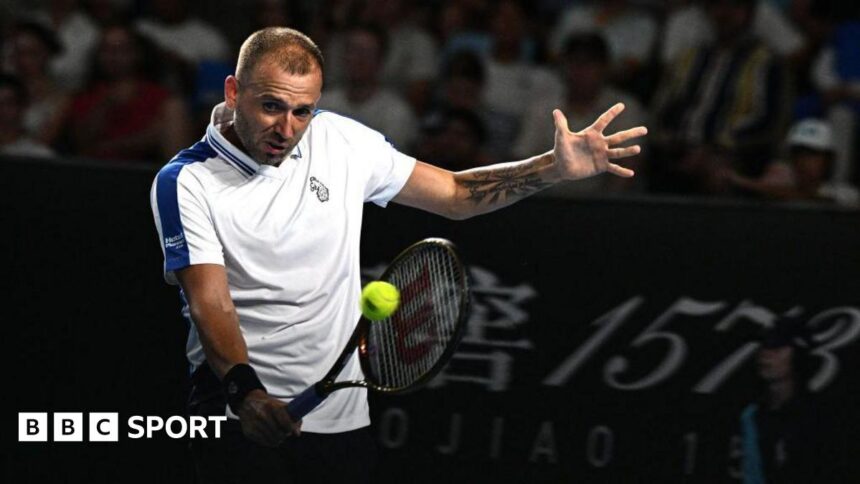
Dan Evans’ Melbourne Misery Deepens as Qualifying Exit Signals Crossroads
The sun-baked courts of Melbourne Park have witnessed both the pinnacle and the nadir of Dan Evans’ career. In 2017, he danced through the draw to a celebrated fourth-round finish, the zenith of his Australian Open journey. Seven years on, the same venue delivered a starkly different, brutally efficient verdict: a 6-1, 6-2 demolition at the hands of Japan’s Rei Sakamoto in the first round of qualifying. For the second consecutive year, the gates to the main draw have slammed shut on the Briton, prompting urgent questions about the road ahead for the 35-year-old former British No. 1.
A 66-Minute Malaise: Dissecting the Defeat
Evans’ defeat was not a dramatic, epic collapse but a quiet, comprehensive unravelling. Lasting a mere 66 minutes, the match was a case study in frustration for the Briton and his supporters. The statistics paint a bleak picture of a player whose weapons misfired catastrophically. Evans’ serve, often a reliable tool for initiating his nuanced, all-court game, deserted him entirely. He recorded four double faults—a telling figure in such a short match—and won a paltry 48% of points behind his first serve. This lack of a foundational shot left him perpetually on the back foot.
Perhaps the most damning stat of all was his inability to mount any offensive pressure on Sakamoto’s serve. Evans did not create a single break point in the entire contest. The 21-year-old Japanese qualifier, ranked outside the world’s top 300, played with freedom and precision, but he was never forced to wrestle with scoreboard pressure or face a moment of genuine crisis. Evans was a passenger in his own defeat, his signature backhand slice and clever net play neutralized by his own inconsistent footing and the young gun’s confident baseline assault.
- Serve Breakdown: 4 double faults, 48% first-serve points won.
- Zero Pressure: Failed to create a single break point opportunity.
- Dominant Opponent: Rei Sakamoto controlled rallies with aggressive depth.
- Historical Context: Echoes his 2024 first-round qualifying loss in Melbourne.
From Fourth Round to Qualifying Quagmire: A Career at a Crossroads
To understand the weight of this loss, one must contrast it with Evans’ history here. His 2017 run to the Australian Open fourth round was a career-defining moment, a proof of concept that his unique, craft-heavy game could thrive on the sport’s biggest stages. He backed it up with a career-high ranking of World No. 21 in 2023 and a famous ATP title in Washington. Yet, the past 18 months have seen a steady, worrying decline. The current ranking of World No. 352 is his lowest in over a decade, a plunge accelerated by a calf injury in 2023 but sustained by a string of early losses.
This second successive failure to even reach the main draw in Melbourne is a psychological blow as much as a ranking setback. The qualifying stages are a brutal, three-round gauntlet where seasoned veterans battle hungry challengers in a high-pressure, low-margin environment. Evans’ game, built on finesse and feel, can be vulnerable to power and relentless consistency in these conditions, especially when his serve is off. The question now shifts from “Can he win a match?” to a more profound, “Can he rediscover the level that once made him a mainstay in the world’s top 30?”
Expert Analysis: What’s Next for the British Veteran?
From a technical standpoint, the immediate fix is obvious: the serve must be repaired. It is the launchpad for his entire strategy. Without a reliable first serve, he cannot shorten points, cannot dictate with his forehand, and cannot use his exquisite touch at the net. Beyond mechanics, there is a mental hurdle to clear. Repeated early losses can erode belief, and the pressure to defend ranking points from past successes has now been replaced by the grinding pressure to simply climb back.
Evans’ schedule will now become a critical factor. Does he drop down to lower-level Challenger events to string together wins and rebuild confidence? Or does he continue to rely on wildcards into ATP Tour main draws, where first-round opponents are typically higher-ranked and even more daunting? His experience and skill make him dangerous on any given day, but the consistency needed to string wins together has evaporated.
Predictions for the 2025 season are necessarily cautious. A return to the top 100 would now represent a monumental achievement. The landscape of British tennis is also shifting, with younger players like Jack Draper and Cam Norrie solidifying their places ahead of him. Evans’ role may be evolving from frontline stalwart to that of a wily veteran capable of the occasional giant-killing, but only if he can arrest the slide. The grass-court season, where his game has always been most effective, looms as a crucial target for resurgence.
How to Follow the Australian Open Action
While Evans’ journey is over, the Australian Open action is just beginning. Fans can follow every swing of the racket from Melbourne through comprehensive BBC coverage.
- Live Radio: Tune into BBC Radio 5 Live Sport and BBC Sounds for ball-by-ball commentaries of the biggest matches.
- Digital Coverage: Follow live text commentaries on the BBC Sport website and app, featuring expert analysis, match stats, and fan interaction.
Conclusion: The Unraveling of a Craftsmaster
Dan Evans’ first-round qualifying exit in Melbourne is more than a bad day at the office; it is a resonant symbol of a career at a critical juncture. The player who once out-thought and out-manoeuvred some of the world’s best on these same courts was rendered powerless by a combination of his own frailties and a confident opponent. The 66-minute defeat to Rei Sakamoto, devoid of break points and full of errors, strips bare the current challenges. The path back is steep and littered with both physical and psychological obstacles. The flair and tennis intelligence that defined Evans’ career have not vanished, but without the engine of confidence and a reliable serve, they remain latent. The 2025 season is no longer about reclaiming past glory, but about answering a fundamental question: does the veteran craftsman have one more act left in him, or has the final chapter of his Melbourne story already been written?
Source: Based on news from BBC Sport.