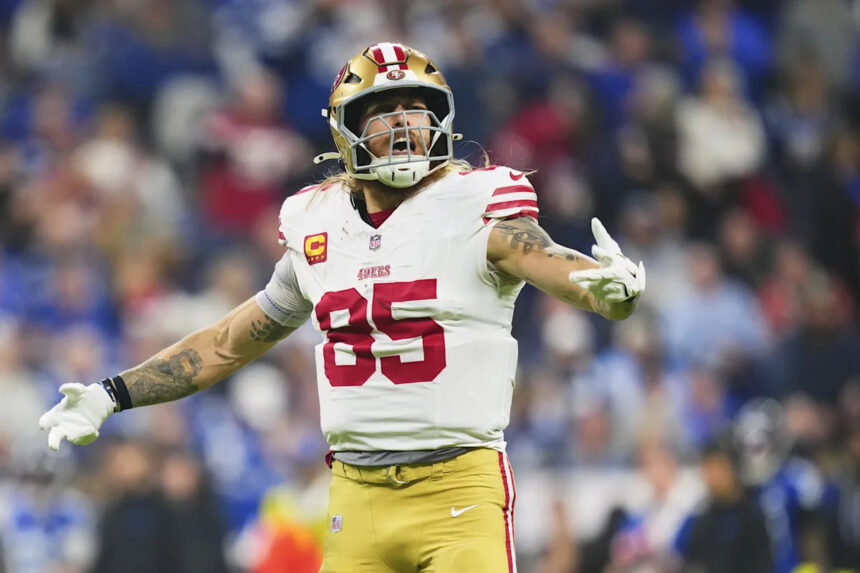
George Kittle Injury Update: 49ers Star TE Exits with Ankle Issue, Questionable to Return vs. Colts
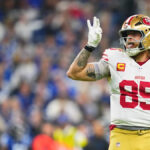
The San Francisco 49ers’ high-powered offense faced a sudden moment of concern in their crucial Week 16 matchup against the Indianapolis Colts. Star tight end George Kittle, in the midst of a dominant performance, was seen limping off the field in the third quarter with an apparent ankle injury. The team quickly listed him as questionable to return, casting a shadow over the Niners’ Super Bowl aspirations and leaving fans holding their breath. As the game entered its final stages, Kittle’s status remained a pivotal, unresolved question mark.
A Sudden Halt to a Dominant Performance
Prior to the injury, George Kittle was unequivocally the engine of the 49ers’ passing attack. He had been systematically dismantling the Colts’ defense, showcasing the unique blend of brute strength and nuanced route-running that makes him arguably the NFL’s most complete tight end. His stat line was already impressive: seven receptions for 115 yards and a touchdown. The connection with quarterback Brock Purdy was electric, and Kittle seemed poised for an even bigger day. The injury occurred not on a massive, highlight-reel hit, but rather on a seemingly routine play—a reminder of the fragile nature of the sport. Video replay showed his ankle getting caught underneath him as he was tackled, an innocuous moment with potentially significant consequences.
The immediate aftermath was telling. Kittle did not retreat to the blue medical tent on the sideline, a signal that the training staff’s initial assessment might have been cautiously optimistic. Instead, he remained on the bench, helmet on, actively working to stretch and loosen up the injured ankle. He was a picture of focused determination, clearly lobbying to get back into the fray. However, as the 49ers’ offense took the field for their next series with just over 12 minutes remaining in the fourth quarter, Kittle remained on the sideline. For the first time all day, he officially missed snaps, replaced in the lineup by backup Luke Farrell.
Navigating the “Next Man Up” Reality
The potential loss of George Kittle cannot be overstated. He is not merely a player; he is a tone-setter, a defensive coordinator’s nightmare, and Purdy’s most trusted safety valve in critical situations. His absence forces a dramatic recalibration of Kyle Shanahan’s offensive playbook. The 49ers’ depth at tight end was immediately tested:
- Luke Farrell: The primary backup, Farrell is a capable blocker but does not offer the same dynamic, field-stretching threat in the passing game as Kittle. His role would likely expand significantly in both protection and short-yardage routes.
- Jake Tonges: The practice squad elevation provides additional depth, but his offensive snaps have been limited primarily to special teams this season.
- Offensive Scheme Adjustments: Without Kittle, Shanahan would likely lean more heavily on wide receivers Deebo Samuel and Brandon Aiyuk in the intermediate middle of the field. Fullback Kyle Juszczyk could also see an increased role as a receiver, and the run game, led by Christian McCaffrey, would become even more central to the offensive identity.
The “next man up” philosophy is a staple of the NFL, but some players are simply irreplaceable. Kittle’s unique ability to line up anywhere—inline, in the slot, or out wide—and command double teams opens up the entire playbook and creates mismatches for every other skill player. His potential absence doesn’t just remove a target; it potentially shrinks the field for the entire offense.
Expert Analysis: The Ankle Injury Spectrum and Playoff Implications
From a medical and strategic perspective, the nature of Kittle’s ankle injury is paramount. The fact that he avoided the medical tent and stayed on the sideline, helmet fastened, suggests the team was initially evaluating a milder sprain rather than a high-ankle or more severe ligament issue. However, the decision to hold him out of consecutive offensive series in a tight game is a clear indicator that the discomfort or instability was significant enough to limit his effectiveness.
“The ‘questionable’ tag in this scenario is fascinating,” says Dr. Alanna Robinson, a former NFL team physician and current sports medicine analyst. “It tells us the medical staff didn’t see an obvious ‘break-glass-in-case-of-emergency’ situation on the initial exam. But with an ankle, especially for a player like Kittle who relies so much on lateral movement and explosive cuts, even a Grade 1 sprain can severely hamper performance. The risk of re-injury or making it worse on the hard, cold December turf is very real. The coaches and trainers are weighing his value in this specific game against his long-term health for the playoffs.”
This is the delicate balance the 49ers now face. With the NFC’s No. 1 seed still within reach but not yet secured, every game is critical. Yet, jeopardizing the health of a franchise cornerstone for a single December contest would be a catastrophic miscalculation. Shanahan’s decision to keep Kittle sidelined as the fourth quarter wound down, even with the game in the balance, may signal a cautious approach with the bigger picture in mind.
Predictions and Looking Ahead for the 49ers
The immediate future for George Kittle hinges on the results of post-game imaging—likely an MRI scheduled for Monday. The spectrum of outcomes is wide:
- Best-Case Scenario: A minor low-ankle sprain with minimal ligament involvement. This could mean limited practice during the week but a strong likelihood of suiting up for Week 17’s massive showdown with the Washington Commanders.
- Moderate Scenario: A moderate sprain that requires a week or two of management. The 49ers, with their depth, might opt to rest him for the final regular-season game to ensure he is 100% for the postseason, especially if their playoff seeding is already locked.
- Worst-Case Scenario: A more significant high-ankle sprain or fracture. This would likely sideline him for the remainder of the regular season and put his availability for the start of the playoffs in serious doubt.
Given Kittle’s toughness and the team’s cautious handling of him on Sunday, the moderate scenario seems most plausible. The 49ers have built a roster robust enough to withstand a short-term absence, but their ceiling as an offense is undeniably lowered without “The People’s Tight End.” The coming days will be filled with watchful waiting, as the diagnosis on Kittle’s ankle will significantly shape the narrative of San Francisco’s Super Bowl chase.
Conclusion: A Tense Wait in the Bay Area
The image of George Kittle, helmet on but sidelined, working diligently on his ankle as his team fought without him, will be the lasting snapshot from the 49ers’ Week 16 victory. It was a stark reminder that championship hopes can pivot on a single, awkward step. While the initial signs point away from a season-ending catastrophe, the ankle injury to George Kittle introduces a layer of anxiety and uncertainty into the 49ers’ otherwise brilliant season. His health is no longer just a footnote; it is now the central storyline as the calendar turns toward January. The team’s “Quest for Six” may very well depend on the strength and stability of one star’s ankle, and the entire Bay Area—and the NFL—will be holding its breath for the next update.
Source: Based on news from Yahoo Sports.