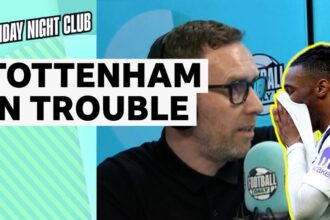
Going Down? Why Relegation is Now a Real and Present Danger for Tottenham Hotspur
The unthinkable is becoming calculable. In the rarefied air of the Premier League’s ‘Big Six’, discussions are typically framed by Champions League qualification, title challenges, and cup glory. For Tottenham Hotspur, a club with a gleaming stadium and global ambitions, the lexicon has abruptly, shockingly shifted. The spectre now looming over N17 is not about finishing fourth; it’s about finishing eighteenth. The shock of the century is no longer hyperbole—relegation from the Premier League is a very real, statistically plausible possibility for Spurs.
A Perfect Storm of Institutional Failure
This descent into peril is not a sudden collapse but the culmination of a perfect storm, years in the making. It is a story of institutional failure on multiple fronts, where short-term thinking has eroded long-term stability. The club’s identity, once built on a clear, attacking philosophy, has been lost in a cycle of managerial churn. The famed “Spurs Way” has been replaced by a palpable sense of drift and confusion, both on the pitch and in the stands. The decision-making at the executive level, particularly in player recruitment and managerial appointments, has created a squad that is imbalanced, mentally fragile, and ill-suited to the brutal fight at the bottom.
Consider the managerial carousel: from the pragmatic José Mourinho, to the attacking but inexperienced Nuno Espírito Santo, to the ultra-positive but tactically rigid Antonio Conte, and now to a head coach in Ange Postecoglou whose system demands a specific player profile the squad lacks. Each change represented a dramatic philosophical shift, requiring different players and attitudes. The result is a dressing room of mismatched parts, assembled by different architects for different blueprints, now asked to perform a function—survival—they were never designed for.
The Anatomy of a Crisis: On-Pitch Symptoms
The league table does not lie. Hovering precariously above the drop zone, Tottenham’s on-pitch performances have exhibited all the classic hallmarks of a team in a relegation battle.
- Defensive Catastrophe: The high defensive line, a non-negotiable for Postecoglou, has been brutally exposed. A lack of pace, poor individual decision-making, and a non-existent midfield shield have made Spurs comically vulnerable to simple balls in behind. They are not being undone by world-class moves; they are being punished for fundamental, schoolboy errors.
- Midfield Vacancy: The engine room is broken. The loss of a genuine defensive midfielder has left a gaping hole, turning transitions into terrifying scrambles. The midfield offers neither control nor protection, leaving a fragile defence repeatedly isolated.
- Mental Fragility: This is perhaps the most damning indicator. Spurs have developed a habit of collapsing after conceding. Heads drop, structure vanishes, and games quickly spiral out of control. This lack of resilience, of fight, is the single most common trait shared by teams who go down.
- Over-reliance on Individual Brilliance: Points have been scraped by moments from Son Heung-min or a moment of set-piece magic, not through cohesive, repeatable team patterns. This is unsustainable in a relegation dogfight where grit and collective organization are the primary currencies.
These are not the growing pains of a project; they are the critical failures of a team in existential trouble.
The Financial and Existential Abyss
For most clubs, relegation is a sporting and financial disaster. For Tottenham, it would be an existential cataclysm. The club is built on a Premier League revenue model. The state-of-the-art Tottenham Hotspur Stadium, a £1.2 billion masterpiece, was financed with the expectation of top-flight broadcasting money, Champions League windfalls, and premium corporate hospitality. The debt servicing is structured around this reality.
Relegation would trigger a financial earthquake:
- A catastrophic drop in broadcast revenue (over £100m).
- Exodus clauses in player contracts being triggered, leading to a fire-sale of top assets.
- Immense difficulty attracting replacements of requisite quality.
- A potential struggle to fill a 62,000-seat stadium for Championship fixtures, hitting matchday revenue.
The very fabric of the club, its ability to compete at any level, would be jeopardized. The gap to parachute-payment-aided rivals would shrink, making an immediate return no guarantee. This isn’t just about one bad season; it’s about a decade of recovery.
Can the Slide Be Stopped? Predictions for the Run-In
So, is it inevitable? Not yet. But the margin for error is gone. The remaining fixtures are no longer about style points; they are about survival scrapes. The key for Postecoglou is a brutal pragmatism he has thus far resisted. He must temporarily shelve the pure ideology and find a way to make the team harder to beat, even if it’s ugly. This could mean:
- Structural Compromise: A deeper defensive line, a dedicated midfield destroyer (even if out of position), and a focus on compactness over expansive control.
- Leadership Mobilization: Players like Son and Cristian Romero must now be true captains in a fight, organizing and demanding resilience every minute.
- Fixture Targeting: Identifying the six-pointers against direct relegation rivals as cup finals. Draws against top sides would be excellent results.
The prediction is fraught with tension. The squad has the individual talent to pull clear, but talent alone doesn’t win relegation battles. The collective spirit, tactical adaptability, and sheer desperation required are currently in severe doubt. The coming weeks will test the club’s mettle like never before. They are in a fight they never saw coming, against opponents who are bred for this struggle.
Conclusion: A Wake-Up Call for a Sleeping Giant
The mere fact that this article can be written with serious analytical intent is the most damning indictment of Tottenham Hotspur’s current state. Relegation is a real risk because the underlying metrics—the defensive record, the mental weakness, the tactical rigidity—are those of a bottom-six side. The club has sleepwalked to the cliff’s edge, mistaking its stadium and history for immunity.
This is the ultimate wake-up call. For Daniel Levy, for the board, for the players, and for the fans. The Premier League’s brutal meritocracy does not care about your brand, your infrastructure, or your past glories. It cares only about results. Tottenham now faces the starkest choice in its modern history: adapt with immediate, pragmatic force to the grim reality of a survival scrap, or risk a fall so great it could define the club for a generation. The shock of the century is on the table. Avoiding it will be the biggest victory Spurs have had in years.
Source: Based on news from Sky Sports.