Beyond the Finish Line: The Unforgettable Boston Marathon Moment That Redefined Victory
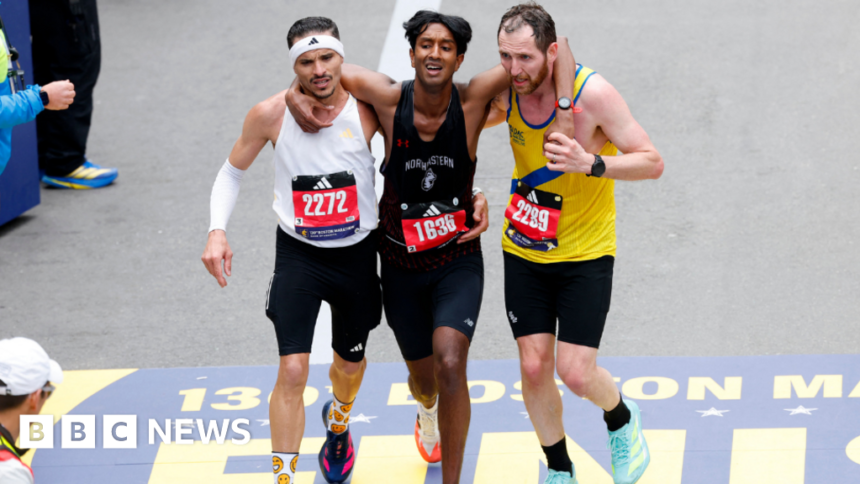
The Boston Marathon is a cathedral of personal achievement. For thousands, its hallowed 26.2 miles represent the culmination of a lifetime of training, a test of will against the unforgiving Newton hills, and the pursuit of a clock time that etches a name in personal history. But in the 2024 race, the most enduring image of victory had nothing to do with a personal best or a podium finish. It was a powerful, human triptych: two runners, sacrificing their own races, physically holding a third, exhausted competitor upright to shepherd him across the finish line. This act of pure sportsmanship, captured in viral spectator videos, didn’t just complete a marathon; it captured the soul of the sport.
The Final Mile: A Collapse and an Instant Decision
The incident unfolded in the marathon’s most brutal theater: the final stretch on Boylston Street. With the iconic finish line banners visibly in sight, runner Ajay Haridasse, his body depleted after 26 miles, fell to the ground. The physical and emotional wall he hit was absolute; he could not stand. In a race where seconds are obsessively guarded, the reaction of fellow runner Aaron Beggs was instantaneous and selfless. He stopped his own race, knelt down, and began to help Haridasse to his feet.
“You could see in his eyes he had nothing left,” Beggs would later recount. “It wasn’t about thinking. It was just about doing what was right.” But even with Beggs’ help, Haridasse was weaving, his legs unable to find purchase or purpose. The finish line, so close, was an impossible distance away. It was at this critical juncture that a second runner, Robson De Oliveira, entered the frame. Assessing the scene in a split second, he made the same profound choice. He looped Haridasse’s other arm around his shoulders, and together, the two strangers became a single, determined unit.
Key Moments of the Rescue:
- Aaron Beggs’ Instinctive Halt: The first critical decision, sacrificing his own race time to aid a fallen competitor.
- The Formation of a Human Crutch: Beggs and De Oliveira, unacquainted, seamlessly coordinating to support Haridasse’s weight.
- The Boylston Street Shuffle: The trio’s slow, deliberate, and powerful march toward the line, witnessed by roaring spectators.
- The Collective Finish: A moment where three individual races became one shared triumph of humanity.
Expert Analysis: Why This Moment Resonates Beyond Sport
To understand the weight of this act, one must understand the marathoner’s psyche. Dr. Lena Torres, a sports psychologist who works with elite endurance athletes, explains: “For a competitive runner, a race like Boston is the apex. Every training run, every dietary sacrifice, every early morning is invested in that one performance. To stop, especially in the final mile, is to consciously override a lifetime of conditioning focused on the self. What these two runners did was an extraordinary leap from a mindset of individual achievement to one of communal humanity.”
This was not merely about helping someone up. It was a profound sacrifice of personal ambition. Both Beggs and De Oliveira were on pace for significant personal records. Their decision transformed their race from a pursuit of a time to a testament of character. The moment also highlights the unique contract of the marathon, a sport that is brutally individual yet fundamentally shared. “The pain is universal,” says veteran marathon commentator Michael Chen. “Every runner on that course understands the struggle at a cellular level. That shared understanding is what makes the bond between competitors so potent. In that final mile, they aren’t rivals; they are survivors of the same journey.”
The incident also serves as a stark and beautiful counter-narrative to the win-at-all-costs mentality that sometimes pervades modern sports. In an era of lucrative sponsorships and branding, their action was gloriously unmonetizable. It was, as De Oliveira simply stated, “just being human.”
Predictions: The Lasting Legacy of a Boylston Street Moment
The ripple effects of this display of sportsmanship will extend far beyond the 2024 race. We can anticipate several key developments:
1. A New Benchmark for Sportsmanship: This moment will become the gold standard, referenced in pre-race briefings, coaching seminars, and running club chats for generations. It redefines what a “successful” race can look like.
2. Enhanced Protocols for Runner Welfare: While Boston already has exceptional medical support, this very public display of late-race extremity may prompt race directors globally to review support in the final 500 meters, potentially increasing the presence of “floating” aid personnel in the finishing chute.
3. The Power of the Citizen Journalist: The event was documented not by official race cameras, but by spectator smartphones. This underscores how the true soul of mass-participation events is now captured and broadcast by the crowd, creating an authentic, unfiltered record of humanity that often outshines official coverage.
4. A Shift in Runner Ethos: New runners entering the sport will carry this story with them. It seeds the idea that while times and medals are memorable, the legacy you leave through your conduct on the course is indelible.
Conclusion: The Greatest Feeling Ever
In post-race interviews, a recovered Ajay Haridasse struggled to find words, ultimately calling the act of his two benefactors “the greatest feeling ever.” His statement is profoundly correct, but its truth extends. The greatest feeling wasn’t just being helped; it was the act of helping. It was the collective roar of the Boston crowd, which reached a fever pitch not for a record break, but for a record *being broken*—the record for compassion in competition.
The story of Aaron Beggs and Robson De Oliveira is a masterclass in perspective. They traded a line in a personal logbook for a permanent line in the story of the Boston Marathon itself. They proved that the most powerful muscles in a marathoner’s body are not in the legs, but in the heart. In the end, they didn’t just help a man finish a race. They reminded the world that before we are runners competing for time, we are people who share a course, a struggle, and a responsibility to one another. That, indeed, is the greatest victory any athlete can ever achieve.
Source: Based on news from BBC Sport.