Hair Pulling “Ought Not To Be Tolerated”: FA Panel Sends a Clear Message After Lisandro Martinez Ban
The beautiful game has a new boundary. A Football Association disciplinary panel has delivered a landmark ruling that will echo through dressing rooms and tactical meetings for years to come: hair pulling is violent conduct and “ought not to be tolerated.” The verdict, which upheld a three-match ban for Manchester United defender Lisandro Martinez, has split opinion among fans but united the game’s lawmakers on a matter of player safety and sporting integrity.
For Martinez, the punishment is now served. The Argentine World Cup winner, 28, will be eligible to return for Manchester United on 9 May against Sunderland, provided he is fit and selected. But the ripple effects of this decision stretch far beyond one player’s suspension. It sets a precedent that could fundamentally alter how defenders defend and how attackers attempt to gain an advantage.
The Incident That Changed the Rulebook
The flashpoint occurred during a tense Premier League clash at Old Trafford, where Manchester United suffered a 2-1 defeat to Leeds. In the 62nd minute, as a corner kick was delivered into the box, Martinez and Leeds striker Dominic Calvert-Lewin grappled for position. Replays showed Martinez reaching up and grabbing a handful of Calvert-Lewin’s hair, yanking his head backward with visible force.
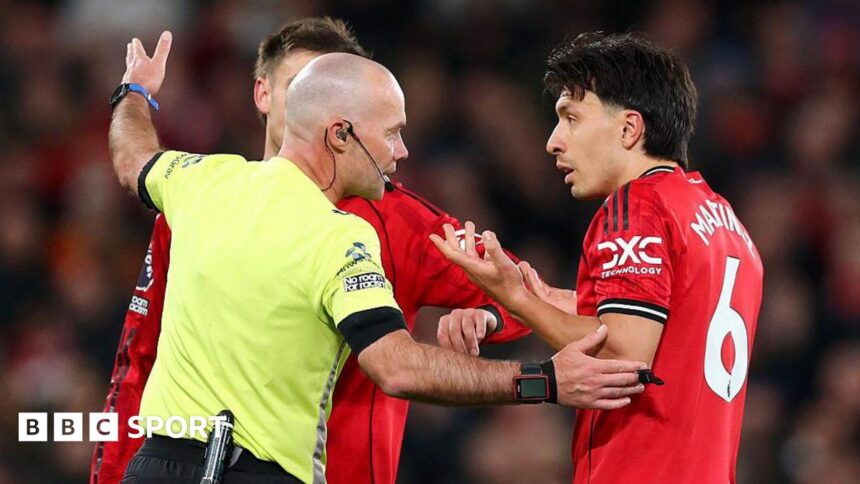
Referee Paul Tierney initially missed the incident. But the Video Assistant Referee (VAR) instructed him to review the footage on the pitchside monitor. After a brief look, Tierney produced a straight red card for violent conduct. Martinez left the pitch in disbelief, and Manchester United’s appeal process began almost immediately.
The club argued that hair pulling did not meet the threshold for violent conduct. They pointed to the fact that no serious injury occurred and that such actions are often treated as minor infringements in the heat of battle. The independent regulatory commission disagreed.
Why the Panel Ruled Against Martinez
In a detailed written report, the panel acknowledged a critical distinction: other forms of violent conduct “carry a much higher risk of harm to an opponent.” A punch, a kick, or a headbutt can cause immediate, visible trauma. A hair pull, while painful and humiliating, rarely results in fractures or concussions.
Yet the panel’s reasoning went deeper. They argued that intent and control are the key factors. Martinez did not simply grab hair in a tangle of bodies; he deliberately pulled it with force, using it as a mechanism to unbalance an opponent. The panel stated that such an action is “deliberate, aggressive, and has no place in football.”
Crucially, the ruling sets a standard that hair pulling is now explicitly listed alongside other forms of violent conduct. It is no longer a grey area. Defenders cannot claim it is “just part of the game” or a “soft” red card. The message is clear: grab hair, get sent off.
- Precedent set: Future incidents of hair pulling will be judged by this standard.
- No tolerance: The panel rejected the “heat of the moment” defense.
- Player safety: The ruling prioritizes dignity and safety over physical harm alone.
Expert Analysis: A Tactical and Cultural Shift
From a tactical perspective, this ruling is a nightmare for defenders who rely on physical intimidation. In the Premier League, set pieces are a battleground. Grabbing an opponent’s jersey, shirt, or hair has been an unspoken tactic for years. It is used to disrupt runs, break concentration, and prevent aerial dominance.
Martinez, despite his relatively small stature for a centre-back, is known for his aggressive, no-nonsense defending. He plays on the edge. This incident suggests he crossed that edge. The panel’s decision effectively tells every defender: adapt or face the consequences.
From a cultural standpoint, this is a victory for players who have long complained about hair pulling being dismissed as “just a game.” Several high-profile players, including Bruno Fernandes and Harry Maguire, have publicly supported Martinez, arguing that the punishment was harsh. But former referees and analysts have largely backed the panel.
Expert take: “This is a watershed moment,” says former Premier League referee Mark Clattenburg. “We have seen players get away with hair pulling for decades because it didn’t cause a broken bone. But the game is evolving. The FA is saying that deliberate, aggressive acts of disrespect and physical control are not acceptable. It is a line in the sand.”
What This Means for Manchester United and Lisandro Martinez
For Manchester United, the timing of the ban was brutal. Martinez missed three crucial fixtures during a congested run-in, including a top-four six-pointer against Aston Villa and a derby against Manchester City. His absence was felt. United’s defense looked less composed, and the team dropped valuable points.
Now, with the ban served, Martinez can return for the match against Sunderland on 9 May. This game is significant for two reasons. First, it is a chance for United to build momentum heading into the final weeks of the season. Second, it is a test of Martinez’s discipline. Will he be more cautious? Or will he continue to walk the tightrope between aggression and recklessness?
The player himself has not commented publicly on the ruling, but sources close to the club suggest he is “frustrated” but “accepting” of the decision. He understands that the game is changing. The modern defender must be not only strong and brave but also intelligent and controlled.
Prediction: Martinez will return with a point to prove. Expect him to be more measured in his physical challenges, but no less committed. He is too experienced to let one incident define his career. However, he will now know that the officials are watching him closely. Any future hair pull, even a minor one, will result in an immediate red card.
The Bigger Picture: Football’s Evolving Code of Conduct
This ruling is part of a broader trend within football to crack down on behavior that was once considered “gamesmanship.” Spitting, biting, and now hair pulling have all been explicitly banned. The game is becoming more sanitized, but also more respectful.
Critics argue that football is losing its edge. They say that physical battles are part of the sport’s appeal. But the FA panel’s reasoning is hard to argue with. There is a difference between a fair shoulder-to-shoulder challenge and a deliberate act that seeks to cause pain or humiliation through a non-essential part of the body.
Hair pulling is unique. It is not a natural part of footballing movement. It is a targeted, premeditated action. In many cultures, pulling someone’s hair is seen as a deeply disrespectful act. The FA has now aligned football with that broader societal standard.
Conclusion: A Line That Cannot Be Crossed
The Lisandro Martinez case is closed. The three-match ban is over. The player will return. But the precedent remains. The FA panel has declared, in no uncertain terms, that hair pulling ought not to be tolerated. It is now officially part of the violent conduct rulebook.
For Manchester United, the focus now shifts to the Sunderland game on 9 May. Martinez will be back, but he will be under scrutiny. For the rest of the Premier League, the message is loud and clear: keep your hands to yourself, or face the consequences.
This is not about being soft. It is about being smart. Football is a physical sport, but it is not a gladiatorial arena. The panel’s decision protects players from unnecessary harm and upholds the dignity of the game. It is a ruling that, in time, will be seen as a necessary evolution.
As Martinez prepares to lace up his boots again, he carries with him a new label: the player who forced football to draw a line in the sand. Whether he likes it or not, he is now part of history. The question is whether he, and every other defender, has learned the lesson. The FA hopes so. The players hope so. And the fans, whether they agree or not, will now know exactly where the line is drawn.
Source: Based on news from BBC Sport.