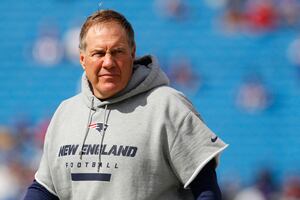
Hall of Fame Voter’s Memory Lapse Fuels Firestorm Over Belichick Snub
The Pro Football Hall of Fame’s selection process is designed to be a sacred, meticulous ritual. For a coach with eight Super Bowl rings and a resume that dwarfs his peers, first-ballot induction seemed less a question of “if” than “when the ceremony would be.” Yet, in the shocking aftermath of Bill Belichick’s unprecedented snub, the process now appears shrouded in a haze of forgetfulness and alleged petty grievances, threatening to tarnish the institution itself.
A “Puzzled” Legend and a Voter’s Curious Admission
When the news broke that the greatest coach in NFL history would not be part of the Class of 2025, the football world reacted with a mix of disbelief and outrage. According to ESPN, Belichick himself was “puzzled” and “disappointed,” a reasonable reaction for a man who built a two-decade dynasty with the New England Patriots. The confusion only deepened when veteran journalist and Hall of Fame voter Hub Arkush, during a radio appearance on 670 The Score in Chicago, made a startling admission regarding his ballot.
When asked directly if he had checked Belichick’s name, Arkush replied, “I honestly can’t remember if I did or not.” He elaborated, stating the process was a “blur” and that he was “pretty sure” he voted for Belichick, but couldn’t say with certainty. For a decision of this magnitude, affecting the legacy of the sport’s most consequential figure, a voter’s unclear recollection is more than an eyebrow-raiser—it’s an indictment of the gravity with which some approach their duty.
The Shadow of Scandal: How Spygate and Deflategate Loomed Large
While Arkush’s memory lapse is troubling, the reported rationale behind the “no” votes is where the controversy finds its substance. Per multiple reports, the old specters of Spygate and Deflategate were explicitly cited by voters as points of contention. The argument, as framed by ESPN’s sources, was that some voters believed Belichick should be “punished” by waiting a year for induction—a symbolic slap on the wrist for transgressions the NFL had already penalized years, and in some cases, decades, ago.
Let’s examine the facts of those sanctions:
- Spygate (2007): The Patriots were fined $250,000, Belichick was personally fined $500,000—the maximum allowed—and the team forfeited its 2008 first-round draft pick.
- Deflategate (2015): The league levied a $1 million fine against the Patriots, stripped two draft picks, and suspended quarterback Tom Brady for four games—a punishment later upheld after a protracted legal battle.
The notion of a “one-year punishment” from the Hall of Fame committee is a bizarre, extra-judicial sanction. It conflates the Hall’s standard of “integrity and sportsmanship” with a desire for retribution, setting a dangerous precedent where off-field controversies, rather than on-field coaching mastery, become the defining criteria for the sport’s ultimate honor.
Expert Analysis: A Process in Crisis of Its Own Making
This incident reveals a fundamental crack in the Hall of Fame’s selection facade. The voting body, comprised of 50 selectors (49 media members and one Hall of Fame player representative), operates in secrecy. There is no public accountability for individual votes, no requirement for voters to justify their decisions. This lack of transparency, while intended to protect the process from public pressure, now shields what appears to be a mix of personal vendettas, flawed reasoning, and astonishing carelessness.
“The Hall of Fame is for honoring the greatest contributors to the game, not for re-adjudicating settled NFL disciplinary matters,” says a veteran NFL personnel executive who requested anonymity. “To make Belichick wait as a ‘punishment’ is to fundamentally misunderstand what the Hall is for. His impact on strategy, roster construction, and the very way the game is played is immeasurable. This isn’t a debate; it’s a fact.”
The comparison point is stark. Coaches with far fewer accolades and their own checkered histories—including those with proven personal conduct violations—have been ushered in without delay. By introducing a new, subjective moral penalty box, the committee has moved the goalposts, undermining its own credibility.
Predictions: What Happens Next for Belichick and the Hall?
The immediate fallout is clear: Bill Belichick will be a first-ballot inductee in 2026. The backlash from this decision has been so severe and widespread that it is difficult to imagine the committee doubling down. However, the damage is done.
Looking ahead, we can predict several consequences:
- Intense Scrutiny on Future Votes: The process will be under a microscope, especially for polarizing figures. The “character clause” will be debated with renewed ferocity.
- A Push for Process Reform: Calls for transparency, such as revealing vote totals or requiring voters to publicly stand by their choices, will grow louder. The “blurred” memory of a voter will not be an acceptable excuse again.
- A Permanent Stain on the Honor: For Belichick, what should have been an unalloyed celebration of his career will now forever be coupled with the story of his baffling initial snub. The Hall has inadvertently created a more dramatic, and ultimately more memorable, narrative for his induction.
Conclusion: A Self-Inflicted Wound on the Sport’s Legacy
The Pro Football Hall of Fame is entrusted with being the guardian of the sport’s history. In failing to induct Bill Belichick immediately, and in the bumbling, controversy-ridden manner in which it unfolded, the selection committee has failed in that duty. They have allowed ancient, league-punished scandals to overshadow 24 years of transformational coaching genius. They have permitted a scenario where a voter cannot recall his vote for the most accomplished candidate in the room.
This was not a judgment on Belichick’s resume; it was a failure of the judges. The Hall’s gold jackets are meant to symbolize excellence. This episode, however, has exposed tarnish beneath the surface—a tarnish not on Belichick’s legacy, which is unassailable, but on the process meant to honor it. Canton will get it right next year, but the question of why it got it so wrong this year will echo far longer than any induction speech.
Source: Based on news from Fox Sports.