The Silva Lining: How Manchester City Navigate a Future Without Captain Bernardo
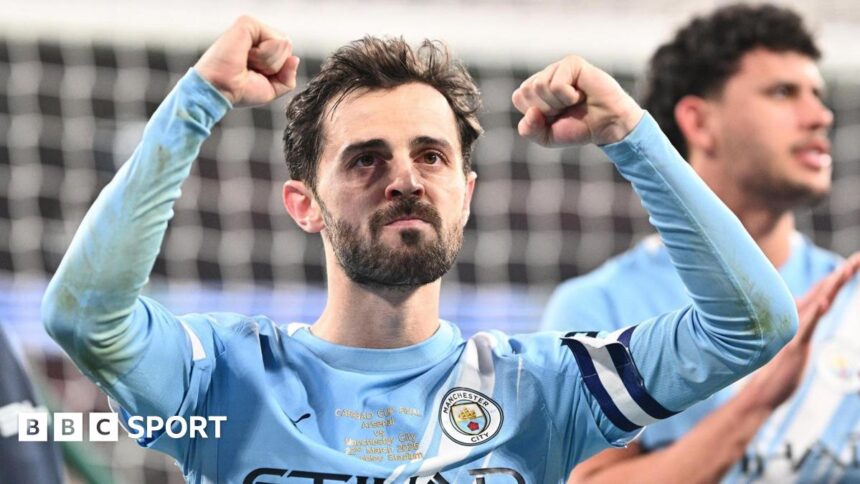
The image of Bernardo Silva hoisting the Carabao Cup at Wembley, a familiar grin etched across his face, felt both celebratory and symbolic. It was his 18th trophy as a Manchester City player, a staggering haul that cements his legacy as one of the most decorated figures in the club’s history. Yet, beneath the confetti, a pressing question lingers at the Etihad: is this the beginning of a long goodbye? With manager Pep Guardiola’s own future a topic of speculation, the potential departure of his most trusted on-field lieutenant, Captain Silva, presents the most intricate puzzle of the City Football Group era. Replacing Bernardo Silva isn’t a mere transfer transaction; it’s an existential challenge of replicating the irreplaceable.
Deconstructing the Irreplaceable: What Bernardo Silva Truly Offers
To understand the scale of the task, one must first appreciate the unique alloy of qualities Silva brings. He is not defined by a single, glaring statistic but by an omnipresent, multifaceted influence. Bernardo is the ultimate system amplifier, a player whose intelligence and technical security make Guardiola’s most complex ideas executable.
His tactical chameleon nature is perhaps his most valuable trait. In a single season, he has been a right-winger, a left-sided #8, a false nine, and a deep-lying playmaker. This flexibility allows Guardiola to reshape his team dynamically, without dropping the team’s technical floor. Silva’s press resistance is legendary; his low center of gravity and dizzying close control in tight spaces are City’s primary escape valve against high-pressing opponents. Furthermore, he brings an unmatched defensive intensity for a player of his technical stature, setting the pressing tone from the front. He is the connector, the disruptor, and the clutch performer, all wrapped into one 5’8” frame.
The Internal Candidates: Can City’s Existing Squad Fill the Void?
Manchester City’s squad is built with succession in mind, and there are several in-house options who could absorb aspects of Silva’s role. However, each comes with a caveat.
- Phil Foden: The most obvious heir. Foden’s technical brilliance, work rate, and growing big-game maturity make him a candidate to assume Silva’s mantle as the creative heartbeat. The key difference is stylistic; Foden is more direct and goal-oriented, whereas Silva is the perpetual motion metronome.
- Julian Álvarez: Possesses the relentless energy and tactical intelligence. He could emulate Silva’s role in pressing systems and as a false nine, but lacks the same profile as a midfield controller in a 4-3-3.
- Rico Lewis: An intriguing wildcard. Lewis’s understanding of inverted full-back and midfield roles shows a tactical intellect that aligns with Silva’s. His long-term development could see him evolve into a versatile midfield operator, though he is years away from that level of influence.
The conclusion is stark: no single current player replicates Silva’s composite skill set. The solution will likely be a collective effort, with multiple players sharing the responsibilities Silva shouldered alone.
The Transfer Market Hunt: Profiling the Ideal Successor
If City dip into the market, their recruitment will be hyper-specific. They won’t seek a like-for-like replica—an impossible task—but a player who can fulfill the core functions while adding new dimensions. Key attributes will include:
- Dual-Playmaker & Presser: The non-negotiable is a player comfortable receiving the ball under pressure and progressing it, while also leading the defensive press.
- Positional Fluidity: Must be effective across multiple midfield and forward roles.
- Big-Game Temperament: A proven performer in the Champions League knockout stages is a premium requirement.
Names that fit this elite profile are scarce. Bayern Munich’s Jamal Musiala embodies the dribbling and versatility, but is nearly untouchable. Barcelona’s Pedri offers the control and intelligence, though with a different physical profile. A more attainable target could be Xavi Simons of RB Leipzig (on loan from PSG), whose creative output and adaptability are compelling. Internally, the continued evolution of Mateo Kovačić into a more advanced role could be a short-term fix, leveraging his own exceptional ball-carrying and retention skills.
A Philosophical Shift: Life After Pep and Bernardo
The potential concurrent exits of Guardiola and Silva signal the possible end of a definitive era. This forces a broader strategic question: does the club seek continuity or evolution? A new manager may not demand a “new Silva,” preferring to build around a different core strength, perhaps prioritizing physicality or a traditional #10. This transition could accelerate the shift towards making Phil Foden the undisputed focal point of the attack, building the team’s creativity around his movement and goal threat. The club’s famed “noisy neighbor” mentality, forged in the Silva and Kompany era, may also need refreshing. Leadership must emerge, whether from the quiet authority of Rúben Dias or the passionate example of Kyle Walker.
City’s model is built on planning and data, but some elements are intangible. Bernardo Silva provided a unique blend of humility and competitive fury, a superstar who played like a academy graduate fighting for his place. This cultural fit is as crucial as the tactical one.
Conclusion: The Blueprint for Transition
Manchester City have faced iconic departures before—Kompany, Agüero, David Silva—and continued to thrive. The exit of Bernardo Silva, particularly alongside Guardiola, would be the most profound test yet of the club’s post-Abu Dhabi infrastructure. The path forward is not a single signing, but a multi-pronged strategy.
Immediate on-field duties will be distributed among Foden, Álvarez, and Kovačić, with a potential marquee signing aimed at long-term elite creativity. The club’s identity will gradually recalibrate around the emerging leadership of Dias and the generational talent of Foden. While the tactical chameleon will be gone, City’s ability to adapt and evolve remains their greatest strength. Replacing Bernardo Silva isn’t about finding one man to carry the weight of 18 trophies; it’s about ensuring the system he helped perfect is robust enough to withstand the departure of its most versatile component. The era defined by Pep and Bernardo may be concluding, but the Manchester City machine, built on more than any individual, is preparing for its next iteration.
Source: Based on news from BBC Sport.