From Plasterboard to the Oche: How Jonny Clayton’s Unlikely Journey Forged a Premier League Champion
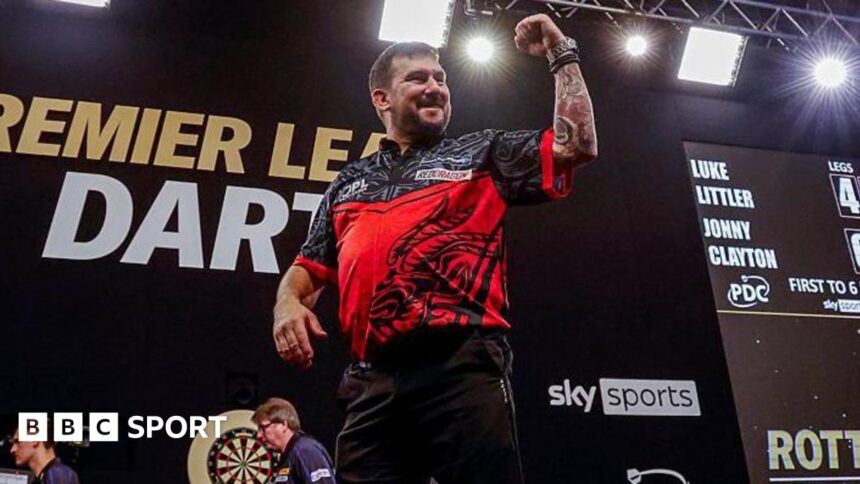
The roar of the crowd is deafening, a wall of sound that vibrates through the very floorboards of the arena. Under a blistering spotlight, a man stands perfectly still, his focus absolute. He is Jonny Clayton, one of the world’s finest darts players, a two-time World Cup winner and a Premier League champion. But the hands that now so delicately grip a tungsten dart, threading it through the eye of a needle at will, are the same hands that spent decades mixing plaster, smoothing walls, and mastering a very different, equally demanding craft. This is not just a story of sporting success; it is a testament to the power of a parallel life, where the discipline of a day job built the unshakeable foundation for darting glory.
The Ultimate Balancing Act: Plaster by Day, Trebles by Night
For most elite athletes, the path to the top is a singular obsession, paved with single-minded dedication from a young age. In the world of professional darts, however, the journey is often more rugged, a side-hustle that must pay its way before it can become a livelihood. The pivotal “job or arrows” crossroads is a rite of passage. Jonny Clayton arrived at this junction and, for years, chose both. While his rivals toured full-time, the affable Welshman was a full-time plasterer for Carmarthenshire County Council, his world a dizzying blend of trade and talent.
Imagine the routine: an early start on a building site, the physical toll of the work, the dust and the deadlines. Then, instead of rest, it was a drive to a tournament, a change into a playing shirt, and a step onto the stage to face a global superstar. This was Clayton’s reality for over a decade. Where others had practice boards, he had plasterboards. His preparation wasn’t endless hours of solitary repetition; it was earned in the gaps, after the real work was done. This work-life balance like no other wasn’t a hindrance to his darting dreams; in a twist of fate, it became their greatest architect.
How the Day Job Forged a Champion’s Mentality
Expert analysis of Clayton’s game often highlights his remarkable consistency, his unflappable demeanor under pressure, and his relentless work ethic. To understand these traits, one must look not just at his practice routine, but at his previous profession. The life of a tradesman instills a unique psychological framework, one that translated powerfully to the oche.
- Pressure as a Perspective: To a man who has balanced on scaffolding and raced against drying plaster, the pressure of a double to win a leg feels different. The darts stage, for all its intensity, was not a matter of structural integrity or a client’s livelihood. This relative perspective allowed Clayton to play with a freedom and enjoyment that often eluded his full-time rivals.
- The Craftsman’s Precision: Plastering is an art of smooth, controlled movements and a keen eye for finish. That demand for manual dexterity and steady hands is directly transferable to the throwing action. Clayton’s smooth, rhythmic throw isn’t manufactured in a darting lab; it’s the motion of a craftsman.
- Grind as a Default Setting: A tradesman doesn’t have the luxury of an “off day.” The work must be completed, and to a high standard, regardless of mood or fatigue. This ingrained discipline forged a mental toughness that made Clayton a nightmare opponent. He was accustomed to delivering his best when he wasn’t necessarily feeling his best—the ultimate asset in a long-format tournament.
His incredible rise to the pinnacle of the sport—culminating in his 2021 Premier League Darts triumph and those two World Cup of Darts titles for Wales—was not a sudden explosion. It was a slow, steady burn, a structure built as solidly as one of his walls, layer by patient layer.
The Ferret Unleashed: Predictions for a Cemented Legacy
Now a full-time professional, “The Ferret” has proven his major victories were no fluke. The question is no longer if he belongs among the elite, but how much more he can achieve. The plasterer’s mindset remains, even if the trowel has been retired.
Looking ahead, Clayton’s trajectory suggests a player who will remain a permanent fixture in the winner’s circle. His game is built on a rock-solid foundation of technique and temperament, not fleeting hot form. We can predict with confidence that he will:
- Remain a Premier League and major title contender for the foreseeable future. His all-round game and big-stage temperament make him a threat in every event he enters.
- Become the bedrock of the Welsh national team for years to come, chasing further World Cup of Darts glory alongside Gerwyn Price.
- Inspire the next generation of “hybrid” athletes. His story is a powerful blueprint for balancing passion with practicality, showing that the road to the top can be walked in work boots.
The greatest threat to Clayton isn’t a rival player; it’s the potential loss of that grounding perspective that his trade provided. Maintaining the humble, hard-working ethos of his plastering days will be key to continuing his success in the often-glitzy world of professional darts.
A Legacy Built on More Than Checkouts
Jonny Clayton’s legacy will ultimately be measured in titles—his Premier League crown, his World Cup wins, his growing collection of TV trophies. But it will be defined by something far more profound: his story. In an era of specialized athletes, he is a glorious anachronism, a reminder of the sport’s working-class roots and a symbol of extraordinary duality.
He didn’t just transition from plasterer to champion; he used the first to enable the second. The strength to hold his nerve on a double-top for the title was built holding a hawk and trowel. The patience to wait for his chance was learned waiting for a wall to dry. Jonny Clayton’s success is a masterclass in applied resilience, proving that the skills for sporting greatness can be honed in the most unlikely of workshops. His journey shouts a powerful, encouraging truth: that the weight of a real job doesn’t have to crush a dream—it can, in fact, be the very thing that makes you strong enough to carry it out.
Source: Based on news from BBC Sport.