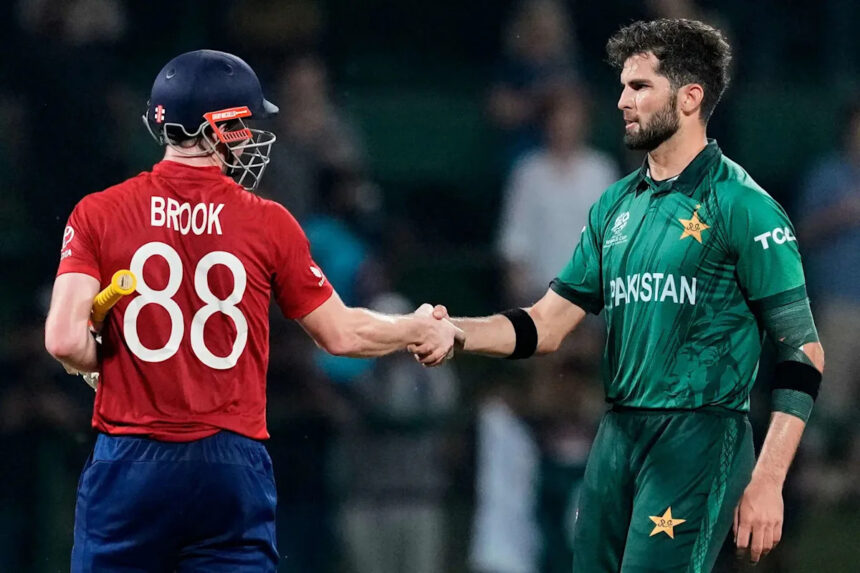
Shaheen Afridi’s Grace in Defeat: A Salute to Brook, a Jab at Hesson, and Pakistan’s Precarious Path
In the crucible of a World Cup knockout, where dreams are shattered and heroes forged, the most telling stories are often written not in the scorebook, but in the moments after. At Pallekele, as Harry Brook’s majestic century extinguished Pakistan’s semi-final hopes, it was the vanquished warrior, Shaheen Shah Afridi, who walked across the battlefield to offer a handshake of pure, unadulterated respect. This single gesture, captured against the backdrop of Pakistani despair, spoke volumes about the man, the sport, and the thin line between rivalry and reverence. In a post-match interview laced with candid reflection, sharp critique, and desperate hope, Afridi painted a picture of a team at a crossroads, tipping his hat to a friend’s “world class” innings while taking a pointed jab at the strategic mindset of coach Mike Hesson.
- The Captain’s Knock: Afridi’s Unflinching Praise for Harry Brook
- “I Hope New Zealand Lose”: The Stark Reality of Pakistan’s Dependency
- Shaheen’s Fire & The Subtle Jab at Mike Hesson’s Philosophy
- Expert Analysis: What Now for Pakistan’s T20 World Cup Campaign?
- Conclusion: Grace Under Pressure Defines a Champion’s Mentality
The Captain’s Knock: Afridi’s Unflinching Praise for Harry Brook
For Shaheen Afridi, the pain of defeat was inextricably linked to the awe of witnessing a masterpiece. Harry Brook’s 101-run knock was more than match-winning; it was, in Afridi’s own words, “the best innings” he had seen, a “captain’s innings” of the highest order. Afridi’s analysis went beyond platitudes, zeroing in on the technical and temperamental excellence that broke Pakistan’s back.
- Partnership Prowess: While Pakistan’s batting crumbled with “back-to-back wickets,” Afridi highlighted Brook’s ability to anchor amidst chaos. “Wickets were falling, but he was still in the crease… building partnership. I think we missed that opportunity,” he conceded.
- Unprepared Preparation: Afridi, a bowler who prides himself on out-thinking batters, was stunned by Brook’s readiness. “I never see a batsman like him. Today he was properly ready for every ball to hit it. He was well prepared for us.”
- PSL Bond Forged in Fire: This admiration is rooted in shared history. Their time together at Lahore Qalandars in the PSL gave Afridi a front-row seat to Brook’s evolution. “He played on Asian wickets and improved a lot,” Afridi noted, revealing he saw Brook’s potential long before he became an England mainstay.
This generous praise in the wake of personal and national sporting devastation underscores a modern cricketer’s ethos: the ability to separate the contest from the competitor, and to acknowledge greatness even as it destroys you.
“I Hope New Zealand Lose”: The Stark Reality of Pakistan’s Dependency
Afridi’s graceful acceptance of Brook’s brilliance was immediately followed by the grim arithmetic of Pakistan’s tournament life. His admission, “I hope New Zealand loses their match,” laid bare the precarious position Pakistan now occupies. Their fate is no longer in their own hands, a reality Afridi met with a mix of hope and harsh introspection.
“These things happen in cricket,” he stated philosophically. “But we are still in the tournament, anything can happen.” This sliver of optimism, however, is tempered by the acknowledgment of self-inflicted wounds. Afridi pinpointed the batting failure as the core issue, specifically the lack of a set batter to navigate the tricky Pallekele surface. The contrast with Brook’s innings was a painful lesson they learned too late.
For a team of Pakistan’s pedigree, relying on external results is a unfamiliar and uncomfortable position. Afridi’s public calculation of the required permutations highlights the shift from proactive contenders to hopeful spectators, a mental adjustment as difficult as any technical flaw.
Shaheen’s Fire & The Subtle Jab at Mike Hesson’s Philosophy
Personally, the match was a powerful comeback for Shaheen Afridi. After being dropped for two earlier games, he returned with a fiery spell of 4 for 30, reclaiming his role as Pakistan’s attack leader. “My focus was to work on my bowling… so that I can give good results,” he said, dismissing any notion of having a point to prove. “I don’t need to prove to anyone.”
Yet, his most intriguing comments were reserved for team strategy and coach Mike Hesson. When asked about the team’s composition and Hesson’s noted preference for stacking the side with all-rounders, Afridi’s response was diplomatically pointed. “Look, he has a mindset, he is a head coach. I think he knows better than us how to run a team. And he is responsible for that.”
Read between the lines, and this is a significant remark from Pakistan’s ODI captain. It suggests a potential divergence in vision between the leadership on the field and the coaching box regarding team balance. Afridi, a pure and world-class fast bowler, subtly questioned the obsession with multi-dimensional players, implying that specialists—like a batter who can bat through the innings, as Brook did—hold equal, if not greater, value. This jibe at coach Mike Hesson’s strategy reveals underlying tactical tensions as the team searches for answers.
Expert Analysis: What Now for Pakistan’s T20 World Cup Campaign?
The path forward for Pakistan is fraught with “ifs” and “buts.” Shaheen Afridi’s words have framed the narrative: a team aware of its flaws, respectful of its opponents, but clinging to external hope. Our expert analysis breaks down the key takeaways:
- Batting Fragility is Fatal: Afridi’s diagnosis is correct. In modern T20s, especially on challenging wickets, one anchor innings is non-negotiable. Pakistan’s middle-order volatility has been their Achilles’ heel.
- Leadership Dynamics: The subtle critique of Hesson’s “all-rounder” mindset is a subplot to watch. It raises questions about selection coherence and whether the team’s identity is being compromised for theoretical flexibility.
- Psychological Toll: Switching from controlling your destiny to praying for other results is mentally draining. It can lead to a flat performance in their final must-win game, or it could unshackle them to play freely.
- Brook’s Coming of Age: For England, Afridi’s testimony cements Brook’s knock as a career-defining, leadership-announcing innings. It signals the arrival of a new, mentally tough pillar for England in post-World Cup transition.
Prediction: Pakistan’s tournament now hinges on a miracle of mathematics and other teams’ results. Even if they sneak through, the structural issues—batting partnerships and strategic clarity—exposed by Afridi and exploited by Brook will remain. Their campaign, regardless of the New Zealand result, feels like a reckoning that will necessitate tough conversations about philosophy and personnel beyond this World Cup.
Conclusion: Grace Under Pressure Defines a Champion’s Mentality
Shaheen Shah Afridi’s post-match demeanor was a masterclass in sportsmanship and stark honesty. In one breath, he celebrated an opponent’s genius; in the next, he dissected his own team’s failings and hinted at internal strategic debates. His “I hope New Zealand lose” is the desperate plea of a competitor, but his salute to Harry Brook’s world class innings is the enduring respect of a pure cricketer.
Pakistan’s World Cup journey may end in the ledger of net run rates and other teams’ scores. However, the image of Afridi, in his moment of professional pain, acknowledging Brook’s excellence, will endure longer. It reminds us that while results are temporary, the spirit of the game and the recognition of true greatness are permanent. For Pakistan, the road ahead requires more than hope—it requires the kind of partnership-building, clear-minded responsibility that Afridi saw, and applauded, in his friend and foe on a fateful night in Kandy.
Source: Based on news from Yahoo Sports.