‘Idiot’ or ‘Understandable’? Dissecting Martinelli’s Apology to Bradley
The beautiful game is often a battlefield of split-second decisions, where raw instinct collides with the rulebook and the unwritten codes of sportsmanship. In the dying embers of a tense, title-race 0-0 draw between Liverpool and Arsenal, a moment of pure, unvarnished frustration ignited a firestorm of debate. As Arsenal’s Gabriel Martinelli attempted to physically push an injured Conor Bradley off the pitch, he crossed a line. The immediate question from fans and pundits was binary: was it the act of an ‘idiot,’ or was it an ‘understandable’ lapse in the heat of a monumental battle? Martinelli’s subsequent apology hasn’t ended the conversation; it has merely framed it.
A Moment of Madness in the Merseyside Crucible
To understand the incident, one must first feel the pressure of the context. The Emirates was a cauldron. A draw kept Arsenal at the Premier League summit, but with Manchester City lurking, every point, every second, felt precious. Deep into stoppage time, with the game locked, Liverpool’s young Northern Irish defender Conor Bradley chased a ball toward the touchline, landed awkwardly, and crumpled, immediately clutching his knee. The ball was in play. For Arsenal, this was a critical opportunity, a potential final attack. For Martinelli, the sight of an opponent down in a crucial area triggered a primal, competitive response.
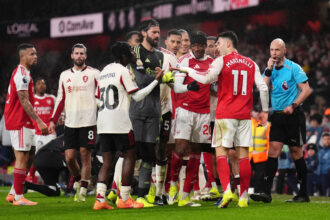
He dropped the ball onto the stricken Bradley—a gesture often seen as a sportsmanlike act to stop play—but what followed was anything but. Martinelli then placed his hands on Bradley’s back and gave a clear shove, an attempt to physically move the player off the field so the match could resume. The reaction was instant and visceral. Liverpool’s players swarmed, led by the incensed Virgil van Dijk. The referee intervened. The image was jarring: a player seemingly prioritizing tactical advantage over a competitor’s evident distress.
- Key Incident: Bradley’s non-contact knee injury in Arsenal’s attacking third during stoppage time.
- Martinelli’s Action: A two-part move: dropping the ball (acknowledging injury) followed by a hands-on shove (attempting to expedite play).
- Immediate Fallout: Furious Liverpool protests, referee intervention, and widespread broadcast condemnation.
The Expert Analysis: Instinct, Rules, and the Grey Area
This is where the debate fractures. From a purely cold, tactical standpoint, Martinelli’s logic is traceable. The laws of the game state an injured player should be removed from the pitch for treatment. With Bradley down in a dangerous area, Arsenal’s flow was halted. In the white-hot frenzy of a title chase, the desire to restart quickly is overwhelming. Some argue this was a brutal but understandable football instinct gone too far, a moment of stupidity rather than malice.
However, the counter-argument, rooted in the sport’s ethical fabric, is far more compelling. Football has a sacred, if informal, covenant regarding player safety. The act of dropping the ball acknowledges an injury. To then violate that same player’s physical space while he is vulnerable is a profound contradiction. It transforms a gesture of concern into one of callous impatience. Pundits have rightly pointed out that the responsibility to stop play and ensure care for an injured player—especially one from the opposition—supersedes any tactical gain. This wasn’t a tactical foul; it was a failure of sportsmanship at the most basic level. The “heat of the moment” defense only stretches so far when the health of a fellow professional is in question.
Martinelli’s swift public apology is a significant data point. “I want to apologize to everyone for that moment,” he stated. “It was never my intention to hurt anyone and I’m sorry.” The apology suggests recognition, a cooling-off period where the instinctual act was replaced by regret. It doesn’t erase the action, but in the modern game where accountability is often scarce, it is a necessary first step.
Beyond the Incident: What It Reveals About the Title Race
This flashpoint is a microcosm of the immense pressure now defining the Premier League title race. Arsenal, under Mikel Arteta, have cultivated a fierce, streetwise mentality. They are a team that thrives on emotional intensity, often dancing on the line of gamesmanship. This incident reveals the potential downside of that ethos: when the dial is turned too high, judgment can fail. For a player of Martinelli’s generally sunny disposition to commit such an act speaks volumes about the psychological burden of a title challenge.
For Liverpool, the reaction was telling. The collective defense of their young teammate underscored the unity at Jurgen Klopp’s core. It also highlighted a potential vulnerability for Arsenal: such actions can galvanize opponents and turn neutral opinion. In a race likely decided by fine margins, reputation and the subtle psychological battle matter. Does this moment paint Arsenal as desperate? Or simply as ruthlessly committed? The narrative is now part of the run-in.
Prediction for the Run-In: This incident will be referenced repeatedly. Arsenal will face heightened scrutiny for their on-pedge conduct. Martinelli’s apology will diffuse some immediate fury, but opponents may use it as a trigger to test his and Arsenal’s temperament in future high-stakes matches. The ability to channel that infamous “fire” into controlled, effective football will be Arteta’s biggest challenge.
The Final Whistle: A Lesson Learned in the Spotlight
So, ‘idiot’ or ‘understandable’? The truth, as in most football controversies, resides in an uncomfortable middle ground. It was an idiotic *action* born of an understandable, if flawed, *impulse*. The apology is the bridge between the two. Martinelli is not a villain, but he committed a regrettable act that betrayed a lapse in his professional and human judgment.
The greater lesson extends beyond one player. In an era where the stakes have never been higher, and the physical and mental demands are extreme, this moment is a stark reminder. The unwritten rules of respect and safety must hold firm. They are what separate elite sport from mere combat. Gabriel Martinelli has apologized, and rightly so. The hope now is that the incident serves as a teachable moment—not just for him, but for every player feeling that same surge of win-at-all-costs pressure. The Premier League title will be won by skill, resilience, and nerve. It should never be tarnished by a needless shove in the back of an injured man. The apology is the end of this chapter, but the imperative to remember its lesson is just beginning.
Source: Based on news from BBC Sport.