Ilia Malinin and the Weight of Inevitability: A Champion’s Crash and the Road to 2026
The narrative was written, the coronation seemed assured. Ilia Malinin, the skater who defied physics and redefined the possible, arrived at the Winter Olympics not just as a favorite, but as a force of nature. Dubbed “The Quad God” for his unprecedented mastery of the sport’s most difficult jumps, his gold medal was considered the closest thing to a sure bet in the unpredictable theater of figure skating. Then, in a stunning three-minute free skate that will be etched into Olympic lore, the narrative shattered. The god fell, not once, but twice. Now, in a raw and revealing social media post, Malinin himself has framed the collapse not as a fluke, but as “an inevitable crash,” setting the stage for a profound redemption story with its eyes fixed on the next Olympic stage.
The Milan Meltdown: Anatomy of a Shockwave
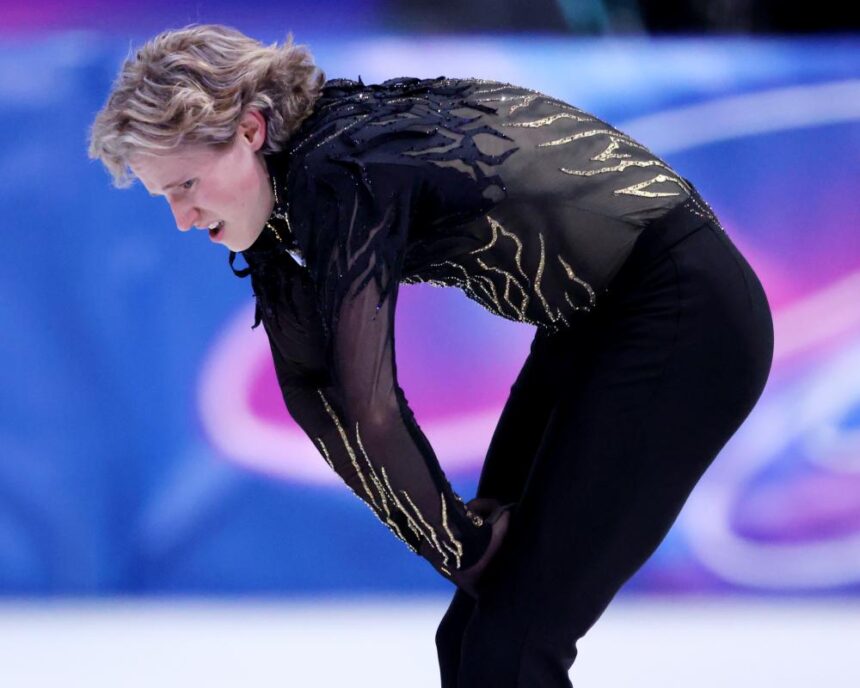
Friday in Milan was meant to be Ilia Malinin’s epoch. Instead, it became a masterclass in the immense, often cruel, pressure of the Olympic moment. Leading after the short program, the 21-year-old American took the ice for his free skate under a weight of expectation rarely seen in the sport. What followed was a heartbreaking unraveling. Two falls, on jumps he typically lands in his sleep, punctuated a performance that seemed gripped by tension. He scored a dismal 15th in the free skate, plummeting to 8th overall, while Kazakhstan’s Mikhail Shaidorov soared to a surprise gold.
The shockwaves were immediate. This wasn’t just an upset; it was a systemic failure of the predicted order. Analysts scrambled to diagnose the cause. Was it the technical burden of his historic, quad-packed program? The psychological toll of carrying the “unbeatable” label? Or simply the fickle nature of a sport where perfection is demanded on a single night, every four years? The result stands as one of the most significant Olympic figure skating shocks in history, a reminder that in this arena, talent alone is never enough.
“An Inevitable Crash”: Decoding Malinin’s Raw Response
True champions are defined not by their falls, but by how they choose to rise. Malinin’s response, delivered via a poignant Instagram video days after the disaster, provides a breathtakingly honest blueprint for his ascent. The video is a study in contrast: glorious, slow-motion shots of his past triumphs—world titles, historic quad jumps, moments of pure flight—jarringly intercut with a single, static image of the skater in Milan, head buried in his hands in despair.
The accompanying text is where Malinin transcends sports cliché. By calling his performance “an inevitable crash,” he demonstrates a startling level of self-awareness. This phrasing suggests an understanding that the unsustainable pressure, the relentless pursuit of superhuman difficulty, and the isolation of being the frontrunner created a perfect storm. The written message hints at the immense psychological burden he shouldered, a burden that perhaps made a stumble under the Olympic spotlight not just possible, but probable.
Most telling, however, is the video’s final frame: “21 February 2026”—the date of the exhibition gala at the next Winter Olympics in Italy. This is not a vague promise to try again. It is a specific, time-stamped declaration of intent. It suggests his future Olympic journey, and perhaps even the artistic expression of his skating, will be built upon the foundation of this painful experience.
Expert Analysis: From Quad God to Complete Champion
To understand the fall is to understand what made Malinin so dominant. His athletic prowess is generational. He turned the quadruple Axel—a jump once considered theoretical—into a consistent weapon. But the Olympic stage demands more than jumping robots; it demands artists, competitors, and resilient minds.
- The Athletic Paradox: Malinin’s technical arsenal is so advanced it exists on a razor’s edge. The margin for error is infinitesimal. Under normal competitive stress, his body executes. Under the unique, crushing pressure of the Olympics, that finely tuned system can falter.
- The Artistic Evolution: Critics have long noted that while his jumping is from 2030, his component scores (performance, interpretation, composition) have room to grow. The Olympics ruthlessly exposes any imbalance between technical and artistic merit.
- The Mental Game: Being the overwhelming favorite is a distinct and debilitating kind of pressure. Every other contender skates with freedom; the favorite skates with the weight of expectation. The mental fortitude required to manage that is a skill in itself, one often only forged in the fire of failure.
This “crash,” as Malinin terms it, may be the essential catalyst he needed. It strips away the invincible aura and allows him to rebuild not just as a jumper, but as the complete, battle-tested champion the Olympics requires.
The Path to 2026: Predictions for a Phoenix Rising
The roadmap from Milan’s despair to 2026’s potential glory is now the central story in men’s figure skating. Malinin’s public framing of this setback is the first, and most critical, step. Here is what the journey will likely entail.
Immediate Future: Processing and Recalibration. The 2024-25 season will be a fascinating watch. Expect Malinin to potentially simplify technical content temporarily to rebuild competitive confidence. More importantly, look for a deliberate focus on artistic development and mental conditioning. He will need to find programs that tell a story, perhaps even *this* story, connecting with audiences on a level beyond awe for his jumps.
The 2026 Narrative: Experience as an Asset. By the time the Olympics arrive in Italy, Malinin will be 23, a veteran with the searing experience of Milan in his rearview. He will no longer be the untouchable “Quad God,” but a seasoned contender who has faced the abyss. This changes the psychological dynamic entirely. The pressure, while still immense, will be of a different, more manageable kind.
The Ultimate Prediction: Ilia Malinin will arrive at the 2026 Olympics as a profoundly different skater and competitor. The man who fell under the weight of inevitability will have spent two years constructing a new version of himself—one fortified by that failure. He will be the favorite again, but a wiser, more complete one. The skating world should anticipate not just a quest for gold, but a performance steeped in the narrative of resilience. His potential exhibition program on February 21, 2026, may just be the most cathartic and celebrated skate of the Games.
Conclusion: The Inevitable Crash and the Unstoppable Comeback
Ilia Malinin’s Olympic nightmare in Milan is not an ending; it is a brutal, necessary beginning. By naming his failure an “inevitable crash,” he has taken ownership of it, transforming a shocking result into a diagnosable moment in a longer arc. In the high-stakes world of Olympic figure skating, where perfection is the only currency, such a public and humbling collapse could break a lesser competitor. But Malinin’s response—artistic, forward-looking, and starkly honest—suggests it will instead forge him.
The road to 2026 is now paved with the lessons of 2025. The skater who once seemed to float above the sport has been painfully, humanly, grounded by it. The journey back to the top will require more than quadruple jumps; it will require a champion’s heart. If his recent message is any indication, Ilia Malinin is not just building a new program for the next Olympics. He is building a legend, and every great legend needs a fall before the rise.
Source: Based on news from Yahoo Sports.