Marcus Rashford’s New Dialect: Decoding the Forward’s Barcelona Evolution
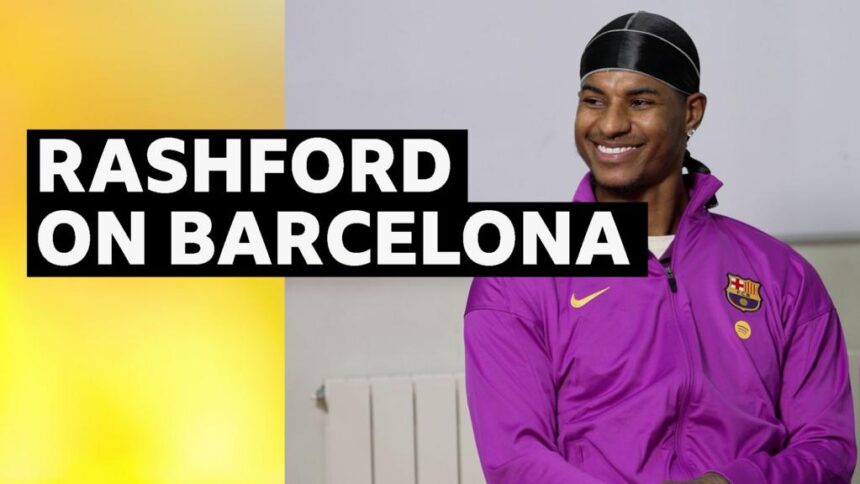
The language of football is universal, a tapestry woven from passes, movement, and intent. But for Marcus Rashford, his sudden immersion at FC Barcelona is about learning a new, highly specific dialect. This isn’t just about picking up Catalan or Spanish phrases; it’s about absorbing a footballing lexicon written by Cruyff, spoken by Xavi, and demanded by the Camp Nou faithful. In a revealing moment, captured during his first community outing for the club, Rashford wasn’t just playing football with local schoolchildren; he was giving us a primer on his own accelerated education.
Beyond the Loan: Rashford’s Catalonian Classroom
The image of Marcus Rashford, at 28, engaging in a community project at a Barcelona school is profoundly symbolic. It’s more than PR. As he chatted and played with students, reported by BBC Sport’s Elizabeth Conway, he was simultaneously a teacher and a student. He was demonstrating his craft while being tested on his assimilation. For a player whose entire elite career has been spent in the distinct, often transitional, rhythm of the Premier League with Manchester United, Barcelona represents a cultural and tactical shock to the system. The pace of the lesson is relentless. Every training session under Xavi Hernández is a masterclass in positional play, a demand for one-touch fluency, and an expectation of spatial intelligence that must become second nature.
This transition is the ultimate professional challenge. Rashford is not a raw prospect; he is an established England international entering his prime. The learning curve is therefore steeper, the scrutiny more intense. He must unlearn certain instincts—the tendency to drop deep for driving, solo runs that define his Premier League game—and replace them with the prescriptive, collective syntax of Barça’s attack. His success hinges not on forgetting his English football vocabulary, but on successfully translating it into BarçaLab.
Decoding the “Rashford Role” in Xavi’s System
So, where does a player of Rashford’s unique profile fit into Barcelona’s storied philosophy? His loan move was met with intrigue precisely because he is not a classic Barcelona winger. His game is built on explosive verticality, not the intricate, touchline-hugging play of a traditional *”extremo.”* However, this is where Xavi’s modern interpretation becomes fascinating. Rashford’s integration offers key insights:
- Interior Channel Threat: Rashford is most dangerous when cutting in from the left onto his stronger right foot. At Barcelona, this aligns with the “interior” spaces occupied by legends like Andrés Iniesta. His runs could become a devastating, direct counterpoint to the midfield’s possession.
- Stretching the Pitch: While not a pure winger, his sheer speed forces defenses to respect the wide area, creating crucial space for midfielders like Pedri and Gavi to operate. This vertical stretching is a weapon Barcelona has sometimes lacked.
- Transition Weapon: Despite Barça’s possession dogma, modern football demands lethal counter-attacks. Rashford is arguably the club’s most potent transitional attacker since a young Ousmane Dembélé. He offers a plan B that is still executed with A-list quality.
- Physical Differentiation: In a squad filled with technicians of slight build, Rashford brings a unique physical profile—pace, power, and aerial ability—that offers a different problem for defenders used to facing nimble, technical dribblers.
The project at the school was a microcosm of this: in loose play, his natural attributes shone, but the real test is executing them within the structured patterns of Xavi’s 11.
“Not a Pressure”: The Psychological Shift
Perhaps the most telling quote from Rashford’s early days is his claim that Barcelona is “not a pressure” compared to his time at Manchester United. This statement requires expert decoding. It is less about the absence of expectation—the pressure at Barça is immense—and more about the nature of it.
At United, Rashford often carried the burden of being the homegrown talisman, the symbol of hope in a period of institutional turbulence. The pressure was diffuse, emotional, and often reactive. At Barcelona, the pressure is different: it is crystalline, tactical, and historical. The demand is not to be a savior, but to be a cog—albeit a brilliant one—in a well-defined machine. The pressure is to execute a known philosophy. For a player who has shouldered immense mental weight, this shift to a purely footballing demand could be liberating. It allows his talent to operate within clear parameters, freeing him from the existential club burdens he faced in Manchester.
Predictions: Will the Dialect Become Native?
The ultimate question is whether Rashford can achieve fluency. His loan spell is a high-stakes audition, not just for a permanent deal at Barcelona, but for the legacy of his career. Predictions hinge on several factors:
The Successful Integration Scenario: Rashford adapts his game, using his speed as a strategic weapon rather than a constant outlet. He learns the triggers for his runs, develops an almost telepathic link with the midfield, and becomes the definitive cutting-edge threat Barcelona craves. He scores 15+ league goals, becomes indispensable in big Champions League nights, and the loan becomes a mandatory purchase.
The Square Peg Scenario: The stylistic gap proves too vast. The instinct to hold the ball or drift becomes a disruption. The system stifles his spontaneous brilliance, and he fails to consistently impact games beyond flashes. The experiment ends with a respectful return to England, his Barcelona chapter a fascinating “what if.”
Based on his maturity, proven quality, and Xavi’s need for game-changing difference-makers, the trajectory points toward a successful, if not always seamless, adaptation. He may not become a pure *”culé”* stylist, but he can become their most potent hybrid.
Conclusion: A Chapter of Necessary Translation
Marcus Rashford’s journey in Barcelona is more than a loan; it’s a linguistic football pilgrimage. His time playing with schoolchildren in the city underscores a simple truth: he is both a star and a student again. Learning the Rashford dialect at Barcelona is about watching a world-class athlete consciously reshape his game to fit a legendary canon. The raw materials—the pace, the power, the finishing—are all there. The coming months are about conjugation: fitting those verbs of motion into the complex sentences of Barcelona’s play.
Whether this chapter is a permanent translation or a brief cultural exchange, it will irrevocably change him. He is not just learning to play for Barcelona; he is learning to see the game through a different lens. And that education, regardless of the final destination, will make Marcus Rashford a more complete, intelligent, and dangerous footballer. The football world watches, dictionary in hand, eager to learn this new language alongside him.
Source: Based on news from BBC Sport.